



 IBA editorial team
 Never before has the workplace been shaped by so many generations working side by side. The internationally active architecture and design firm Gensler has recently dedicated an article in its Dialogue blog to this topic, drawing on data from the Gensler Global Workplace Survey 2025. The conclusion is clear: older employees are no longer a marginal group but are increasingly becoming a key success factor. Organisations that actively embrace this development benefit from experience and loyalty while creating work environments that inspire and motivate people at every stage of their careers.
A multigenerational workforce: opportunity and challenge
Demographic change and evolving life paths are redefining the boundaries of working life. More and more people are remaining in employment well beyond the traditional retirement age. These so-called “grey talents” are shaping everyday working life and influencing expectations of leadership, culture and workplace design. The Gensler survey distinguishes three career phases: early-career professionals, mid-career employees and extended careers beyond the age of 65. One finding stands out in particular: older employees show a strong level of commitment to their workplace. Staff aged over 65 frequently state that they intend to remain loyal to their organisation and are willing to contribute more than is formally required. This underlines the significant loyalty potential of this group.
Workplace design: four recommendations for multigenerational quality
Four key recommendations for designing workplaces that work across generations can be derived from the findings:
- Invest in high-performance environments
High-quality workplaces support concentration, collaboration and wellbeing across all age groups. This includes ergonomic furniture, good acoustics, areas for focused work and open spaces for creative exchange. In particular, the combination of natural daylight, flexible work settings (individual desks, team zones and community areas) and digital tools (such as collaboration platforms and bookable meeting rooms) makes organisations more adaptable and resilient. - Strengthen loyalty and belonging
Spaces where appreciation and community can be experienced — such as lounges, project cafés, library corners or outdoor areas — encourage interaction across generations. They help older employees share their knowledge while creating places where teams can identify with the organisation. Studies show that strong emotional attachment to both the workplace and the organisation measurably increases loyalty and willingness to innovate. - Break down stereotypes in spatial design
DThe common assumption that older employees primarily prefer secluded, traditional workstations cannot be confirmed empirically. Gensler’s findings suggest that different age groups express similar needs for flexibility, quiet areas and genuine collaboration. Open, interactive spaces, flexible workpoints instead of fixed desks and modular room-in-room solutions are valued and used equally by younger and older employees alike. - Design inclusively for all career stages
The survey shows that working styles vary greatly between individuals but are not strictly tied to age. Multigenerational workplaces should therefore be flexible and accessible, for example through height-adjustable desks, clear wayfinding systems, dedicated quiet areas and an infrastructure that can adapt to changing team structures and tasks. In this way, space becomes a connector between generations and supports participation, development and motivation for everyone.

The power of mixed-age teams
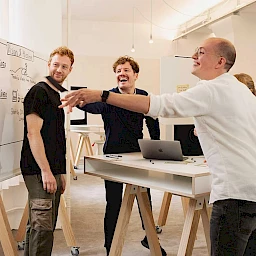
Age diversity is about more than simply having experience “on board”. Research on age diversity and innovation shows that teams composed of different age groups are more likely to develop new products and services. Older employees contribute industry knowledge, context and pragmatism, while younger colleagues add digital skills and fresh perspectives. This combination makes organisations more resilient and more capable of innovation. Further studies indicate that age-diverse workforces increase adaptability and competitiveness, particularly in times when markets and technologies are changing rapidly.

Continuous knowledge exchange through mixed-age teams
Studies such as the EDGE–EY–EqualVoice Generations Report 2024 show that around two-thirds of surveyed executives see age diversity as an important driver of innovation and competitiveness. Additional research by Allianz Research, the Institute for Employment Research (IAB) and BCG demonstrates that mixed-age teams generate innovation more frequently and make better use of the strengths of both younger and older employees.
Ergonomics, communication and health as building blocks of success
Future-ready workplace design takes ergonomic requirements across all age groups into account. Adjustable furniture, good lighting, clear circulation routes and high acoustic quality support both performance and health. Equally important are communication structures that provide space for exchange, feedback and shared learning. Experts point out that corporate initiatives supporting physical and mental health are becoming increasingly critical to maintaining the employability of older workers. Younger employees benefit as well, as the overall work environment becomes more productive and more humane.
The workplace of tomorrow: open, inclusive and performance-oriented
The shift in mindset is evident: older employees do not automatically cling to traditional working patterns. On the contrary, studies show that — just like younger generations — they value modern, well-designed environments that offer opportunities for interaction and learning. Organisations that invest in flexible, adaptable workspaces strengthen collaboration and communication while fostering a sense of belonging — a true “spirit of belonging” — across all age groups. Multigenerational design supports long-term talent retention and helps bring the vision of an inclusive and innovative organisation to life.
Gensler emphasises that the key to success lies in intergenerational collaboration. Workplaces that take diversity seriously enable concentration, innovation and a new form of loyalty. The challenges of demographic change cannot be addressed with rigid concepts, but with flexible, open and high-performance environments that enable development and participation for all generations.
Further reading and data sources:
Gensler (2025): Gensler Global Workplace Survey 2025: https://www.gensler.com/gri/global-workplace-survey-2025
Gensler (2025): Designing for a Multigenerational Workforce, dialogue blog: https://www.gensler.com/blog/multigenerational-workforce-design
EEDGE Certified Foundation / EY / EqualVoice (2024): Generations Report – Making the Most of the Advantages of Age Diversity in Corporations: https://www.ey.com/en_ch/newsroom/2024/12/generations-report-making-the-most-of-the-advantages-of-age-diversity-in-corporations
Allianz Research (2024): Fostering Age Inclusion at Work to Make Companies More Resilient and Innovative: https://www.allianz.com/content/dam/onemarketing/azcom/Allianz_com/economic-research/publications/specials/en/2024/september/2024_09_19_demography_2024_AZ.pdf
Institute for Employment Research (IAB) (2019): Age Diversity and Innovation: Do Mixed Teams of “Old and Young” Workers Foster Innovative Firm Performance? https://doku.iab.de/discussionpapers/2019/dp0419.pdf
Boston Consulting Group (2018, updated): How Diverse Leadership Teams Boost Innovation: https://www.bcg.com/publications/2018/how-diverse-leadership-teams-boost-innovation
Cover photo: @iStock / skynesher