

 Manuela Lieber
 What do people need to succeed at work? This question is being revisited, not only because of hybrid working models or skills shortages, but also due to increasing automation and the growing use of artificial intelligence (AI) in work processes. It is no longer just about tools, but about a central design question: how will humans and machines truly work together in the future, and what role will space play in this?
From activity-based working to mindful-based working
Space is not a neutral backdrop. It influences behaviour, cognitive processes and communication, both consciously and unconsciously. Spaces can promote or disrupt concentration, strengthen a sense of belonging or trigger feelings of insecurity. Anyone seeking to design working environments in which change can succeed must understand how people and space interact as a system.
Four human dimensions as a basis for design
A structured approach to workspace design is based on four interlinked dimensions:
1. Culture & Leadership, i.e. the socio-cultural character of an organisation and its leadership.
2. Activities & Tasks: what people actually do in a space (e.g. networking, focused work, creative collaboration, learning, relaxation). This principle is known as activity-based working (ABW), in which spatial zones are differentiated according to typical activities.
3. Basic neuropsychological needs: including orientation, control, security, autonomy, belonging, identification and regeneration.
4. Personalities & Neurodiversity, i.e. individual differences in perception, sensory processing and social behaviour, including introversion and extraversion.
An expanded understanding of interior design builds on these dimensions: while activity-based working primarily addresses point 2, the complementary approach of mindful-based working focuses on the systematic consideration of dimensions 3 and 4. The aim is to create spaces that are not only functional, but also psychologically supportive, emotionally strengthening and suitable for different modes of perception.
This approach draws on key ideas from humanistic psychology and the New Work philosophy. Maslow’s original model, later simplified into a pyramid, was fundamentally about balance and connectedness rather than hierarchy. In combination with Frithjof Bergmann’s understanding of New Work, which views work as an expression of self-determination and meaning, this forms the basis of a human-centred approach: working environments that foster motivation and resonance instead of demanding conformity.
This holistic perspective is becoming increasingly important, particularly in the context of the growing use of AI. As Professor Nick Tyler (UCL, London) emphasises, it makes sense to design spaces in a way that also works for neurodivergent people, because their heightened sensitivity to stimuli often reveals factors that affect others as well, albeit less consciously. Spaces that are neuropsychologically coherent provide the best foundation for all forms of cognitive work, from deep concentration and creative co-creation to informal networking.
Space as a multidimensional structure
Spaces exert their influence through many simultaneously active factors such as light, acoustics, colours, shapes, materials, proportions, furnishings, order, biophilia and scent. These can be broken down into twelve key factors that are considered particularly influential on behaviour and perception in architectural and environmental psychology.
Specific requirements emerge depending on the tasks, organisational culture, personality structures and basic needs present within a space. A meaningful planning approach integrates these layers in a context-sensitive rather than standardised way. It is precisely the connection between physical space and emotional experience that determines whether AI transformation becomes a decisive competitive advantage.

Why new spaces are becoming crucial now
For artificial intelligence to be meaningfully integrated into work processes, organisations face a particularly demanding phase: the joint review, realignment and creative redesign of processes, often across departments or organisational silos.
AI cannot simply be layered onto existing structures. It requires a fundamental rethink:
- Which processes are genuinely suitable for automation?
- Where do existing structures need to be adapted, streamlined or completely reimagined?
- Which silos are obstructive, and how can spaces for new thinking and action be opened up?
This initial phase is highly complex, collaborative and design-intensive, placing significant demands on the spaces in which it takes place. What is needed are environments that enable co-creation, transitional logic, non-linear thinking and social resonance. The following four spatial typologies respond directly to these requirements. They do not describe conventional offices, desks or individual workstations, but rather places where the crucial groundwork of the AI transformation is laid: human, collaborative and complex.
Four spaces: Four functions
1. Socializing & Serendipity: SPACES for spontaneous encounters and genuine networking
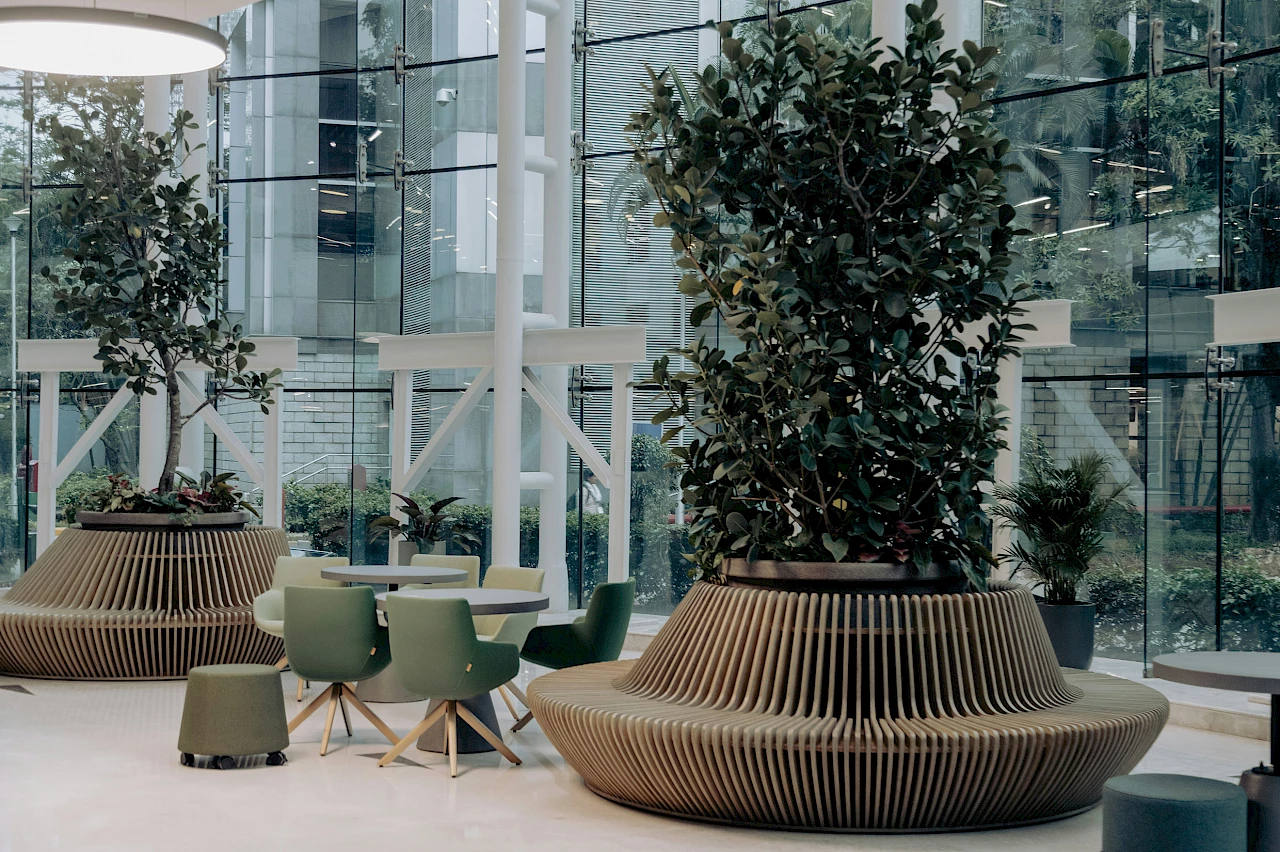
Informal conversations, unexpected ideas and cross-departmental inspiration do not arise by chance, but in spaces that actively facilitate encounters. Small kitchenettes enclosed by walls and doors that only accommodate three people, or large empty halls dotted with sofas, rarely generate serendipity. Open, accessible transition zones, for example near reception areas, staircases, lifts or central walkways, are far more effective.
Success factors
- Coffee points or other anchor functions in central locations with sufficient space
- Visual openness combined with opportunities for retreat (zoning, backing, ‘defensible space’)
- Colours, lighting and materials that create warmth and a sense of closeness
- Furnishings that encourage spontaneous interaction without psychological barriers
These zones address fundamental needs such as belonging, visibility and emotional security, and foster trust and meaningful networking among employees.
2. Ideation & Co-Creation: New ideas emerge where spaces enable flexibility, movement and visible thinking
In the early phases of creative and conceptual development, physical and mental movement, shifts in perspective and collective exploration are essential. Ideas evolve most effectively in environments that allow flexibility and visible thinking. A workshop-like atmosphere that does not strive for perfection is particularly important.
Success factors
- Mobile furniture that can be easily rearranged
- Floor-to-ceiling whiteboards or writable walls
- Materials for visualisation and prototyping
- Zoned, protected areas for deep work and team flow
- Options for both standing and seated work over extended periods
This creates a climate for exploratory work beyond traditional meeting formats.
3. FUTURE SPACE FOR HUMANS & AI: ENVIRONMENTS FOR NEW THOUGHT PROCESSES
AI is transforming not only content, but also the way we think. Spaces designed for this shift must integrate different modes of thinking and support multisensory, technology-enabled collaboration. The focus lies on structured reflection, systemic thinking and the redesign of complex processes with technological integration.
Success factors
- Digital and analogue tools with intuitive, low-threshold access that enable spontaneous participation without technical barriers
- Differentiated work zones with visual and acoustic shielding for focused team work
- Visible documentation of thought processes (e.g. large boards or shared surfaces)
This creates spaces that form interfaces between people, organisations and technology.
4. CONFIDENTIAL SPACES: THE NEW GENERATION OF MEETING ROOMS
Even in the evolving world of work, there remains a need for protected environments that support trust, consensus-building and conflict resolution.
Success factors
- Tables with rounded edges and room designs incorporating fractal structures and biophilic materials
- Comfortable chairs with textured, non-slip fabrics that convey warmth and provide ergonomic support
- Warm, subdued lighting in shades of yellow to orange, fostering calmness and closeness
These spaces create the conditions for trust and genuine interpersonal connection.
Conclusion: Transformation begins with space
Whether AI is applied meaningfully, whether organisational culture is experienced and whether teams are able to thrive depends not only on tools or strategies, but on the interaction between people and their environment. Psychologically attuned spaces enable resonance, participation and orientation and form the often overlooked yet essential foundation for genuine transformation.
Manuela Lieber is the founder of Mindful Workspaces and developer of a human-centred approach to optimising work environments. She combines business administration, architectural psychology and organisational development with the aim of designing workspaces that integrate performance, culture and humanity. Further information: https://www.mindfulworkspaces.de/
Cover photo: unsplash.com / @Bernd Dittrich