

 IBA editorial team
 With the new EDEKA Campus in Minden, the regional company EDEKA Minden-Hannover has, for the first time, consolidated numerous administrative locations previously spread across the city into a single site. The newly developed campus features a new administrative building designed not only to improve spatial efficiency but, above all, to foster new forms of collaboration.
A main magistrale as spatial backbone of the campus
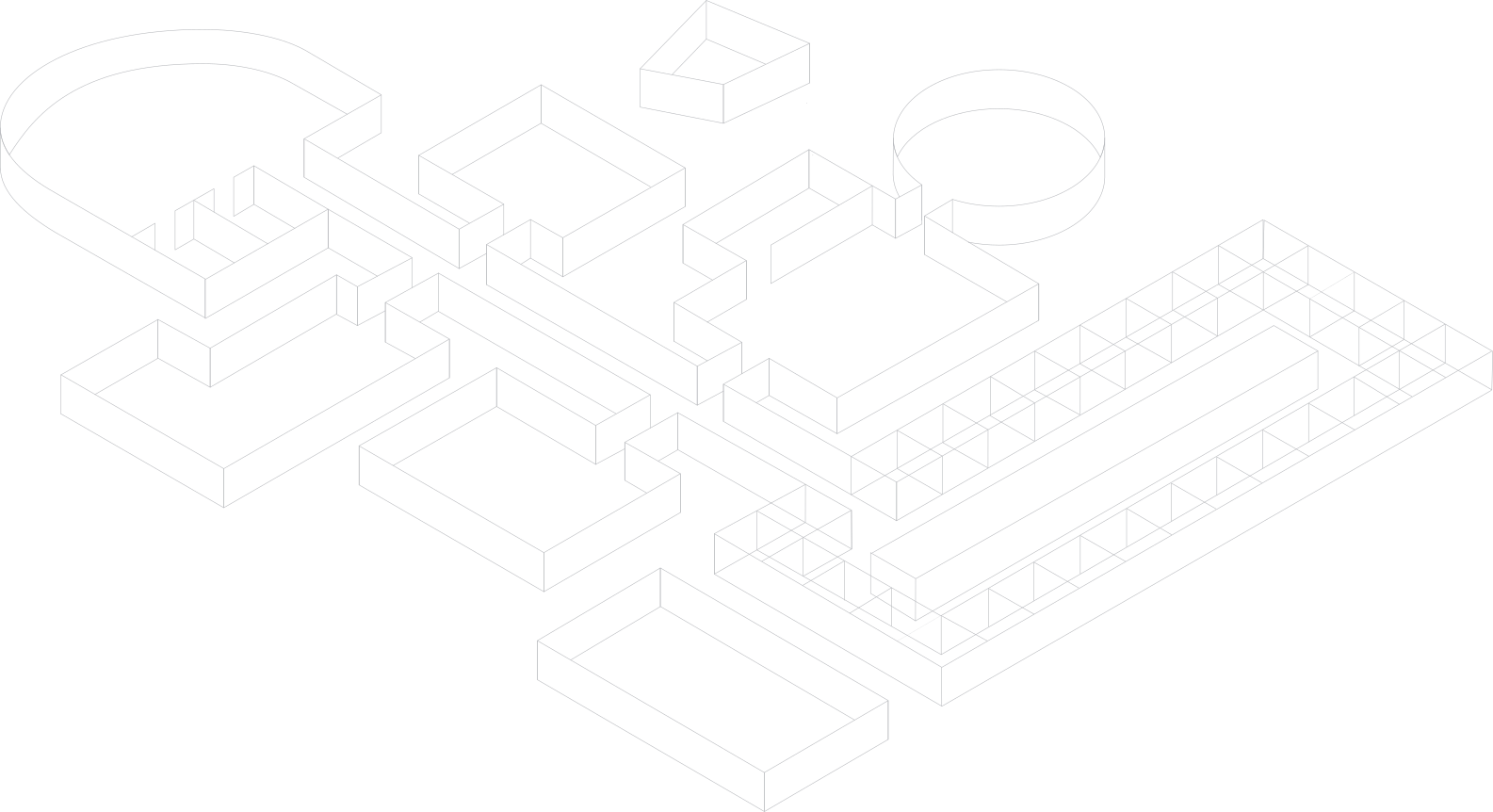
The campus consists of five three-storey building blocks connected by a central spine approximately 110 metres in length. The ring-shaped structures, each with its own inner courtyard, create a clearly organised layout, while the central spine serves as the main circulation and meeting zone. From here, all areas of the campus are easily accessible – an architectural principle that provides orientation while encouraging interaction. The external appearance of the complex is defined by a compact dark brick façade structured by horizontal bands of glazing. Inside, however, the architecture opens into a bright and generous spatial composition with long sightlines and a central spine that acts as the connective element between the individual buildings.
A GLIMPSE OF THE EDEKA-CAMPUS:


Future-oriented working environments
With the new EDEKA Campus, EDEKA Minden-Hannover sets a clear benchmark for modern, future-oriented workspaces. Flexible workplace models, open team areas and informal zones shape the working landscape. The design supports a way of working that adapts to different tasks while enabling spontaneous exchange. A variety of acoustic solutions and retreat areas provide spaces for focused work, while open zones create opportunities for interaction and collaboration. The concept is complemented by energy-efficient building technology, photovoltaic systems and advanced building services. In this way, the campus combines contemporary architecture with high ecological standards.
A campus for a new organisational structure
The new building was developed against the backdrop of fundamental changes in workplace organisation. During the early planning stages, it became clear that the project would not merely be a construction project, but would also accompany a broader organisational transformation. Topics such as desk sharing, hybrid working models and flexible workplace structures therefore played a central role from the outset. A particular focus was placed on involving employees early in this process of change. The campus was not intended simply to provide new office space, but to create a working environment that supports a wide range of activities. The office areas were therefore conceived as open, flexible work landscapes, complemented by numerous dedicated zones, retreat spaces and communication areas.
Architecture as a connecting element
The central spine forms the spatial backbone of the campus. It serves as the primary circulation zone and connects all parts of the complex. During the planning phase, it was frequently described as the building’s “marketplace” – a place where employees meet, orient themselves and from which all areas of the campus can be accessed. In buildings of this scale, clear wayfinding plays a crucial role. The spine fulfils this function while also acting as a communicative centre that holds the campus together both spatially and organisationally.
Interior spaces between focus and interaction
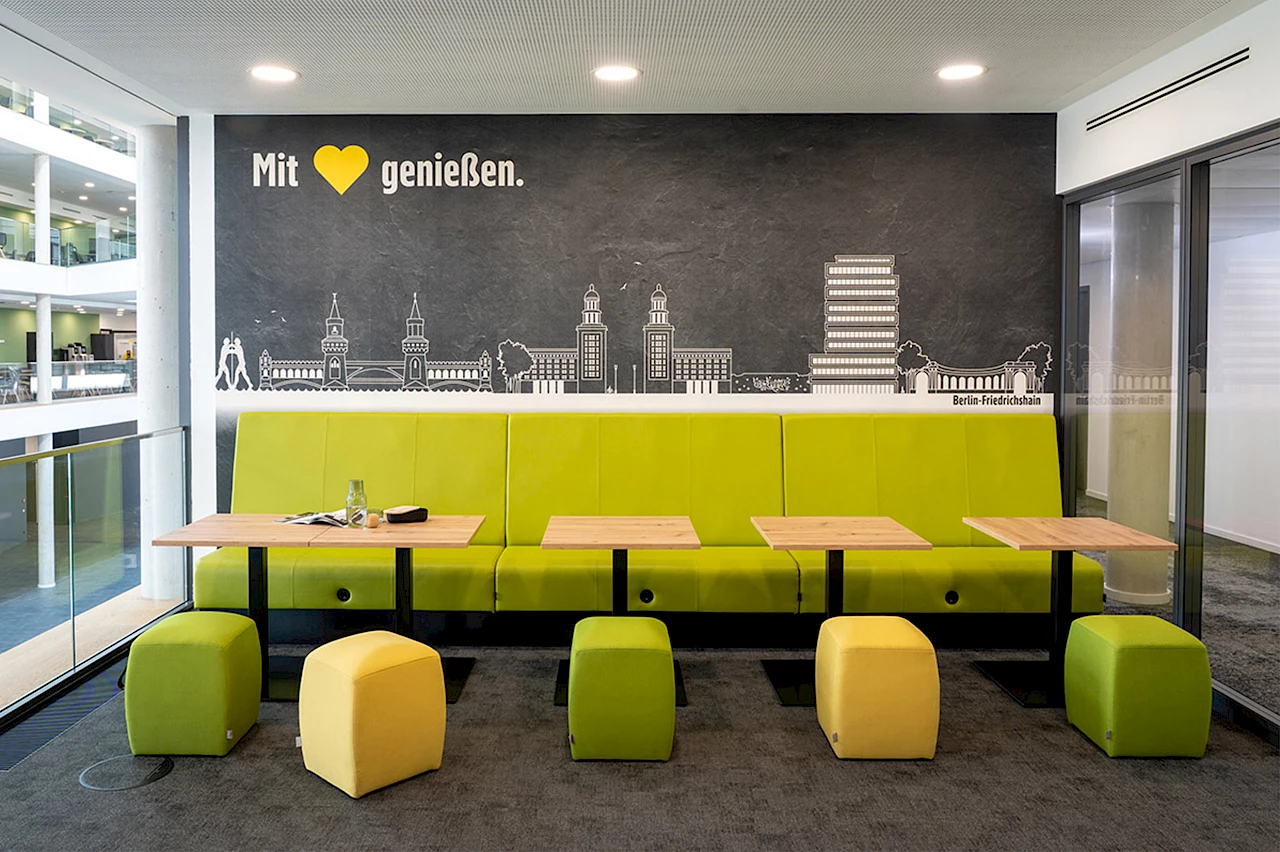
A key component of the campus concept is the design of the interior spaces. In addition to workstations, areas for interaction play a central role in fostering collaboration among employees. Meeting rooms, open communication zones and lounge areas are distributed throughout the building, enabling different forms of exchange. At the same time, acoustically differentiated areas and retreat spaces ensure that focused work remains possible even within open-plan environments. The interior design follows a principle widely applied in contemporary office architecture: workspaces should accommodate a variety of activities and adapt to the changing demands of everyday work.
Tailored furnishings for diverse work settings
The furnishing of the EDEKA Campus features a comprehensive mix of furniture, including solutions from SMV and GOWLD. Many elements were specifically developed for this project to meet both architectural specifications and functional requirements. The furnishing concept follows the principle of combining different qualities of working and social spaces. In the open office areas, ergonomic workstations and modular furniture systems support activity-based working. Meeting and social zones are equipped with robust upholstered furniture that offers both comfort and durability. The concept is complemented by coordinated colour and material schemes that reflect the generous interior architecture of the campus and create a calm and cohesive spatial atmosphere.
Staff restaurant as a social hub
A central feature of the campus is the staff restaurant “Grüner Wenzel”. The name refers to the historical founding site of EDEKA Minden eG and deliberately connects the building to the company’s regional heritage. With several hundred seats, open areas and a spacious terrace, the restaurant serves as an important social hub for employees. In addition to the traditional lunch break, the space also provides opportunities for informal encounters throughout the working day. Such shared spaces play a vital role in the social fabric of large organisations. Particularly in hybrid working environments, they gain additional importance by fostering personal interaction.


A campus for encounter and collaboration
The new campus in Minden creates a workplace that combines architectural clarity with organisational transformation. Bringing together previously dispersed locations opens up new opportunities for exchange, collaboration and collective working. This is particularly evident in the central spine, where colleagues from different departments will meet on a daily basis – a vision that was already defined during the planning phase.