

 Jasmin Najiyya
 The office is no longer a static place. It is increasingly understood as a system that adapts to organisation, technology and society. Hybrid working has become established in many companies. At the same time, pressure is growing to use space more efficiently, meet diverse requirements and support a workforce with a wide range of needs. Against this backdrop, the key questions for 2026 are shifting: What is the purpose of the office if work can also be done elsewhere? Which spaces promote collaboration, learning and culture? What conditions are necessary to enable people to work in a healthy and focused way?
Hybrid becomes standard – but only with spatial anchors
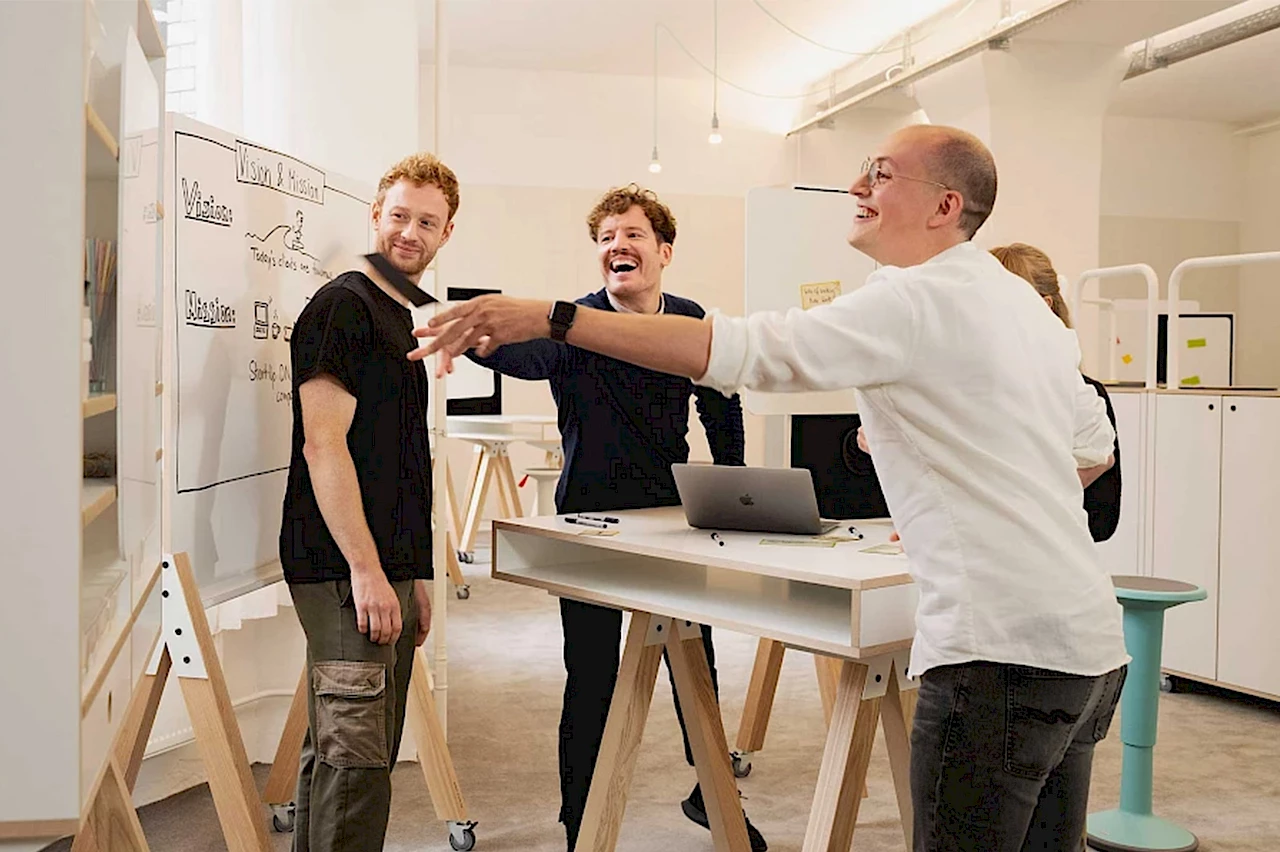
Hybrid working is considered normal in many organisations, but remains challenging from an organisational perspective. When teams are separated in time and space, new frictions can arise: spontaneous coordination becomes more difficult, loyalty to the organisation may decline, and time spent in the office can sometimes turn into a succession of online meetings. The Spatial Thinkers series at the IBA Forum sums up this tension succinctly: flexibility needs spatial anchors. In other words, places and routines that reliably enable collaboration and a sense of belonging. For 2026, this means that the focus is no longer on mere presence, but on consciously designed shared time. Formats such as fixed team days, shared rituals or curated exchange formats are gaining importance in order to ensure that coming into the office offers clear added value. At the same time, the need for retreat and focused work within the office remains essential as a counterbalance to open collaborative spaces.
Adaptive spaces and activity-based working: the office as a toolkit
Another key trend for 2026 is the move away from rigid space programmes. Organisations are changing more rapidly, project teams work more dynamically and utilisation fluctuates. As a result, adaptable structures are becoming increasingly valuable. Activity-based working remains a guiding principle, but is increasingly understood as a modular toolkit. Spaces should be easy to reconfigure with minimal effort. In this context, the Tomorrow’s Office Report describes the adaptive office as a toolkit comprising mobile elements, flexible zones and hybrid formats combining work, learning and community spaces. The decisive factor is not maximum openness, but suitability. People need choice, but also orientation. Strong concepts therefore clearly differentiate between spaces for focus, exchange, creativity, learning and regeneration, and make their use intuitive rather than complex.
The smart office becomes practical: data as a basis for better use
Sensors, occupancy data and analyses of indoor climate are not new, but in 2026 they are being deployed in a more pragmatic way. The aim is not high-tech for its own sake, but the establishment of space and operations management based on reliable data: Which areas are actually used? Where do bottlenecks arise? Where is energy consumed even though spaces are empty? And which services increase comfort without creating new barriers? For smart-office approaches to work in everyday practice, questions of governance and acceptance are moving further into focus. From a user perspective, the key issue is whether technology provides unobtrusive support, for example through simple booking systems, reliable equipment or improved environmental quality.
AI is changing collaboration – and therefore workspaces
Artificial intelligence is a particularly dynamic driver for 2026. AI is not only discussed as a tool, but also as a catalyst for new forms of collaboration. When AI structures content, makes knowledge accessible, prepares workflows or collaborates as an “agent”, roles, responsibilities and learning requirements change. The pre-read to the New Work Order study on collaboration with AI emphasises that organisations need rules, skills and new routines for this transformation – and that spaces must support it. A spatial trend for 2026 can be derived from this: more space for co-creation, prototyping, review and learning, while rooms designed purely as conference rooms lose significance. The office increasingly becomes a real-world “sandbox” in which teams can experiment with AI-supported ways of working, reflect on them and develop them further together. This is also where the work of Manuela Lieber comes into play, as she describes the neuropsychological requirements of new learning and transformation spaces. She shows that AI transformations rarely follow a linear path and place high demands on spaces for exchange, a constructive error culture, orientation and cognitive relief. As a result, the focus shifts: spaces are no longer planned solely by typology, but by thinking and learning processes.
Architectural psychology and workplace strategy: spaces shape behaviour
Increasingly, attention is turning to how spaces influence behaviour and make corporate culture visible. Sandra Gauer, workplace strategist and architectural psychologist, describes work environments as an interface between space, culture and behaviour. Her approach highlights that flexibility must also be psychologically sustainable. Spaces should enable individuality and orientation at the same time, thereby strengthening belonging, self-efficacy and trust. The decisive factor is the balance between openness and structure. In practice, this means that retreat and concentration are just as important as spaces for encounter, informal networking or learning. In this way, architecture becomes a cultural management tool.
Wellbeing and experiential quality: the office as a place that shapes health and commitment
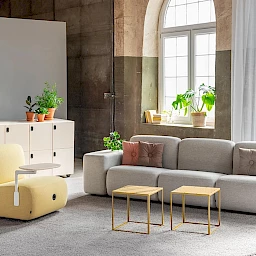
At the same time, the experience of work is becoming increasingly important. When physical presence is no longer a given, the quality of the office becomes a decisive factor for commitment, motivation and innovation. According to the Gensler Global Workplace Survey 2025, the physical workplace remains an anchor of modern organisations, even though its function is changing. Employees cite social reasons such as exchange, belonging and collaboration as key motivations for coming into the office, while also expecting versatile, inspiring and comfortable environments. For 2026, this means that acoustics, lighting, air quality and ergonomics are increasingly regarded as basic requirements. In addition, spaces for retreat and regeneration, biophilic elements and a hospitality-driven logic are coming into focus.
Sustainability and circularity: from add-on to design principle
In 2026, sustainability will not only shape material choices, but also decisions around refurbishment, operations and life cycles. The Tomorrow’s Office Report identifies sustainability requirements as a key driver and describes circular, durable and adaptable solutions as the foundation for resilience. In practice, this increases the value of modular systems, reusable components and flexible planning that enables change within existing buildings.
Conclusion
2026 marks a transition: the office is evolving from a purely functional place of work into a deliberately designed social and cognitive environment that enables collaboration, learning and wellbeing. Decisions about space and technology are becoming more strategic, design more evidence-based, and spaces themselves are becoming instruments of the organisation. The most successful models are those that combine adaptability, user-centricity and cultural clarity. For organisations, this means that the office itself is not in question, but rather its role, which becomes increasingly important as work becomes more diverse.