



 IBA editorial team
 When international architecture practices address strategic questions about the future, they are usually concerned with more than purely aesthetic trends. The current Design Forecast 2026 by Gensler positions itself explicitly as a strategic compass for an industry in transition.
Under the heading “AI, agility, and adaptation”, the global design firm outlines six trends set to fundamentally reshape real estate value, the organisation of work and the development of urban environments. At the centre lies not only technological acceleration but also a structural shift: artificial intelligence intersects with economic volatility, changing user expectations and evolving work models. Design therefore becomes less a question of form and increasingly one of strategic infrastructure — particularly where workplaces function as central platforms for innovation and collaboration.
AI as a creative lever
This shift is most evident in the trend titled “AI revolutionises what’s possible in the built environment”. Here, AI is described not primarily as an automation tool but as a creative partner in the design process. It is expected to reveal hidden patterns in user behaviour, simulate spatial scenarios more rapidly and underpin decision-making with data-driven insights. As a result, not only does the pace of planning change, but so too does its scope of insight. In the design of office and work environments, this leads to an entirely new evidential foundation. Movement flows, dwell times, collaboration patterns and space utilisation can be analysed with greater precision. On this basis, spatial programmes can be developed more strategically: which areas support focused knowledge work? Where do productive informal encounters emerge? Which spaces remain consistently underused? AI thus becomes an instrument for refining workplace environments on the basis of evidence and for informing more robust decisions about space investment. Beyond efficiency, innovation emerges as a key competitive factor. As organisations redefine their business models, the question arises as to how physical workplaces can support this transformation. The forecast suggests that AI may help position spatial structures as accelerators of innovation.
The workplace as strategic infrastructure
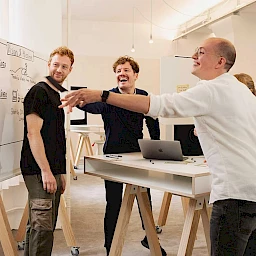
Another focal point is the “next workplace revolution”. After several years of hybrid experimentation, many organisations are once again investing more strategically in their physical workplaces. Competition for talent, national location strategies and the need to make corporate culture tangible are leading companies to view offices increasingly as strategic assets. The emphasis is less on spectacular interior design and more on the concrete value the workplace provides. Spaces are expected to foster identification, facilitate collaboration and support innovation processes. At the same time, they must remain flexible in response to fluctuating team sizes, project-based work formats and varying attendance patterns. Here again, AI plays a significant role. Data-based analysis can support the continuous optimisation of workplace concepts. Meeting areas, focus rooms, learning zones and informal interaction spaces can be adjusted according to actual usage patterns. Workplace design thus becomes an iterative process that aligns spatial solutions with strategic business objectives.
Agility as an economic imperative
Alongside technological developments, the forecast also addresses economic realities. The trend “Agility and intelligence turn volatility into advantage” describes design agility as a strategic capability. This refers to the combination of predictive cost analysis, data-driven planning and real-time collaboration between project stakeholders. For office and commercial real estate development, this means projects must be conceived in ways that allow them to respond to changing market conditions. Flexible layouts, modular fit-out systems and adaptable technical infrastructures gain importance. Organisations that regularly review and adjust their space strategies are better positioned to mitigate economic risk. AI-supported planning tools contribute by modelling alternative scenarios and clarifying decision pathways. Adaptability therefore becomes not only an architectural consideration but also an economic one.

Experience as a measure of value
Another trend concerns the reassessment of real estate value. “Experience becomes the true measure of real estate value” describes a shift from spatial quantity to experiential quality. Properties are increasingly evaluated not solely by size or location but by the quality of the user experience they offer. For workplaces, this implies a stronger orientation towards user needs. Decisive factors include comfort, atmosphere, light, acoustics and opportunities for social interaction. Offices compete not only with other employers’ facilities but also with alternative work settings such as home offices and co-working spaces. The physical workplace must therefore offer a discernible added value, both functional and emotional. In urban contexts, this development is reflected in the closer integration of office locations with cultural, gastronomic and public amenities. Workplaces become part of mixed-use districts that connect different aspects of everyday life.
New uses for existing typologies
The Gensler Design Forecast 2026 also identifies increasing permeability between traditional building typologies. Shopping centres are becoming educational venues, transport hubs are evolving into cultural platforms, and former retail spaces are being transformed into work and innovation hubs. This adaptive reuse responds to shifting patterns in consumption, mobility and work. For companies, this opens up new location opportunities. Existing structures can be converted into flexible work environments that combine proximity to urban amenities with functional adaptability. The urban blueprint is thereby reinterpreted: uses become less rigidly separated, and hybrid models gain prominence.
Conclusion
The Design Forecast 2026 by Gensler offers a strategic analysis of current developments. AI is presented as a tool that accelerates planning processes and provides new insights into usage patterns and spatial qualities. At the same time, agility and user experience emerge as central drivers of value creation. For companies, real estate developers and workplace strategists, this raises concrete questions: how can data be systematically integrated into space strategies? What role will physical workplaces play in the competition for talent? And how can office environments be designed to remain adaptable to changing requirements?
The forecast does not provide definitive solutions but identifies key fields of action. It becomes clear that the design of workplaces is increasingly a strategic task at the intersection of technology, economics and organisational culture.
The Gensler Design Forecast 2026 is an annual publication by the international architecture and design firm Gensler. It analyses key developments in the built environment and identifies trends shaping real estate markets, work environments and urban spaces. The 2026 edition places particular emphasis on artificial intelligence, design agility and new usage concepts within the context of economic and technological transformation. The full report is available as a digital publication: https://www.gensler.com/press-releases/design-forecast-2026-ai-future-cities-trends
Cover photo: iStock @ Peshkova