

 IBA editorial team
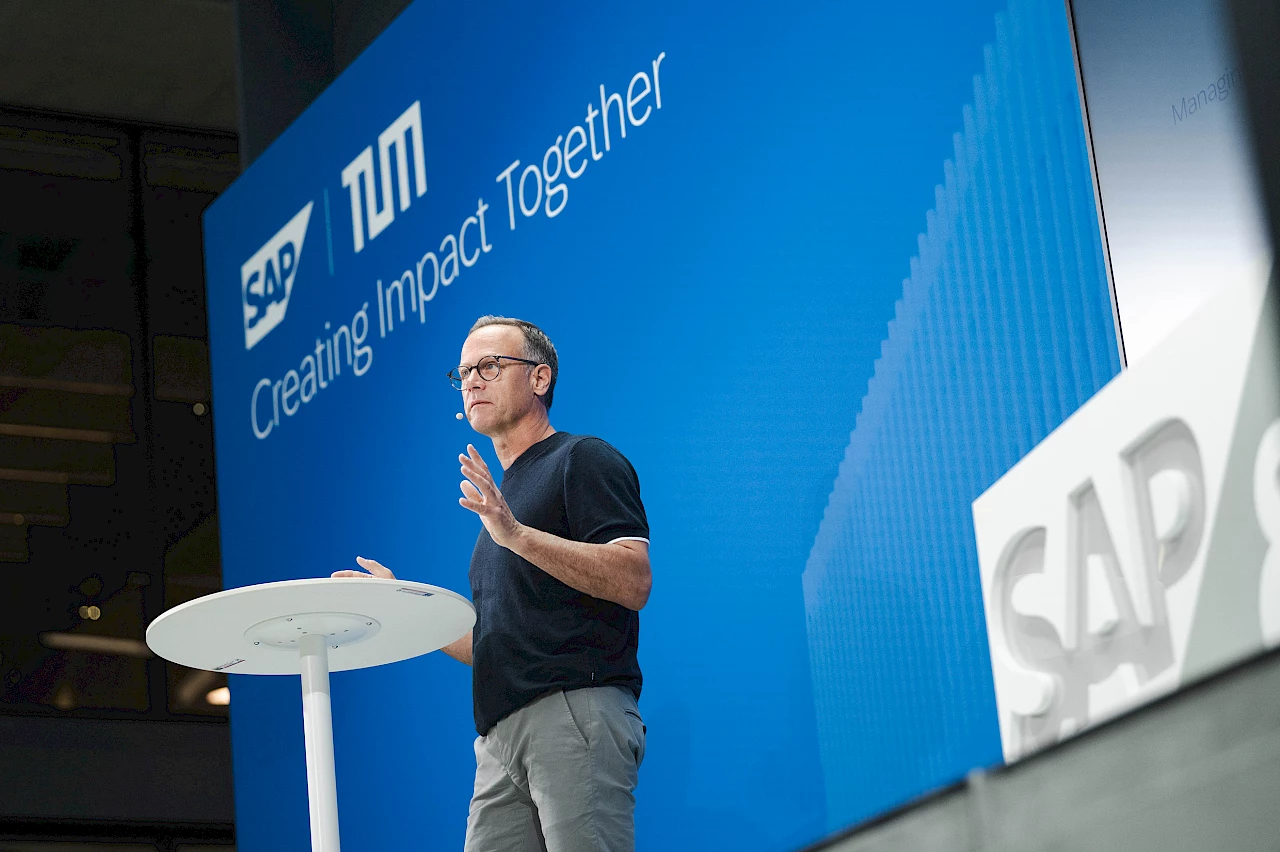
 In June 2024, the new SAP Labs Munich Campus opened at Garching Research Centre. Under the slogan ‘Creating Impact Together’, a place of encounter for research and business has been created. In this interview, Stefan Wagner, SVP and Managing Director of SAP Labs Germany, explains why the building is far more than an office complex, how openness, circularity and community have become integral elements of the spatial concept, and why collaboration with the Technical University of Munich was also conceived from an architectural perspective.
Mr Wagner, SAP Labs Munich is part of Science City Garching. What is the vision behind this project?
Our vision was to create a place for innovation that goes beyond the traditional office typology. SAP Labs Munich was never intended to be a closed corporate facility, but rather part of a vibrant ecosystem of universities, customers, partners and start-ups. From the outset, the idea was therefore not only to design a functional building, but to create a platform for encounters. The architecture is thus a physical translation of our ambition: we develop the future – together with others.
What distinguishes this location from traditional SAP offices?
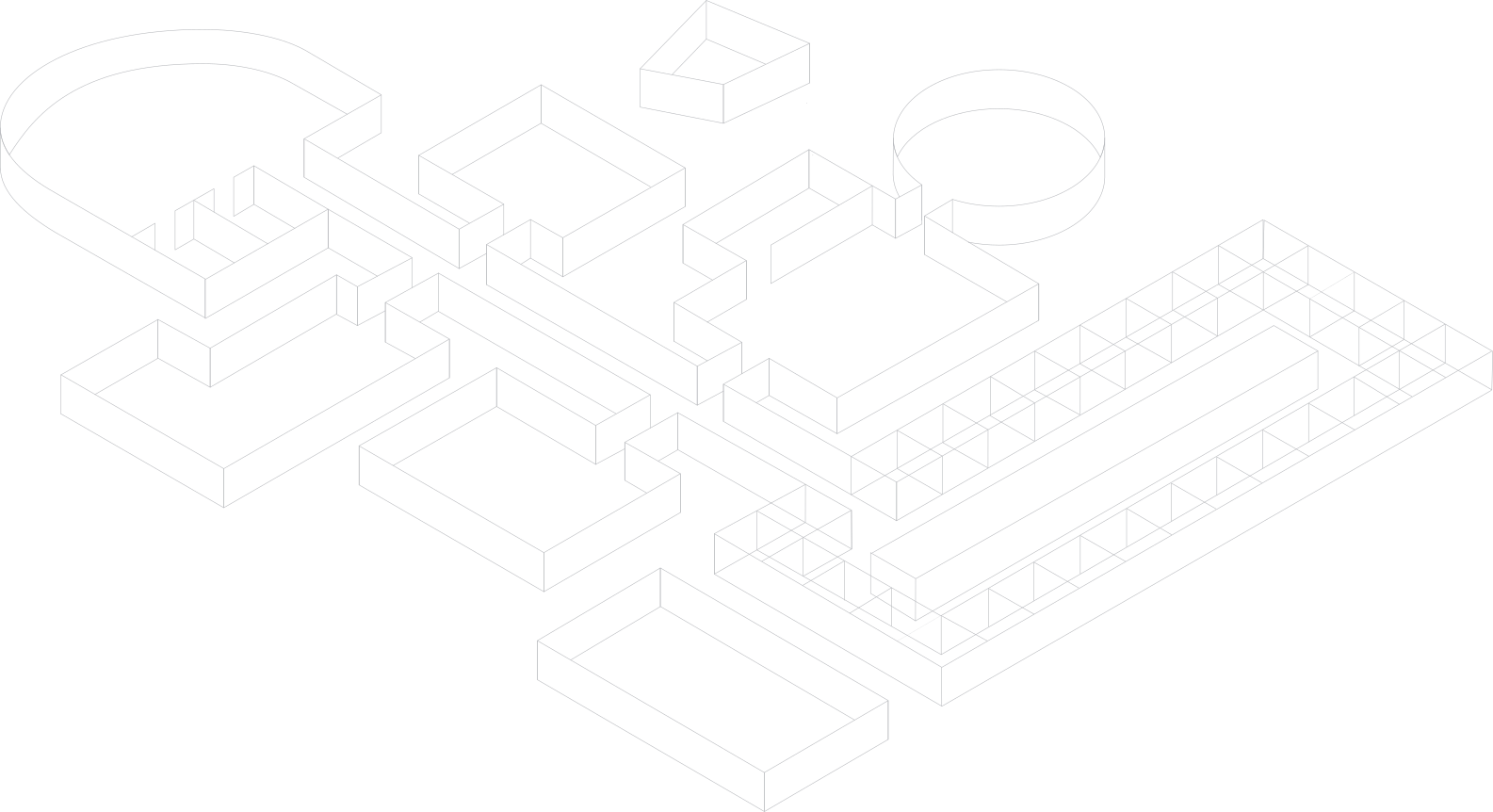
It is the openness. Instead of a fixed spatial programme, we have implemented a guiding principle: collaboration rather than departmental thinking, circularity rather than single-use solutions. Together with SCOPE Architects, we developed a structure based on the principles of reuse, reduce and recycle. This means the building can change, grow and be reprogrammed. Even the car park has been designed in such a way that it could be converted into office space in the future should mobility concepts change. This architectural flexibility reflects our agile, open and learning-oriented work culture.
How was this openness implemented spatially?
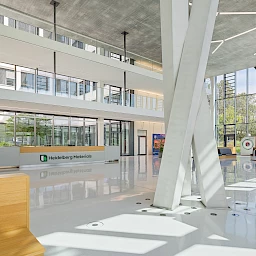
The centre of SAP Labs Munich is the atrium, our shared hub. It is more than just a circulation space. It forms the social and cultural core of the building. This is where researchers from the Technical University of Munich, SAP teams, partner companies and guests meet. The atrium connects the auditorium, the SAP Five Café, the showroom and collaboration areas to create an open space for communication. We see it as a small-scale urban forum. Here, architecture becomes a stage for exchange, for ideas and sometimes even for chance encounters.
Please also read
The atrium is open to the public – this is new for SAP. Why take this step?
In fact, it is SAP’s first publicly accessible building worldwide. This opening was a deliberate decision. We wanted to demonstrate that innovation does not emerge behind access controls, but through encounters. The SAP Five Café, which connects directly to the Science Loop, is open to everyone, including students, researchers and passers-by. Of course, we had to find a new balance between transparency and security. But it was worth it: the public brings energy into the building and makes it come alive. Our employees notice this as well.
How does collaboration with the Technical University of Munich work in this context?
We do not only share the campus, but in some cases even the building itself. The Technical University uses its own spaces within the complex, which are accessed via the central platform. This creates short distances and encourages informal exchange – you quite literally meet halfway up the stairs. Research and application merge spatially here. Joint research projects give rise to concrete product ideas, which in turn also shape the way our teams work.
The building is regarded as an example of circular and resource-efficient construction. How was this implemented in practice?
The concept clearly follows the principles of the circular economy. All materials were selected so that they can be separated by type and dismantled. Floors and ceilings are based on modular systems that can be fully reused. This reduces waste, saves energy and enables us to respond flexibly to new forms of use in the future. Circularity is part of the project’s DNA.
How does sustainability manifest itself in day-to-day operations?
On the one hand, of course, through material reduction and energy efficiency. For us, however, sustainability also means creating a building that people genuinely enjoy using. The best sustainability concepts only work if they are embraced by users. That is why we place great importance on active site management with events, lectures and community formats. The atrium is not only used, but actively animated. This keeps the building alive and allows it to fulfil its purpose by promoting exchange, learning and innovation – while meeting our sustainability standards.
How do you address hybrid working models?
SAP Labs Munich is a hybrid environment in two senses. It combines physical and digital work and brings together people from a wide variety of locations and backgrounds. Our meeting rooms are equipped with flexible settings, intelligent acoustics and integrated media technology. Our goal was to ensure that digital and physical presence function equally well. This also reflects our concept of an open system.
Are there any elements designed specifically for employees?
Yes, several. One example is the Work Café on the third floor, where people can meet spontaneously, hold conversations with customers or wind down at the end of the day. The canteen no longer follows a traditional operating model either. During the day it functions as a restaurant, in the evening as an event space, and in between as a meeting place. We wanted to create spaces that can accommodate different working rhythms and cultures. This also includes our sports facilities.


What was the biggest challenge during the planning stage?
Quite clearly: allowing openness without creating chaos. When functional boundaries are removed, clear spatial principles are needed to provide orientation. The atrium fulfils this role. It is the fixed point around which everything is organised. Reconciling the security requirements of a DAX-listed company with the idea of a public building was also challenging. It was a long, but very constructive process.
Mr Wagner, one final question: what does SAP Labs Munich mean to you personally?
For me, it is a symbol of change and courage. We have shown that large companies can build openly, and that sustainability and technology are not mutually exclusive. I see the building as an invitation to collaborate, to experiment and to think ahead. In other words, SAP Labs Munich is not just a place where people work. It is a place where the future takes shape.
Mr Wagner, thank you very much for talking to us.