


 Lorenz Riethmüller
 Hybrid work models, flexibility and employee wellbeing are among the key themes shaping today’s world of work. Companies are investing in digital infrastructure, fitness and meditation apps, and ergonomic furniture. Yet one crucial factor is often overlooked: proper workplace lighting.
Lighting has a significant impact on employees’ health, performance and overall wellbeing. Good lighting combines sufficient brightness, high light quality and the intelligent use of daylight. It supports the body’s natural rhythm, enhances concentration and contributes directly to employee health. From an ergonomic perspective, it is just as important as an office chair or desk. Poor lighting, on the other hand, can lead to fatigue, headaches, burning eyes, poor posture, reduced concentration and lower productivity. To sum it up, the right lighting can influence the success of an entire organisation. But what exactly constitutes “good” or “proper” lighting? What kind of light is needed at the workplace? And what should be considered when designing an office — or a working from home office?
It’s All a Question of Good Light
Good work requires good light. Modern lighting design is no longer limited to simply providing adequate illumination levels. It also considers how brightness is perceived within the overall distribution of luminance. The goal is to achieve balanced brightness ratios between the visual task and its surroundings, creating a stable and comfortable visual environment. For screen-based or desk workstations, an average illuminance of at least 500 lux is recommended. The immediate surroundings should not fall into shadow but should be lit at 300 lux or more. These standards define the minimum requirements. Depending on age and personal preferences, employees may require even higher light levels. That is why it makes sense to invest in luminaires with adjustable settings. Sufficient brightness helps prevent eye strain and fatigue.
Besides brightness, colour temperature, measured in Kelvin (K), also plays a decisive role in productivity and atmosphere. Light with a higher proportion of red wavelengths appears warmer, while light with more blue content appears cooler. Light colours are generally divided into three categories. Daylight white (over 5300 K), which is stimulating and concentration-enhancing, commonly used in offices. Neutral white (3300–5300 K), which is less cool and suitable for productive environments. Warm white (up to 3300 K), which is relaxing and cozy, ideal for living spaces and lounges. Choosing the right colour temperature therefore depends heavily on the task and environment. Lighting should not only evoke certain emotions but also harmonise with the colours and surfaces of the space to achieve optimal reflection and visual comfort. As a rule of thumb, cooler light colours are paired with higher illumination levels and diffuse distribution, while warmer light works best at lower intensities and with more directional light.
LED lighting should ideally allow flexible adjustment of both brightness and colour temperature to meet changing needs. Modern office luminaires also offer considerable energy-saving potential. Daylight sensors and motion detectors can reduce energy consumption by up to 80 per cent — both in offices and home offices.
Between Function and Comfort: Lighting Strategies for Hybrid Workplaces
While office and home office lighting share the same goal—supporting focused work—their priorities and requirements differ considerably.
The Traditional Office: Balancing Productivity and Wellbeing
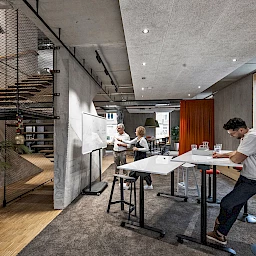
Alongside spatial design, optimal lighting planning is a decisive factor in both productivity and employee wellbeing. Lighting concepts must always be tailored to the respective organisational setup — whether individual offices, shared spaces or open-plan environments. Planning should therefore extend beyond the workstations themselves to include meeting rooms, break kitchens, foyers and corridors. The interplay of daylight and artificial lighting forms the foundation of any office lighting strategy. Individual offices often benefit from higher levels of natural daylight, while meeting and conference rooms typically require lighting systems that support focused work as well as dynamic communication. Break kitchens, on the other hand, are spaces for relaxation and informal exchange and therefore need lighting that meets both functional and atmospheric requirements. To accommodate these varying uses, investing in controllable and adjustable luminaires is highly recommended.
Office spaces and workstations must also comply with established standards. Glare and reflections should be avoided, and lighting should be evenly distributed throughout the space. Strong contrasts between light and dark areas should be minimised. In addition to selecting the appropriate colour temperature, good colour rendering is essential. This is measured using the Colour Rendering Index (CRI), with natural daylight, rated at CRI 100, serving as the ideal benchmark.
To create an ergonomic lighting environment, companies typically combine different types of lighting that complement one another: direct light for task-focused illumination at the desk and indirect light for overall ambient brightness. Flexible floor lamps or permanently installed pendant luminaires above workstations often provide both direct task lighting and ceiling illumination. General lighting is frequently achieved with downlights that reflect off walls and ceilings to create uniform brightness and targeted accents. All directly emitting luminaires, such as spotlights or uplighters, should be properly shielded to prevent glare and visual discomfort.
The Home Office: Harmony and Flexibility
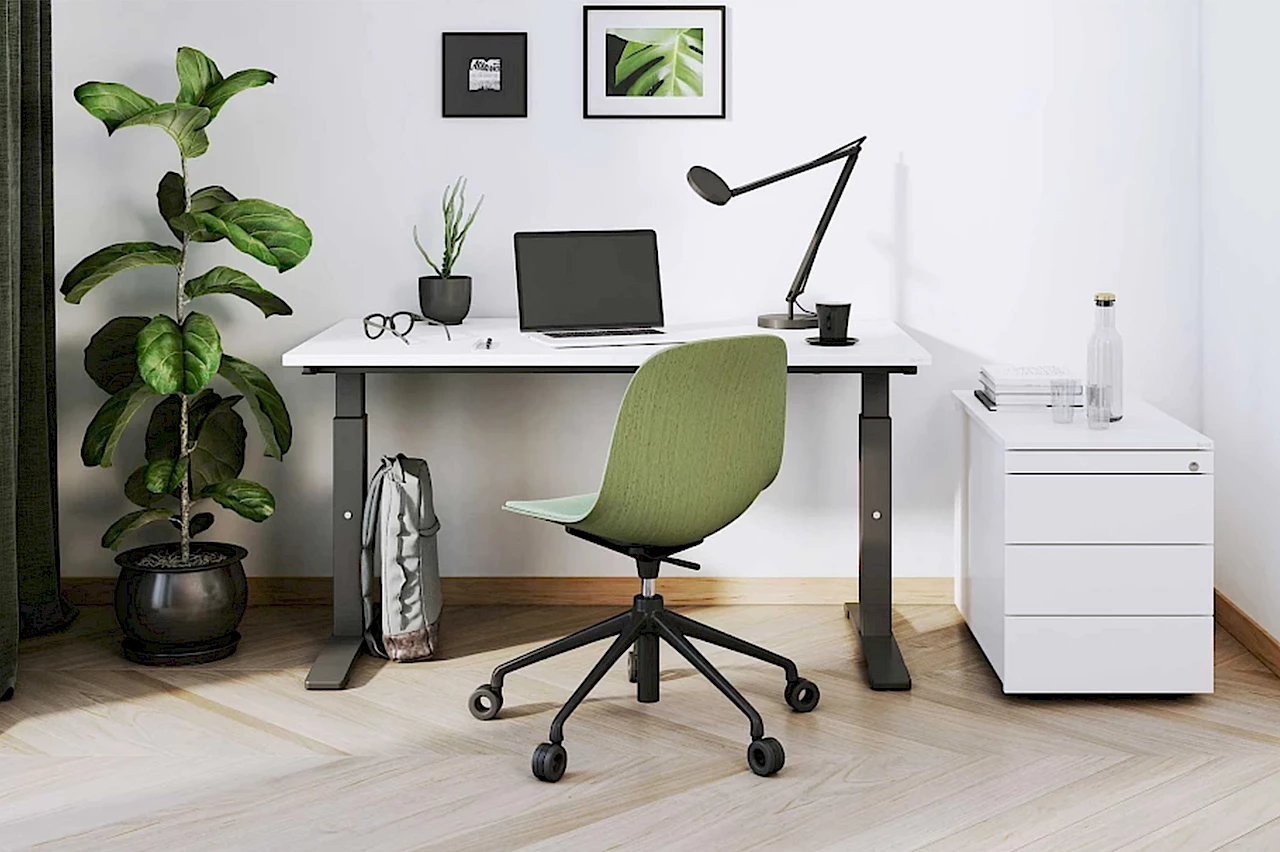
The home office is less a dedicated room and more an activity that may take place in a study, at the dining table, in a guest room, or in a corner of the living room or bedroom. Here, the focus is less on rigid standards and more on individual adaptability and creating a pleasant balance between working and living environments. For this reason, warm white light (below 3000 K) is typically used for general lighting in the home office to create a cosy, residential atmosphere. For focused tasks, however, it should be combined with neutral white or daylight white light at the desk to maintain concentration during working hours. An adjustable desk lamp that provides direct light is always a good choice for the home office. Additional light sources can be used to brighten the space as needed. Modern LED lighting solutions offer a high degree of flexibility, but alternatively, multiple separately switchable light sources can also be used. This ensures the right mood and lighting conditions for different usage scenarios.
Quick Tips for Proper Lighting in the (Home) Office
- use daylight: Position the desk so that daylight enters from the side to avoid glare and shadows. A view outside also allows for healthy screen breaks.
- rule of thumb: For right-handed people, place the lamp on the left; for left-handed people, on the right.
- Mix your lighting: Combine indirect general lighting with focused task lighting.
- Human Centric Lighting: Use smart lighting systems that mimic the natural course of daylight—cool, energising light in the morning and warmer light toward the evening for relaxation.
Lighting as an Investment in Productivity, Efficiency and Retention
Professional lighting design is a strategic investment. It increases productivity, reduces sick days and lowers energy costs.Although often underestimated, the right lighting proves to be one of the most powerful levers for employee wellbeing, satisfaction and retention — especially in times of skilled labour shortages.