

 IBA editorial team
 Working from home has become an established component of working life. According to the ifo Institute, the proportion of employees working from home in Germany remains stable at around 25%. Yet although hybrid models are widely discussed at an organisational level, one central question often remains unanswered: what do the physical working conditions at home actually look like, and what do they mean for health, productivity and spatial planning? The IU Home Workspace Compass 2025 provides a comprehensive assessment. In an online survey, the spatial, ergonomic and behavioural parameters of 794 individuals regularly working from home in the DACH region were systematically recorded. The focus is not on remote work as a model in itself, but on the concrete physical environment – the home workspace.
The typical home workspace: Functional, but not always exclusive
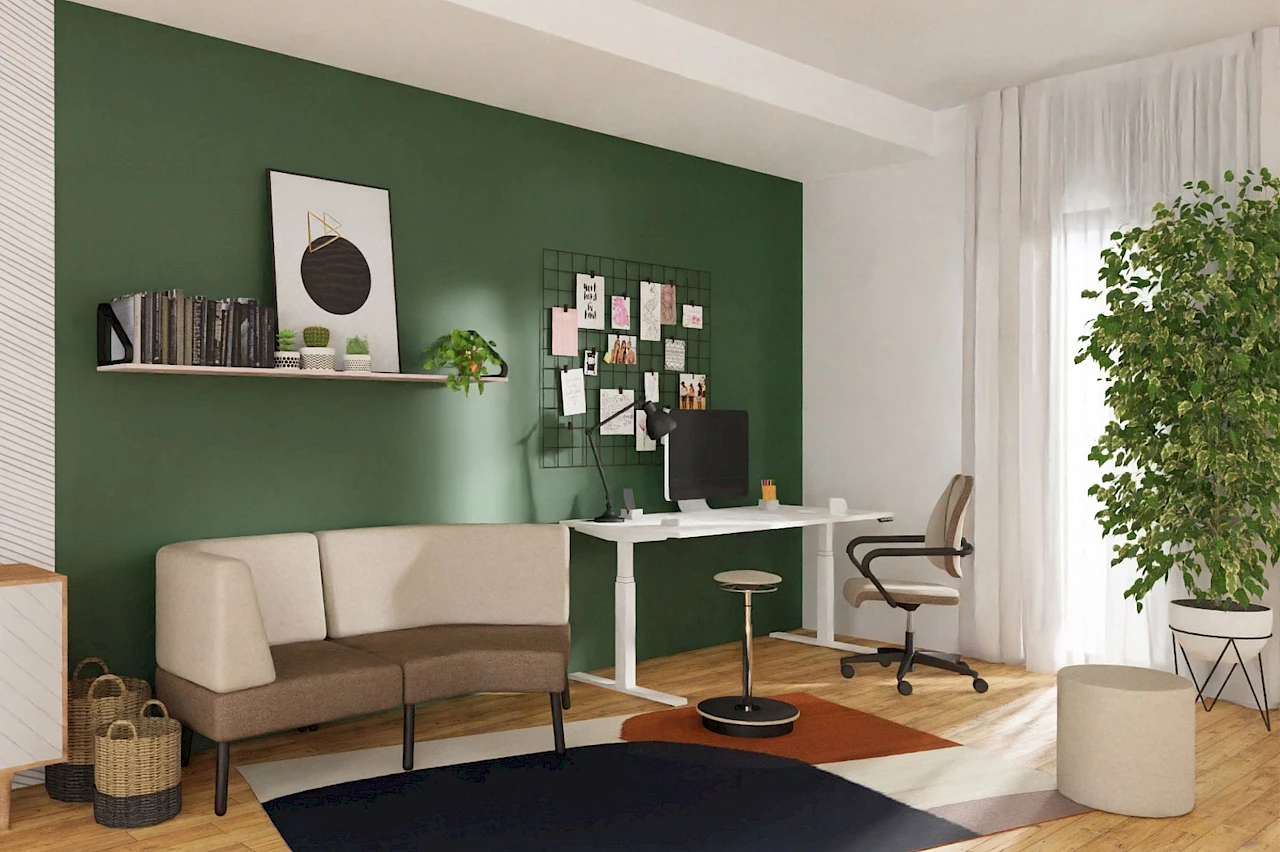
The image of the typical home workstation is clearly defined: a desk positioned in front of a white wall, a window to the side, a height-adjustable office chair and a desk lamp. 49% of respondents work primarily in a dedicated study, 23% in the living room and 18% in the bedroom. Structural differences are notable. Men are significantly more likely to have a separate study (60% compared to 44% of women). In addition, women’s home offices are more frequently used as multi-purpose rooms, for example as guest rooms, hobby spaces or storage areas. The home workspace is therefore also a question of allocation and availability within the household. A further divide emerges between urban and rural settings: people living in rural areas or small towns are considerably more likely to have access to a dedicated study than residents of large cities. Combined with respondents’ assessment of the suitability of their workspace, this indicates a structural disadvantage for urban households with limited living space. At the same time, 58% of respondents do not work exclusively in their primary workspace but regularly move to other rooms, most commonly the living room or kitchen-living area. The home workspace is therefore often not a clearly demarcated place, but part of a spatially flexible everyday arrangement.
Ergonomics: Increasing professionalisation, with room for improvement
Contrary to the widespread assumption that improvised kitchen-table solutions dominate, the study indicates increasing professionalisation. 87% of respondents use a conventional desk as their main work surface, and 35% already have a height-adjustable desk. Ergonomic models also predominate in office seating. Only 13% work without adjustable comfort features. The majority work seated upright at a desk; fewer than 20% report regularly working in unconventional postures, such as on the sofa or in bed. From a health perspective, the findings are nuanced. Overall, working from home does not lead to a significant increase in health complaints. On the contrary, fatigue, stress and restlessness have decreased for 28% of respondents, while only 13% report an increase. One exception is back pain, reported by 21%. The data suggests a correlation between the ergonomic quality of seating and the prevalence of back complaints.
Lighting and indoor climate conditions
84% of respondents report having sufficient daylight during the day. However, 55% also experience glare or screen reflections. This indicates potential for optimisation in the positioning of desks and monitors. Ventilation behaviour also shows largely positive results: 86% ventilate regularly or continuously in warm temperatures. Unlike in office environments, users at home can individually control lighting and indoor climate conditions. The quality of the home workspace therefore depends strongly on the specific spatial situation and the degree to which it can be adapted.
Behaviour and work rhythm
Work carried out at home is concentrated predominantly in the morning. 73% of respondents take a break after two to four hours at the latest. 49% deliberately change rooms within the home for this purpose, although leaving the house itself is less common. Breaks are often combined with eating, household tasks or short errands — everyday life remains integrated into the working routine. In communicative terms, however, a deficit becomes apparent. Both the quantity and quality of communication are perceived as lower compared to the office, particularly with regard to personal interaction. This represents a central challenge of hybrid models: physical autonomy may come at the expense of informal exchange.
Assessment and willingness to invest
Overall, respondents assess working from home positively. The difference between individuals with a dedicated study and those working in the living room or bedroom is particularly pronounced. The former rate their ability to concentrate, their motivation and the functional suitability of their workspace significantly higher. The spatial consequences are considerable. 63% have purchased new furniture in the past three years, 33% have rearranged furniture and 23% have altered room layouts. 16% have even relocated due to increased home working. Looking ahead, 26% plan to purchase new furniture and 14% are considering moving home. 31% would accept a professional consultation service to optimise their home workspace, while a further 40% might consider doing so.
Implications for planning and the property sector
The IU Home Workspace Compass 2025 makes clear that the domestic workplace has become a relevant part of the overall working landscape. Its quality depends heavily on housing type, location, gender and available space. At the same time, the data indicates growing professionalisation and a willingness to invest. For project development, residential construction and refurbishment, this raises concrete questions: how can floor plans respond more flexibly to hybrid working models in the future? What role do acoustic and visual quality play in residential environments? And how might advisory or service offerings relating to the home workspace be integrated?

The IU Home-Workspace-Kompass 2025 was conducted by Professor Miriam Irle and Professor Felix Klingmüller of IU International University of Applied Sciences. The study is based on an online survey of 794 individuals regularly working from home in Germany, Austria and Switzerland between July 2023 and March 2024.
Cover photo: @Nowy Styl