

 IBA editorial team
 Today’s offices serve far more than purely functional purposes. Alongside focused work and formal meetings, they are increasingly becoming places of social interaction. A recent survey conducted by ORGATEC on behalf of Koelnmesse shows that personal relationships are considered a natural part of everyday working life for many employees. This brings attention to an aspect that is often underestimated in discussions about modern workplaces: the role of spatial design in facilitating interpersonal encounters. Offices are not merely working environments, but social spaces where trust is built, collaboration develops and relationships can emerge.
The figures from the ORGATEC survey illustrate this development clearly: 41% of respondents stated that they had flirted with colleagues at some point. Among men, the figure stands at just over 47%, while among women it is just under 35%. Around one third of those who had already been in employment had been on at least one date with someone from their workplace. Nearly 29% entered into a romantic relationship with a colleague during their working life, and almost 16% met their current or former partner through work. International studies, such as the Forbes Workplace Romance Statistics, reveal comparable findings and underline that social relationships are an established part of workplace reality.
Spaces of informal interaction in the office
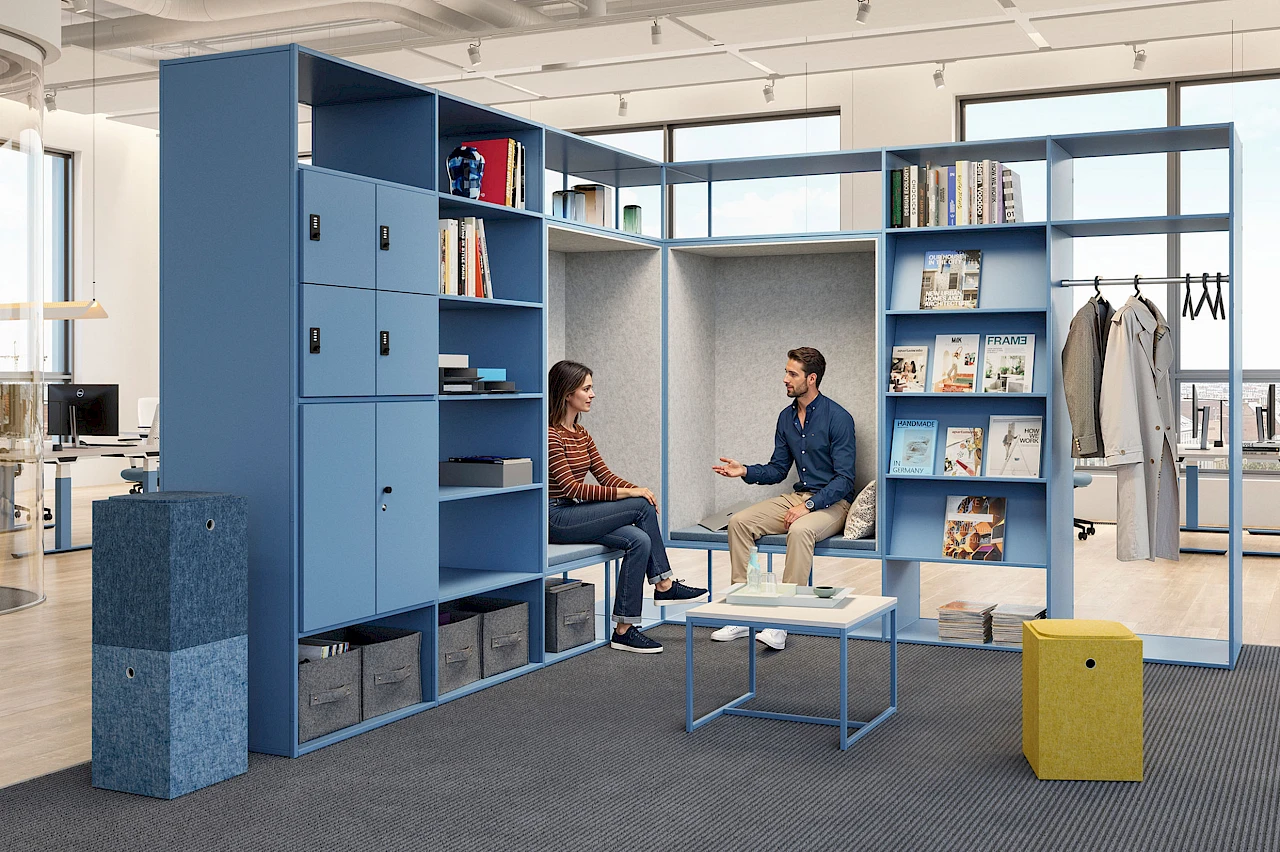
What is particularly interesting is not only that these relationships develop, but also where they develop. According to the Koelnmesse survey, company events and after-work gatherings are perceived as the places with the greatest potential for flirting and social interaction, receiving just over 40% approval. They are followed by kitchen or coffee areas at around 28%, and the traditional workstation at approximately 25%. What these situations have in common is that they are informal, low-threshold, and shaped by minimal hierarchy. A closer look at specific office areas confirms this pattern: sofa corners and lounge furniture are especially frequently identified as spaces that encourage social closeness. Outdoor working areas and terraces are also rated highly, followed by communal tables and shared desks. Further studies on the design of social office spaces likewise show that shared areas encourage spontaneous conversations and relationship-building. Wherever people encounter one another naturally and without pressure, trust and social bonds are more likely to develop.
Spatial design as an influencing factor
This broadens the perspective on workplace design. It influences not only efficiency, acoustics, or ergonomics, but also the likelihood of social interaction. Informal zones, open communication areas, and flexible spatial structures create the conditions that allow people to connect. Those working in open or semi-public areas encounter others more frequently, engage in more spontaneous conversations, and gain insight into different perspectives. This form of interaction forms an important foundation for collaboration and team dynamics. For the office furniture industry, this means that products extend far beyond their purely functional role. A sofa is not simply a seating option; it can become a social anchor point. A communal table is not merely a work surface, but a place for exchange between different teams and departments. Terrace and outdoor furniture extend the workspace into areas that lie between work and leisure, enabling new forms of interaction.
The interplay between space, organisation, and culture
At the same time, research shows that spaces do not unfold their effects in isolation. What matters is the interaction between spatial design, organisational structures, and corporate culture. In the New Work Order studies by trend researcher Birgit Gebhardt, the office is explicitly described as a learning environment and a resonant space in which physical surroundings, work organisation, and culture interact. Research reviews on new forms of work reach similar conclusions, emphasising that working environments are particularly effective when they support different needs such as communication, concentration, and recovery. In the context of hybrid working models, risks are also highlighted. As physical presence in the office decreases and spontaneous encounters become rarer, a form of “social erosion” may occur. The office is then perceived less as a place of exchange and more as a purely functional environment. Against this backdrop, office attendance days are gaining a new significance: they are increasingly understood as opportunities for interaction, coordination, and relationship-building — for example through deliberately planned team days or shared community days in the office.
Balancing openness and privacy
The debate surrounding open-space concepts and desk sharing also illustrates the ambivalence of modern working environments. Open structures can promote communication and transparency, but without sufficient opportunities for retreat they can quickly lead to overstimulation and social stress. A balanced design that enables both proximity and privacy is therefore essential. Alongside open communication areas, there must also be protected spaces such as telephone booths, quiet zones, or small meeting rooms. These create the conditions necessary for different forms of interaction to take place appropriately.
Conclusion: Spatial design as a factor that structures social processes
The findings presented here demonstrate that the function of the office is shifting in the context of hybrid working models. While concentrated individual work is increasingly location-independent, the office is gaining importance as a space for social interaction. This also changes the benchmark for what constitutes a good working environment: the decisive factor is no longer simply space efficiency, but rather the quality of the encounters it enables. Spatial design therefore becomes a factor that structures social processes. For companies and manufacturers alike, this creates the need to think about working environments in a more differentiated way. What is required is concepts that deliberately support different modes of use while simultaneously strengthening the office’s social function. The extent to which this succeeds will become an increasingly important factor in collaboration, employee identification, and the overall attractiveness of the workplace in the future.