


 wll.news editorial office
 AI agents are fundamentally changing the world of work: they analyse documents, manage processes and increasingly carry out tasks independently. Nico Bäumer, Member of the Executive Board and CTO of the family-owned software company d.velop, explains why digital sovereignty, transparent decision-making and control over corporate data are crucial to trustworthy agentic AI.
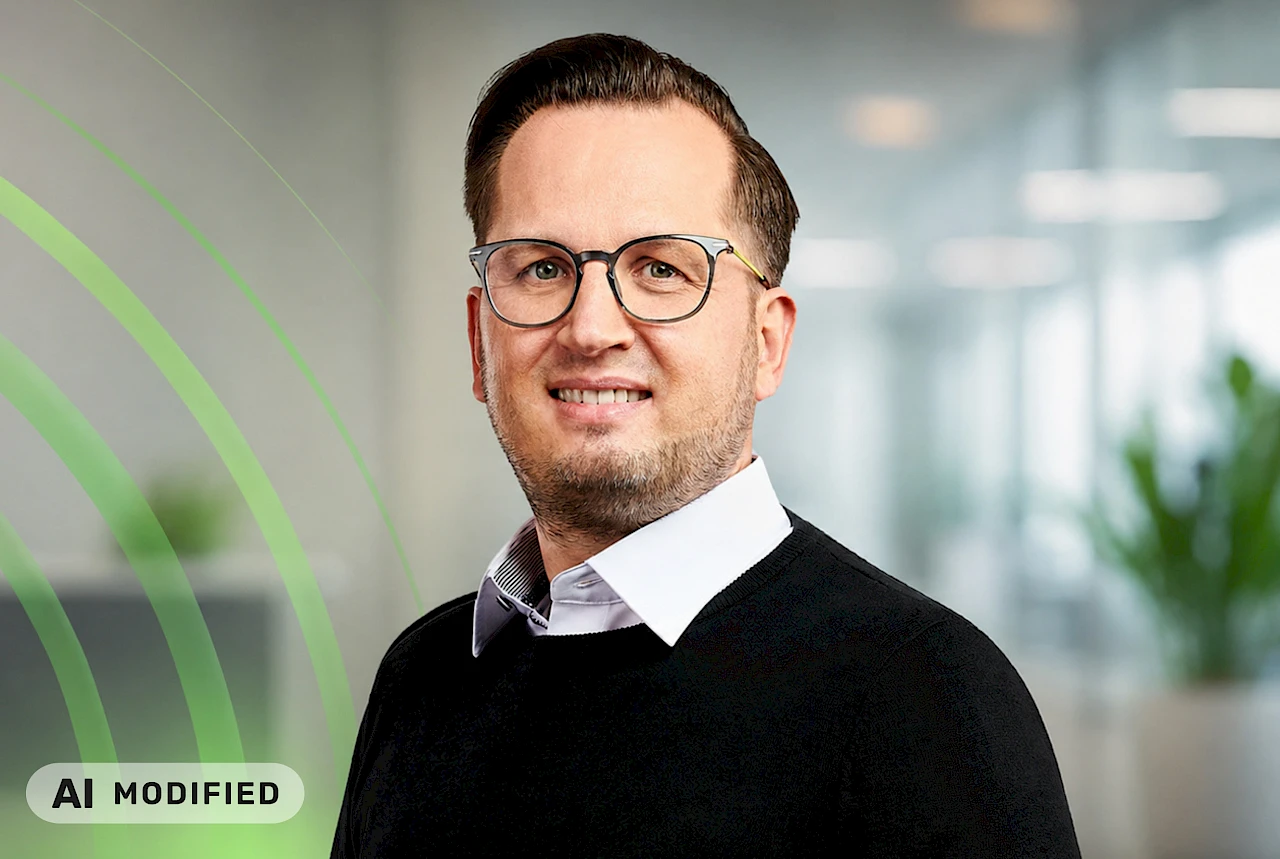
Nico Bäumer is an Executive Board Member and CTO of d.velop AG. Drawing on his many years of experience in product management and product development, he drives the company’s innovation and digitalisation strategy. Previously, as a Solutions Architect at AWS, he supported software companies on their journey to the cloud. His current focus is on artificial intelligence and its potential to fundamentally transform enterprise content management.
Nico Bäumer, the term ‘AI agents’ seems to be everywhere at the moment. In your view, what distinguishes AI agents from previous AI applications – and why could they fundamentally change the world of work once again?
Generative AI assists: it waits for input and delivers output. AI agents reverse this relationship. You give them a goal, they break it down into individual steps, access systems and documents, and carry the process through to completion. Instead of saying, ‘Summarise this contract for me’, we will say: ‘Check this incoming contract against our standards, flag any deviations and forward it for approval.’ We no longer operate software – we delegate work to it.
What matters here is not the AI model itself. Models are increasingly becoming a prerequisite rather than a differentiator. What makes the difference is the context in which an agent operates: Does it have access to the relevant corporate knowledge? Does it understand the actual processes? And can we trace what it does and on what basis? This is precisely where d.velop AI comes in. We bring documents, processes and agents together in a way that ensures data remains within the company and under its control.
I am convinced that, in a few years’ time, no one will be asking which AI a company uses. The crucial question will be how well people and AI agents work together – and who retains control over data and decisions.
What tasks can AI agents already take on today, particularly in document processes? And where do you see further potential applications?
Document processes are one of the first areas in which measurable benefits can already be achieved. They combine structure, clear rules and large volumes. An agent can check incoming invoices, match them against purchase orders and present only the discrepancies to a human. It can analyse a contract against internal standards, flag critical clauses and initiate the approval process. What matters is that these agents can access corporate knowledge across different systems and base their responses on traceable sources – rather than on a black box that merely produces plausible-sounding answers.
The real leap forward will come when, rather than a single agent handling one task, several specialised agents work together to orchestrate an entire business process – across departmental and system boundaries. At that point, AI moves from being a tool to becoming an active part of the organisation.
But this is precisely where the underestimated challenge lies. When agents make decisions, it must always be possible to trace who decided what and on what basis. Governance and the complete documentation of agentic decisions will become the real bottleneck. They are not optional extras, but prerequisites for companies to be able to use agents productively in the first place.

When AI agents carry out tasks independently, who ultimately bears responsibility? And what role will people play in these processes in future?
Responsibility cannot be delegated to AI – only tasks can be delegated. That is why all decisions must be documented transparently, traceably and in an audit-proof manner, so that it is always clear which information was used and who ultimately bears responsibility. The human role is shifting from that of an operational processor to that of a controller and decision-maker. The well-known ‘human in the loop’ will therefore continue to exist. And it needs to.
AI provides speed, scalability and the ability to handle routine tasks, while people contribute context, experience and judgement. In my view, it is precisely this controlled collaboration between people and agents that forms the basis for trustworthy agentic AI.
Where do you currently see the greatest risks or misconceptions when it comes to using AI agents? Are there limits?
Responsibility cannot be delegated to AI – only tasks can be delegated. This is not a legal technicality; it is at the heart of the entire debate. Every decision must therefore be documented transparently, traceably and in an audit-proof manner. Which information was used? Which agent carried out which step? And who is responsible for the result? Audit-proof documentation is not a new topic for us. It is how d.velop has always built trust. With agents, it becomes essential.
The human role is shifting from operational processing to control and decision-making. ‘Human in the loop’ only captures part of this. It is not about a person signing off every single step, but about intervening at the right points, setting goals and defining the boundaries within which an agent is allowed to operate. AI provides speed, scalability and consistency; people provide judgement, responsibility and the knowledge of when a rule does not fit the situation.
In my view, this controlled collaboration – rather than maximum AI autonomy – is the foundation of trustworthy agentic AI.
What is the current state of agentic AI – both in the market generally and specifically at d.velop?
The market is currently moving from individual pilot projects to production-ready solutions. Many companies have experimented with AI. The more difficult question now is how to integrate it reliably into day-to-day operations. This is where it will become clear who is genuinely using agentic AI and who is merely experimenting with it.
The decisive factor is not the number of AI tools, but the intelligent integration of information, processes and AI. This is the approach we are pursuing with d.velop AI as an end-to-end framework – from infrastructure and governance through to specific agents. We are deliberately building agentic AI not as an additional tool, but as an integral part of existing business processes.
One principle is strategically important to us: freedom of choice when it comes to the AI model. We rely on open standards and a model-agnostic approach – not because of a technical preference, but because no company should make its processes dependent on a single provider. The model landscape changes from month to month; anyone who locks themselves in today will pay the price tomorrow. Our customers should always be able to use whichever model is best suited to their particular use case.

What developments do you expect over the coming months? What is realistic in the short term, and what is still some way off?
In the short term, over the next few months, agents will increasingly take on not only individual steps, but entire subprocesses, working together in multi-agent systems with different agents performing different roles. It is also realistic to expect specialist departments to configure their own agents without needing support from IT – just as someone today can create a spreadsheet without being a programmer. This brings AI closer to where the specialist knowledge actually resides.
What is being overestimated in the short term is autonomy. Many people expect agents to manage entire areas of a business on their own. What is being underestimated is the work required to build the foundations: reliable data, well-designed processes and robust governance. These factors will determine whether a pilot becomes a productive solution or remains stuck at the showcase stage.
In the longer term, agents will assume defined areas of responsibility within organisations. However, I consider the idea of a fully autonomous company to be a misconception rather than simply a question of time. Strategic decisions – and responsibility for them – will remain with people. Which brings us back to where we started: it will not be about which AI a company uses, but how well people and AI work together.
What prerequisites do companies and public authorities need to meet in order to work effectively with AI agents? How important is digital maturity?
The most important success factor is not the AI itself, but the state of an organisation’s information. An agent is only as good as the information it can access. If information is scattered in an unstructured way across inboxes, network drives and people’s heads, even the best model will not help. An agent can only deliver its full value once knowledge is structured, processes have been digitalised and trustworthy data are readily available.
This has a consequence that many people underestimate. Document management is no longer an administrative task; it is the strategic foundation of every AI initiative because it is what makes an organisation’s knowledge usable by AI in the first place. Those who have invested in this area over the past few years now have an advantage that cannot be made up in a matter of weeks.
For public authorities and regulated industries, there is a second layer. Auditability, data protection and traceable decisions are not optional; they are mandatory. This is precisely where it becomes clear why trustworthy and transparent AI is not simply a marketing term. It is a prerequisite for these organisations to be allowed to use agents at all.
Agentic AI is therefore not an isolated AI project. It is the point at which it becomes clear whether an organisation has its information base under control.
A key issue is the digital sovereignty of data: transparency, traceability and control. Why is this particularly important when it comes to AI agents – and how can it be ensured both technically and organisationally? What role does d.velop’s status as a family-owned company play?
The more autonomously an agent operates, the more important the following questions become: What data does it access? Which rules does it use to make decisions? And can those decisions be traced? For us, digital sovereignty therefore means more than storing data in Europe. It means retaining full control over information, permissions, the models being used and governance – in other words, over all the factors that contribute to an AI-driven decision.
We embed this technically in the architecture. Through our Trust Layer and Agent Center, every action performed by an agent remains logged and auditable: which information was used, which permissions were checked and which step was carried out. Traceability is therefore not a retrospective control mechanism; it is built into the system. In addition, we use a range of specialist and application-specific models as well as open standards to ensure that companies remain technologically independent.
The fact that we are a family-owned company is not incidental. We think in decades, not quarters, and rather than merely promising trust, we can make it a fundamental principle of our products. For us, European sovereignty is something we put into practice. In the 2026 Gartner Magic Quadrant for Document Management, d.velop is the only one of the 16 global providers to be entirely European-owned and therefore free from US jurisdictional risks such as the CLOUD Act. For customers in regulated markets, this is not a question of image; it is often a prerequisite for being able to use AI at all.
Please also read

How will collaboration between companies, employees and AI agents change over the next three, five and ten years?
I deliberately distinguish between these time horizons because the dynamics are very different. Over the next three years or so, people will remain firmly at the centre. Agents will take on clearly defined operational tasks, while people will manage, prioritise and make decisions. The maturity of individual organisations will determine the pace more strongly than the technology itself. During this phase, the gap between pioneers and laggards will become increasingly visible.
Looking five years ahead, several specialised agents will work together on interconnected processes, across departmental and system boundaries. Employees will shift from execution to orchestration: they will define goals and guardrails and intervene where experience and judgement are required.
In ten years’ time, the distinction between ‘software’ and ‘AI’ will have disappeared for users. In its place will be an intelligent layer connecting information, applications and processes. People will work with goals rather than individual programmes. What will matter then is no longer be the ability to operate software, but judgement, creativity and the ability to take responsibility. Ultimately, the companies that stand out will not be those with the most AI, but those that design this collaboration most effectively.
What is your personal vision for the future world of work?
My vision is a world of work in which technology recedes into the background. People will no longer interact with individual applications, but with an organisation as a whole – and organisations will interact with one another across their boundaries.
Today, interaction between companies, customers, suppliers and public authorities is still fragmented: different portals, breaks between digital and analogue processes, and uncertainty as to whether something has been legally validly and successfully delivered. I believe we need an open standard for this – a legally secure and binding form of digital delivery that works for everyone, in both directions, and is not owned by a single provider.
We believe d.velop can play a major role in shaping this category. With eIDAS certification, we have established the legal foundation, and our platform already has around five million registered users. Built by d.velop, but open to everyone. I am convinced that this category – sovereign, binding interaction between organisations and people – will become crucial over the coming years.
Cover image: Nico Bäumer, d.velop, AI-modified