


 Oliver Baxter
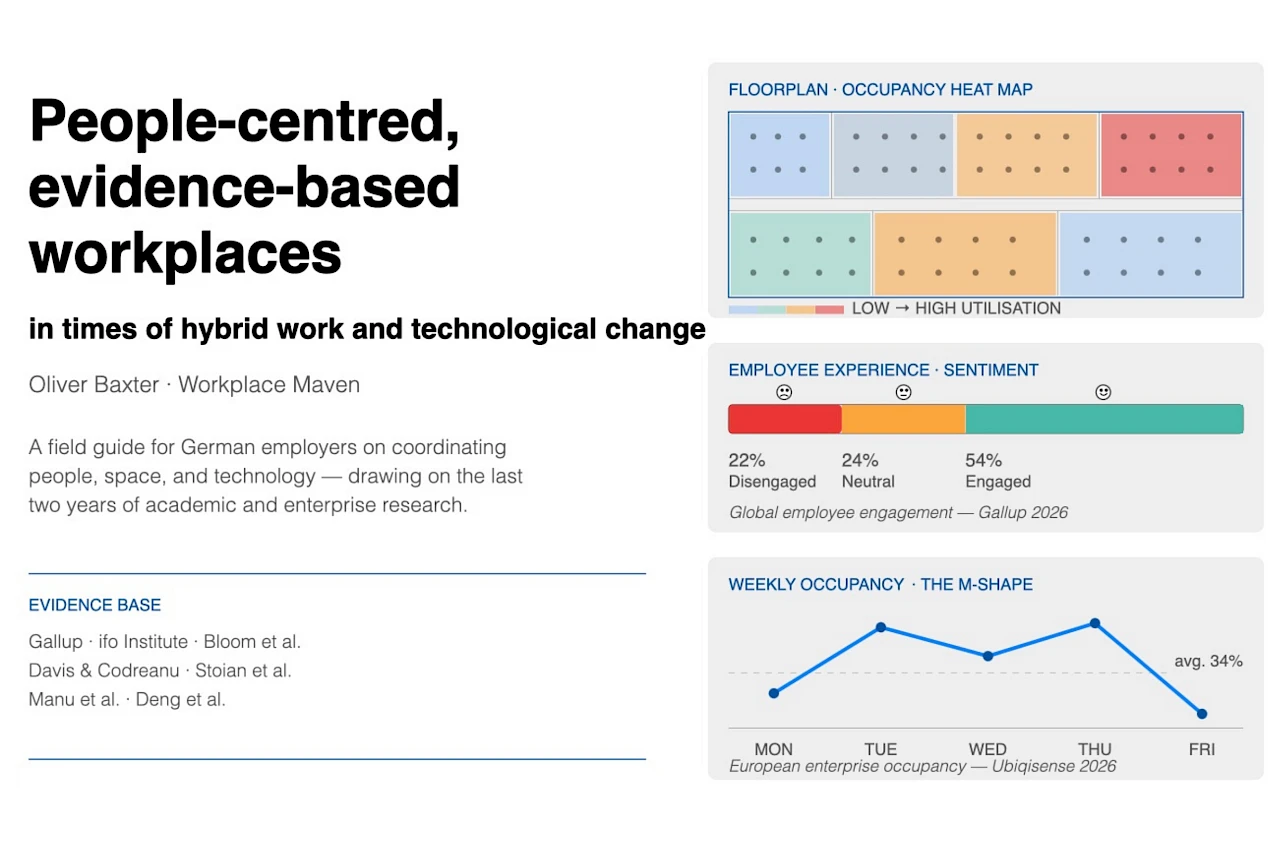
 Hybrid is no longer the disruption. Disengagement is. Gallup’s 2026 State of the Global Workplace puts global employee engagement at 20%, its lowest since 2020, with the slump costing the world economy roughly $10 trillion in lost productivity¹.
Manager engagement has fallen nine points in three years, dropping from 31% to 22%¹. The story isn’t that people are working from the wrong place. It’s that organisations are still trying to manage hybrid workforces with pre-pandemic instincts, pre-pandemic buildings, and an evidence base most leaders haven’t read.
For German employers in particular, the implications are immediate. Working from home in Germany has settled at just under 25% of all working days², with employees averaging 1.6 days a week at home, second only to Finland in the EU³. This isn’t a temporary equilibrium waiting to revert. It’s the new floor.
The hybrid question is settled. The design question isn’t.
Five years of evidence converge on a clear finding: well-designed hybrid work doesn’t damage performance. Bloom and colleagues’ randomised trial at Trip.com, published in Nature, assigned 1,612 graduate employees to either two days a week working from home or full-time office attendance. Hybrid workers showed no productivity loss, attrition fell by 33%, and promotion rates were unchanged⁴. A 2025 cross-country study of 1,255 IT employees and managers identifies a “sweet spot” of six to ten office days per month, where workers report significantly higher perceived efficiency and lower office-related stress⁵.
The same study uncovered something more uncomfortable. Managers were nearly twice as likely as employees to rate hybrid as the most efficient model, and consistently evaluated remote-work resources more favourably than the people actually using them⁵. Most organisations are flying blind on the gap between what leadership thinks is happening and what employees experience day to day.
That gap is where engagement leaks out.

Technology is now the floor, not the ceiling
Davis, Bloom and Codreanu’s analysis of 5.6 million U.S. patent applications from 2010 to 2026 found that the share of patents advancing work-from-home technologies rose by roughly two-thirds within three years of the pandemic, and remains around 50% above pre-pandemic levels⁶. Corporate America has placed long, expensive bets on the infrastructure of distributed work. Video, asynchronous collaboration, scheduling intelligence, occupancy sensing, AI co-pilots, none of these are going back in the box.
But adoption is uneven, and the Gallup data show why it matters. In organisations that have implemented AI, 65% of U.S. employees say it has improved their personal productivity, yet only 12% strongly agree it has changed how their organisation actually works¹. The bottleneck isn’t the tool. It’s the manager. Employees whose managers actively support AI use are 8.7 times more likely to say AI has transformed how work gets done. In Germany, only 21% of employees in AI-using organisations say their manager actively supports them in adopting it¹.
The lesson generalises beyond AI. Workplace technology only delivers when management practice is built around it.
What people-centred actually requires
Increasingly, workplace strategy is shifting from periodic real estate planning exercises toward continuous workplace intelligence, where organisations monitor how space, technology, culture, and work patterns interact over time. The most effective workplaces are no longer designed solely around density or attendance targets, but around enabling performance, wellbeing, coordination, and adaptability simultaneously. Four commitments separate organisations that get this right from those that just announce policies.
This is the gap platforms such as Workplaced are designed to address. Rather than relying on assumptions or blanket mandates, organisations can model hybrid work scenarios against measurable trade-offs including space utilisation, employee experience, commute burden, collaboration patterns, talent retention, and productivity outcomes. By combining employee preferences, behavioural data, and workplace utilisation insights, evidence-based planning becomes possible before policy decisions are implemented. This is particularly important given research showing that leadership often overestimates the effectiveness of hybrid arrangements compared to employees themselves⁵. The challenge is no longer whether hybrid work exists, but whether organisations have the tools and governance models to manage it intentionally.
The second is making the policy usable on the day. A hybrid plan is only as good as the friction employees encounter when they try to act on it. If finding a desk, a meeting room with the right kit, or a parking space takes ten minutes of trial and error, anchor days lose their pull and people quietly default back to home. The German platform goconut addresses this layer specifically: desk and room booking classified by Activity-Based Working zones, integrated with Outlook and Google calendars, extending to parking and shared assets. It’s the practical bridge between a hybrid policy and a workable office day, and the Activity-Based Working classification is precisely what the Indoor Environmental Quality (IEQ) literature points to matching task to environment rather than treating all desks as interchangeable.
The third is measurement over assumption. Without instrumented feedback, leadership consistently overestimates how well its workplace strategy is working. Engagement surveys catch this late. Real-time signals utilisation, dwell time, meeting density, environmental conditions catch it early. Ubiqisense sits in this layer, using anonymous sensing to show how buildings are actually being used rather than how they were designed to be used.
Their European enterprise data tells the story bluntly: average weekly occupancy sits at 34%, with the familiar M‑shape of busy Tuesdays and Thursdays, quieter Mondays and Wednesdays, and Friday running far below the rest of the week¹². Most German offices were sized for a working pattern that no longer exists. The three layers together form a closed loop: Workplaced models the policy, goconut runs the daily operation, Ubiqisense measures what actually happens. Without that loop, real estate decisions stay anecdotal.
The fourth is environmental quality. A systematic review of 51 studies on indoor environmental quality in work-from-home settings found that thermal comfort, lighting, acoustics and air quality consistently predict cognitive performance and self-reported wellbeing⁹. A multi-domain review in Indoor Air reached the same conclusion for offices: Indoor Air Quality interacts with thermal, visual, and acoustic conditions to shape productivity in ways single-factor studies miss¹⁰. When 40% of German firms are still requiring full on-site attendance¹¹, the office has to compete with the home for environmental quality, not just policy.
What this means for German employers
Germany already leads Europe on hybrid take-up, but the next phase isn’t about how many days. It’s about how those days are designed, measured, and supported. Three practical moves follow from the evidence:
Coordinate office time around team interdependence rather than headcount targets. Anchor days only work if they’re built around what teams actually need to do together.
Instrument the building and the workforce in parallel.
“Occupancy and environmental data without engagement data describes a building. Engagement data without building data describes a mood. The two together describe a workplace”.
Train managers to support hybrid practice, not police it. The Gallup data are unambiguous: manager engagement is the lever that moves everything else, and Germany sits below international peers on AI manager support specifically¹.
The organisations that will pull ahead in 2026 aren’t the ones with the loudest return-to-office mandates or the most generous remote policies. They’re the ones running their workplace the way they’d run any other production system: with evidence, instrumentation, and managers who know how to use both.