


 IBA editorial team
 AI is the new megatrend. It promises knowledge and efficiency, is widely available, yet remains largely ineffective in many organisations. This is why the German Interior Business Association (IBA) asks very specific questions: how will people collaborate differently with machines? What new impulses does AI bring to the division of labour within organisations? And how are leadership and knowledge transfer within teams changing?
Artificial intelligence will profoundly transform our working world — that much is clear. What is less clear, however, is how organisations should restructure departments and reorganise the division of labour between humans and machines. This is precisely what interests us as the Industry Association for Office and Work Environments, and, of course, the spaces and realities in which this new form of collaboration with AI will take place in the future. We believe that far more will be possible than today’s hybrid office concepts have been able to deliver. To avoid falling back into familiar patterns, let us therefore set aside the hybrid office of today and focus instead on tomorrow’s collaboration with AI.
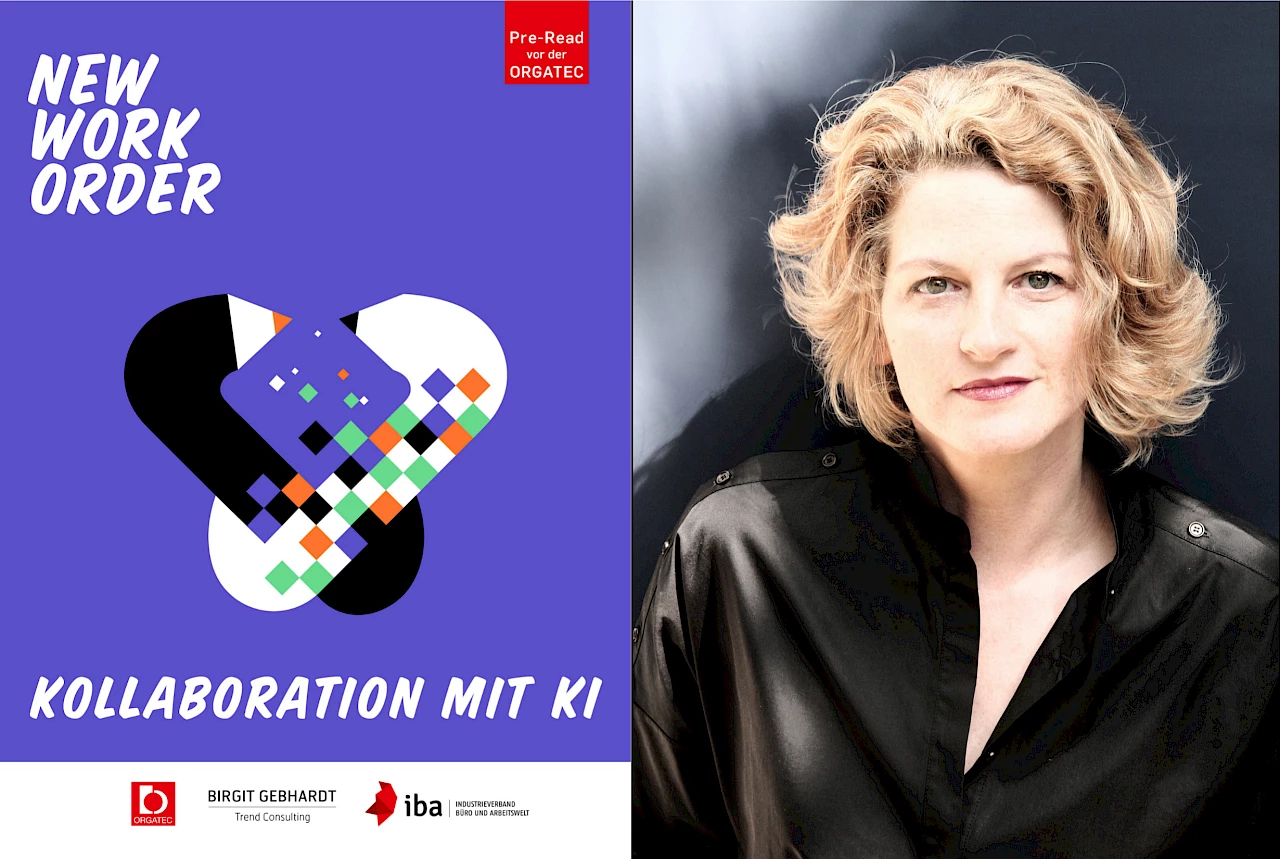
We were supported in developing this perspective by trend researcher Birgit Gebhardt, who outlined the key drivers, premises and approaches to collaboration with AI for the pre-read of the new ‘New Work Order’ study. Rarely has it been so imperative to actively shape the future. With this pre-read, published one year ahead of ORGATEC, the IBA aims to open the discussion and invite an expert audience to enrich the future perspectives presented here with feedback and examples.
let us begin with the trend perspective:
Why is AI the key driver for new forms of collaboration?
AI is not an entirely new phenomenon; it has accompanied us since the early days of machine learning on mainframe computers and in the automation of industrial processes. And yet, the rules of collaboration with AI have changed – more quickly and more profoundly than many organisations expected.
AI has long been present as a driver of efficiency, forecasting and automation. Later, we witnessed its capabilities in games such as chess, in algorithmic stock trading in the 1980s, and in visual pattern recognition in images ranging from urban environments to cellular structures.
And yet, compared with what is happening now, digital transformation appears to have been merely the beginning. With large language models and generative AI, the development of artificial intelligence has shifted qualitatively. AI is no longer just an analytical and automation tool operating in the background; it has become conversational, creative and intuitively usable. With these new characteristics, collaboration itself is changing. AI can now understand language and images, conduct dialogues, document content and generate it independently – operating in an iterative mode of creative variation and trial-and-error learning. Above all, its low-threshold availability via simple interfaces brings AI directly into the everyday work of teams and organisations.
Compared with what is happening now, digital transformation appears to have been merely the beginning. With large language models and generative AI, the development of artificial intelligence has shifted qualitatively. AI is no longer just an analytical and automation tool operating in the background; it has become conversational, creative and intuitively usable. With these new characteristics, collaboration itself is changing. AI can now understand language and images, conduct dialogues, document content and generate it independently — operating in an iterative mode of creative variation and trial-and-error learning. Above all, its low-threshold availability via simple interfaces brings AI directly into the everyday work of teams and organisations.

If we take a closer look at the upheavals, the driving forces behind the megatrend of AI are coming from several directions at once:
- Technologically speaking, artificial intelligence refers not merely to another digital function, but to a bundle of adaptive capabilities that can be networked, supplied with data, trained and expanded. It is therefore not just a tool, but a cross-cutting technology of the digital age: it connects front and back office, processes and products, markets and customers, people and machines. This connectivity creates a new logic of integration that enables collaboration across traditional boundaries. The pre-read also shows how AI is expanding the boundaries between the physical and the digital, with working environments overlaid through sight and sound and transformed into simulated application contexts.
- ECONOMICALLY AI not only promises efficiency gains through process automation, but also forces companies to redefine the division of labour between humans and machines. In AI-driven companies, we are seeing how AI streamlines and accelerates processes while opening up new value-creation potential. AI agents in particular, which can take over entire workflows across departments, are making silo thinking obsolete: they open access to knowledge for mixed teams, integrate external partners and thus create platforms for collaborative work. At the same time, new business models are emerging for organisations that train and operate these agents. The pre-read outlines the transition stages from an AI-optimised to an AI-native organisation and attempts to develop a new model of networked and circular value creation with AI.
- SOCIALLY artificial intelligence opens up new opportunities for social interaction: it shapes communication in social media, changes learning pathways and places educational opportunities in new contexts. This brings with it the challenge of avoiding deskilling — in other words, not just handing routine tasks over to machines, but also expanding people’s skills through upskilling. AI is becoming a catalyst for teamwork in mixed groups, where different perspectives come together and collective knowledge is created. Because AI prepares decisions and opens up options for action, there is also a growing need to question it critically and clearly anchor social responsibility. The pre-read relates these societal premises to economic constraints. Only when seemingly contradictory requirements interact do the framework conditions become concrete and the conclusions sustainable.
- Culturally AI is changing expectations of user experience: systems personalise, anticipate and create new dimensions of collaboration in augmented, virtual and mixed realities. Work is becoming increasingly hybrid, oscillating between physical presence and digitality, between virtual meetings and real laboratories. AI also acts as a catalyst for physical AI: it connects digital intelligence with physical environments, creating new interfaces between humans, machines and space. Collaboration via the digital twin not only has technical advantages — fact-based, real-time and across locations — but can also bring blue-collar and white-collar workers together in very concrete ways around the product itself. The office should not be denied the benefits of AI-based collaboration systems, so in the pre-read we consider whether physical proximity between product and production could also bring research and development closer to the digital factory. Examples include the BMW Research and Innovation Centre by HENN Architects and Festo’s Bionic Workbench. In this way, experiential knowledge, prototyping and scaling logic could merge into a new culture of collaboration.

When AI ceases to be merely a supporting technology and becomes an active contributor, it affects not only processes and business models, but the very essence of work itself. The crucial question therefore is:
how does ai change daily collaboration, leadership and knowledge transfer?