

 IBA editorial team
 The models of archetypal learning spaces developed by American educational researcher David Thornburg are being discussed more and more outside the field of education. In his essay ‘Campfires in Cyberspace’ and later in his book ‘From the Campfire to the Holodeck’, he describes spaces in terms of their social function rather than their floor plans or furnishings. Central to these spaces are areas for knowledge sharing, individual reflection, and informal exchange.
This shift in perspective renders Thornburg’s models highly relevant to contemporary office and workplace environments. In the context of hybrid working, declining office attendance and evolving workplace expectations, the question of the role of physical workspaces has never been more pertinent. While traditional desk-based areas are losing importance in many organisations, communication zones, retreat spaces and social meeting points are gaining relevance. Thornburg’s archetypes offer a valuable conceptual framework in this regard. They encourage us to view office spaces as ecosystems of learning, communication and interaction, rather than merely collections of workstations.
Thornburg’s archetypes: Campfire, Cave and Watering Hole
The model is centred on three fundamental types of space: the campfire, the cave and the watering hole. Thornburg deliberately uses imagery from pre-industrial contexts to describe universal human situations. The Campfire represents places where knowledge is shared. One person conveys information to a group. Historically, this may have been a fire, but today it could be a seminar room, lecture hall, town hall or workshop area within an organisation. The Cave represents retreat. It is a space for thinking, writing, reflecting or focused work, providing individuals with distance from stimuli, interruptions and social observation. The Watering Hole refers to spaces for unplanned interaction. Here, people meet by chance, ask questions, exchange experiences and develop new ideas through conversation. These social in-between spaces are where knowledge often emerges informally. In later developments, Thornburg added a fourth dimension: Life or the world – real environments in which knowledge is applied. In organisational contexts, these include project work, client interaction, workshops, innovation labs and operational processes – places where ideas are put into practice.
Why Thornburg’s approach is relevant today
The model’s strength lies in its understanding of learning and knowledge work as sequences of different situations, rather than as activities tied to a fixed workstation. Work alternates between input, focus, exchange, and application. This perspective closely aligns with current discussions on hybrid working models and activity-based workplace design. Numerous studies demonstrate that focused individual work is vital, that spontaneous encounters promote innovation and that social connection cannot be fully replicated digitally. The New Work Order-Study The Power of Space by Birgit Gebhardt, also describes the office as a learning environment, a stage, and a cultural space, drawing on similar spatial and behavioural concepts. A single standard workstation cannot meet these diverse requirements. Against this backdrop, Thornburg’s model appears remarkably contemporary. It provides a simple language for a complex phenomenon: the need to provide spatial support for different modes of work.
From floor plan to spatial ecosystem
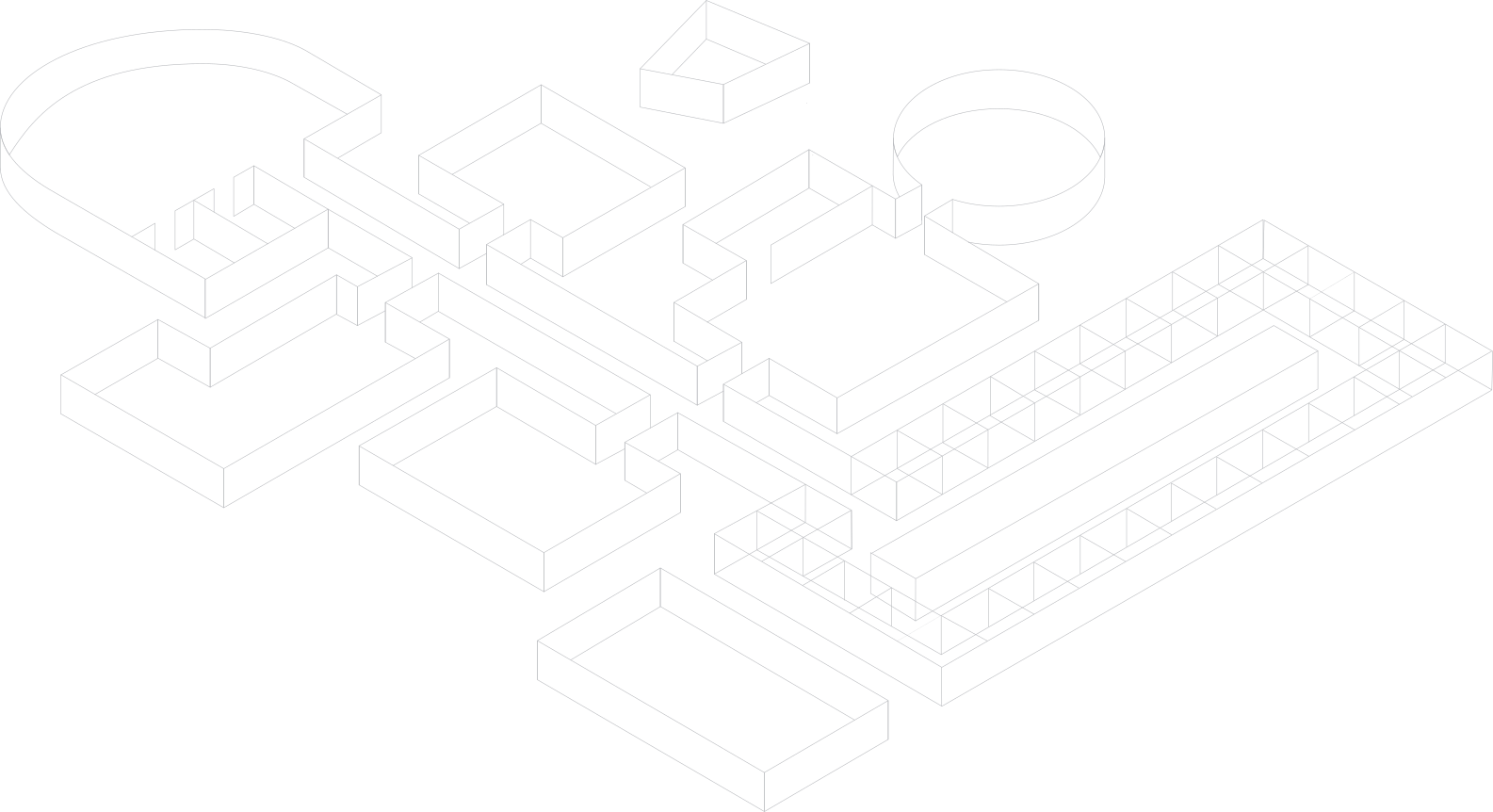
Applying Thornburg’s model to office planning fundamentally changes how space is perceived. Rather than a homogeneous landscape of desks, meeting rooms and circulation areas, the workplace becomes a composition of different spatial qualities. ‘Campfire’ situations can be found in workshop rooms, project areas, town hall zones or presentation-ready meeting rooms. Caves can be realised as focus rooms, library zones, acoustically shielded niches, or small retreat spaces. ‘Watering holes’ emerge at the social nodes of an organisation, such as central coffee and kitchen areas, open lounges, staircases designed for lingering and deliberately created transitional zones that are neither corridors nor formal meeting rooms. This shifts the central planning question from ‘How many desks do we need?’ to ‘Which situations do we want to enable?
Watering holes: Where culture becomes visible
Watering holes deserve particular attention within organisations. Many companies have found that culture, a sense of belonging and informal learning are more difficult to develop in purely digital environments. Although virtual meetings are effective for coordination and information exchange, they are not ideal for spontaneous encounters, subtle cues or building trust. In this context, the office takes on a new role – not primarily as a place of mandatory presence, but as a social resonance space. Against this backdrop, watering holes are more than just attractive design features. They act as anchor points in hybrid working environments, facilitating cross-functional connections and catalysing organisational culture. However, their quality is crucial. Simply placing a coffee machine in a corridor does not automatically create a meeting place. A space only becomes a true watering hole through a combination of spatial quality, visibility, appropriate furniture, good acoustics, and thoughtful integration into circulation paths.
Openness requires retreat
A common misconception in modern office design is that open-plan layouts alone can generate communication. In practice, however, the opposite is often observed: without adequate spaces in which to retreat, satisfaction declines and concentration suffers. Communication may shift to digital channels or external locations. Thornburg’s model highlights the importance of balance. Focusing exclusively on watering holes without providing sufficient caves can overwhelm employees. Focusing exclusively on quiet spaces can weaken social dynamics. Relying only on campfire settings primarily leads to one-directional communication formats. Effective office planning therefore requires a balance between exchange, focus, shared learning, application, and social connection, tailored to the organisation’s industry, activities, culture, and patterns of presence.
Furniture as behavioural architecture
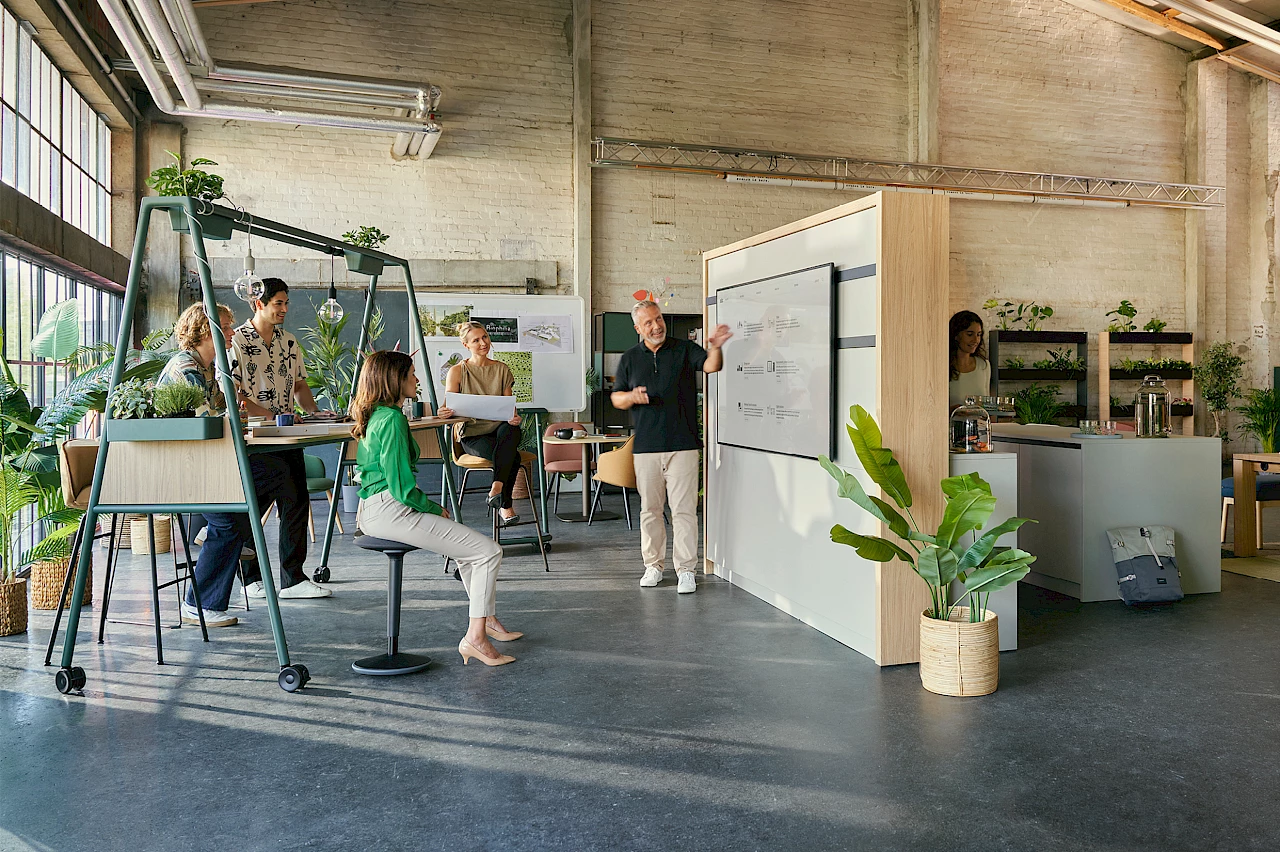
Translating Thornburg’s learning environments into workplace design also has implications for furniture. Furniture not only equips a space, but also shapes behaviour. For example, a high table encourages short, spontaneous conversations, while a sofa invites longer, more informal interactions. Acoustically shielded seating areas support confidential discussions or focused work. Mobile presentation elements facilitate informal campfire-style gatherings. Depending on its furnishing, the same floor plan can feel like a circulation zone, a meeting place or a productive focus area. Furniture thus becomes a strategic tool. It communicates the intended use of a space, lowers barriers to interaction, and translates spatial concepts into practice.
What organisations can take away
Thornburg’s model offers a practical lens through which to assess existing environments. It prompts questions such as: Where do campfire situations occur in our organisation? Do we have enough caves for focused work? Where are the genuine watering holes that connect different departments? Which spaces are still missing for effective hybrid collaboration? This perspective can help improve the quality of work experiences, particularly in the context of space reduction, organisational change or the introduction of new working models.
Conclusion: Office planning as the design of learning and work culture
Although Thornburg’s archetypes were originally developed in the context of schools and universities, they are relevant far beyond the field of education. Similar questions arise in office environments: Where is knowledge created? How is it shared? When is retreat needed, and when are visibility and interaction required? For those approaching office planning strategically, Thornburg’s model provides a valuable conceptual tool. It shifts the focus from individual workstations to a carefully balanced ecosystem of different situations. In this way, the office becomes a place of learning and a carrier of culture, as well as a social hub, gaining a new and distinct significance in the hybrid world of work.
New Work Order-Study “The Power of Space”
Published in 2022 as an ORGATEC special edition, this study explores the impact of spaces and their design. Birgit Gebhardt consolidates findings from previous New Work Order studies and expands them with perspectives on hybrid working in both urban and rural contexts. Download the study

Pre-Read New Work Order-Study “Collaboration with AI”
How is AI transforming ways of working, workplace environments and collaboration culture? What challenges arise for leadership, teams and organisational development? The New Work Order study Collaboration with AI, to be published in autumn 2026, provides insights into how organisations can harness the potential of AI and asks: are we ready for a future in which AI becomes an indispensable colleague? Download the study
Cover photo: @Sedus