

 IBA editorial team
 The ongoing discussion around climate protection, resource scarcity and new ways of working is increasingly bringing corporate building stock into focus. Office and administrative buildings, in particular, are at the centre of attention, as they are comparatively well suited to circular strategies.
But what exactly is circular construction?
The German Sustainable Building Council (DGNB) defines circular construction as an approach in which stakeholders in the construction and real estate sectors view buildings as valuable material resources, make intensive use of existing material flows and aim for long-term use within closed loops—ideally eliminating waste altogether. Key elements, according to the DGNB, include the responsible use of resources, life cycle-oriented planning, design for disassembly and recycling, and the avoidance of harmful substances. With the DGNB system for deconstruction and its circularity indices, it is now possible to systematically assess not only new buildings but also dismantling processes in terms of circularity. This highlights an important point: circular construction encompasses the entire life cycle—from initial design through refurbishment and adaptation to disassembly and reuse of components.
Circularity begins with existing buildings and early design
Recent research on European case studies shows that CO₂ emissions and primary resource consumption can be reduced most effectively when existing structures are adapted rather than replaced. While material selection and construction methods play an important role, the greatest leverage lies in early planning and design phases—where decisions can enable future adaptability, reuse and even reductions in space requirements. In professional discourse and recent practical examples, it is increasingly emphasised that circular architecture does not begin with materials, but with the brief itself. What is actually needed? What already exists? And how might future uses evolve? This perspective shifts the focus away from purely technical optimisation—such as recycling rates or carbon footprints—towards a design and planning culture that prioritises preservation, adaptability and long-term usability.
Three dimensions of circular architecture
In practice, circularity is now commonly understood as encompassing three key dimensions: constructive-technical, material-aesthetic and socio-functional. The constructive-technical dimension focuses on reversible, modular systems that can be dismantled and reused while remaining robust in everyday use. The material-aesthetic dimension explores how aged or previously used materials can be meaningfully integrated into design concepts, for example through visible patina, traces of use or exposed joints. The socio-functional dimension considers buildings as adaptable systems whose layouts and infrastructures are designed for reuse, appropriation and spatial efficiency, enabling long life cycles. These three dimensions are particularly visible in office environments—through flexible layouts, modular systems and designs that openly accommodate change.
Evidence: Office buildings as circular material banks
An analysis of 65 European projects demonstrates that circular strategies—such as preserving structural elements, reusing components and incorporating recycled materials—can significantly contribute to the decarbonisation of the built environment. In many cases, office and administrative buildings were transformed while retaining their core structures, enabling new working environments with substantially lower resource consumption than new construction. At the same time, the DGNB continues to develop quality standards and circularity indices that allow the circular performance of buildings to be systematically assessed. Projects implementing advanced circular strategies are rewarded with additional credits in DGNB certification systems—sending a clear signal to developers, investors and users that circularity measurably enhances overall building performance.
Circular strategies in corporate real estate
Reports from the European real estate sector show that circular approaches are increasingly being integrated into corporate real estate strategies. These include flexible, use-neutral spatial concepts, adaptable building envelopes and models that prioritise performance and utilisation over ownership. The advantage is clear: buildings designed for change can be more easily adapted to new working models, tenant requirements or organisational developments, allowing them to remain economically viable over longer periods. For companies, this reduces vacancy risks and creates opportunities to evolve workplaces in line with cultural and organisational change—without the need for major structural interventions.
Circularity in everyday office environments: fit-out and furniture
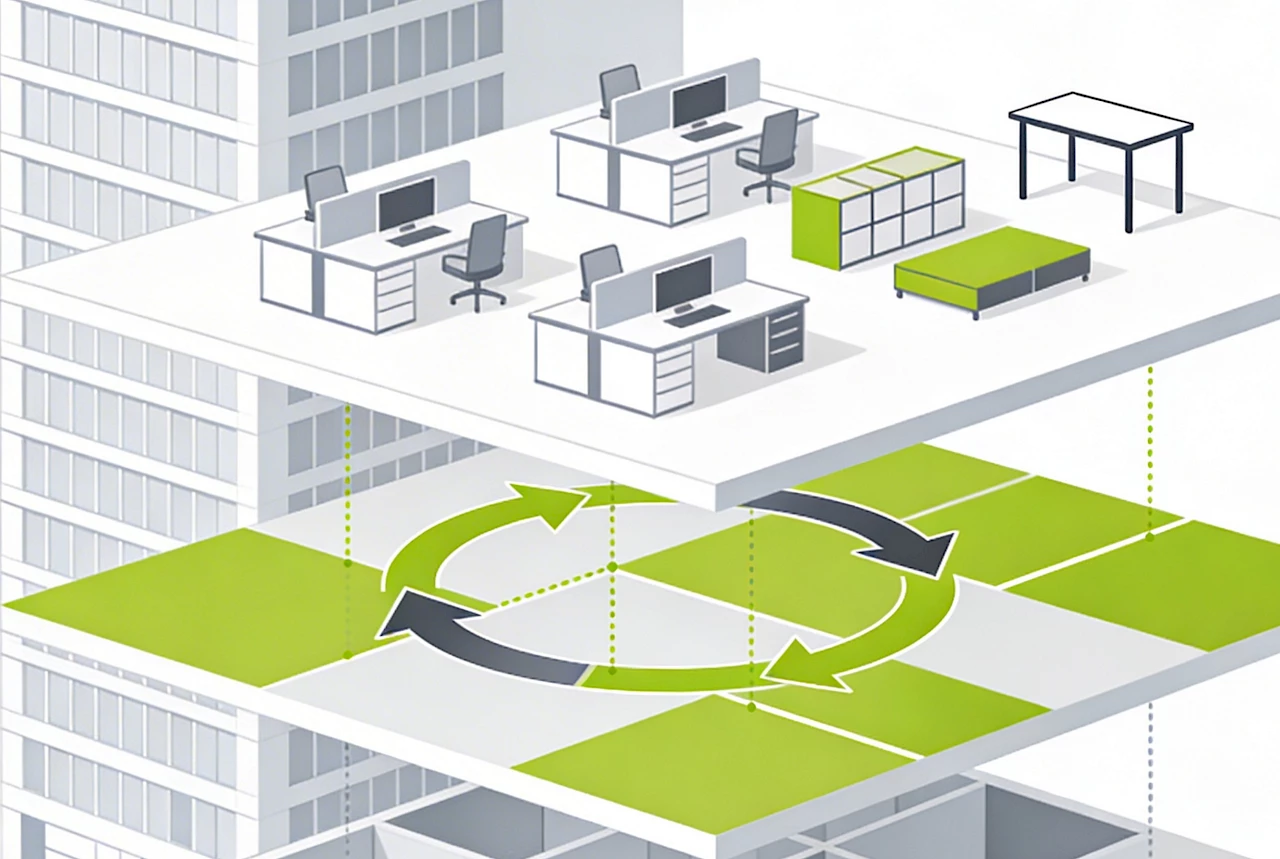
The principles of circularity become particularly tangible in office interiors. The State of the Circular Workplace report defines a circular workplace as an environment where resources are maintained at a high level of use for as long as possible and waste is minimised. This includes the reuse and refurbishment of office furniture, take-back and service models, and digital systems that track inventory and identify opportunities for reuse. In practice, this is reflected in modular, demountable interior systems and furniture that can be relocated and reconfigured multiple times. A report on circularity in the furniture sector (2017) shows that remanufacturing and reuse not only reduce demolition waste but also significantly lower the emissions embedded in furniture production. Complementing this, the DGNB has developed a dedicated certification system for interior spaces, specifically for office and administrative environments. This system evaluates projects—whether in new or existing buildings—based on criteria such as ease of disassembly, recyclability, material health, flexibility and user comfort, making the implementation of circular principles transparent even at the interior level.
Changing roles and competencies
The implementation of circular concepts is also transforming professional roles within the construction process. Designers increasingly take on tasks beyond traditional job descriptions—from sourcing and evaluating reclaimed materials to managing material flows and developing reversible construction techniques under the principle of “design for disassembly”. At the same time, early-stage planning gains importance. In a preliminary “phase zero”, stakeholders systematically assess whether new construction is necessary—or whether objectives can be better achieved through refurbishment, adaptive reuse or improved spatial efficiency. For companies, this means that circular construction is not only a technical challenge but also an organisational and cultural one. It requires new forms of collaboration between clients, planners, contractors and users, as well as a willingness to experiment and learn through pilot projects.
From concept to infrastructure: enabling second-life use of office furniture
For circular strategies to have real impact in everyday office environments, it is not enough to design products for circularity. What is equally important is the processes and infrastructures that enable materials and products to move reliably into subsequent use phases. Currently, many solutions remain fragmented. Office clearance projects are often handled ad hoc, inventories are only partially documented, and the ultimate destination of furniture is frequently unclear. Circular workplaces therefore require structured systems that enable planned reuse and establish the transition from first use to second life as a standardised, digitally supported process. Such systems must also connect the various stakeholders involved. In doing so, circularity in office furniture evolves from a conceptual ambition into a functioning infrastructure—benefiting companies, manufacturers and service providers alike, and representing a key building block on the path towards truly circular work environments.