


 IBA editorial team
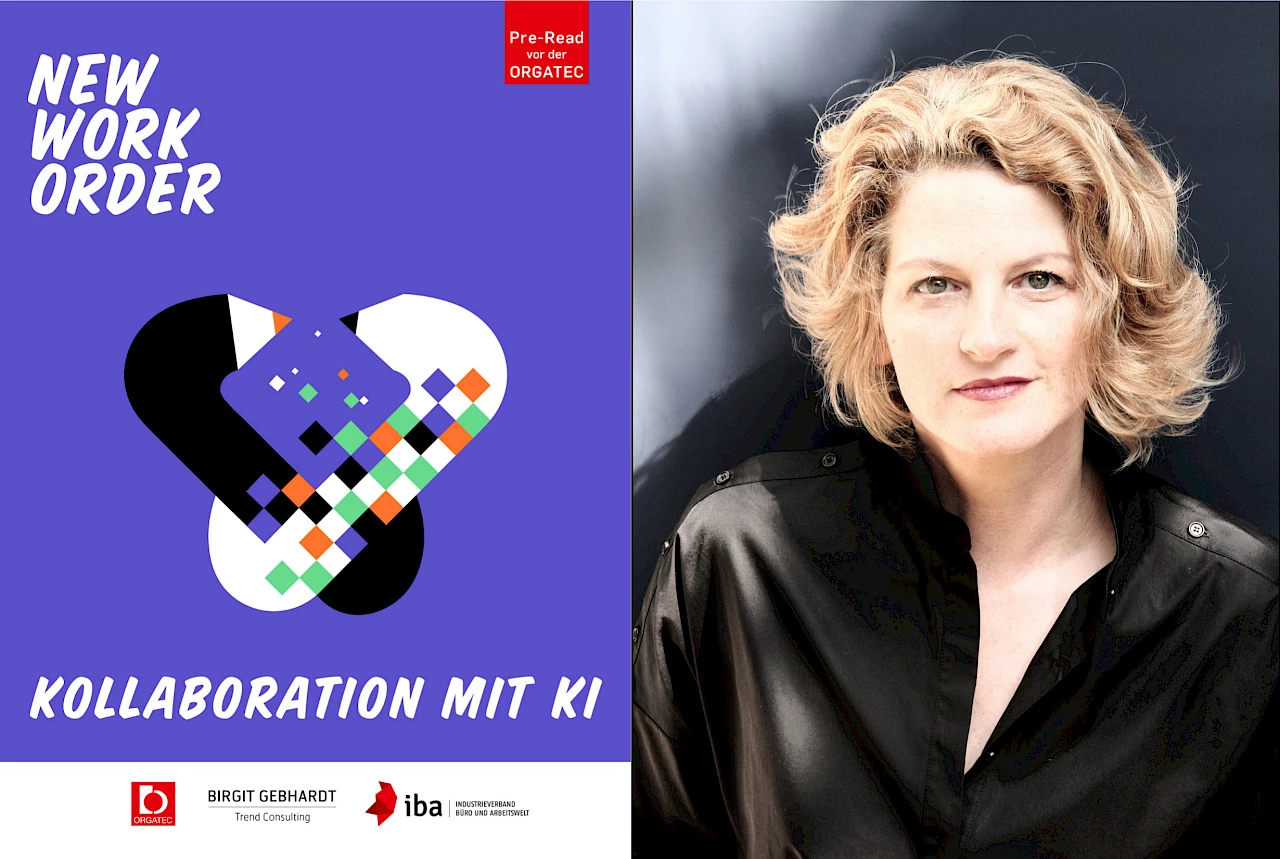
 Artificial intelligence is not only transforming tools and processes, but also reshaping how we experience space and what we need the office for today. While AI agents no longer require a physical workplace, presence, shared experience and the very reason for coming together remain central questions. In this fourth part of the pre-read, trend researcher Birgit Gebhardt focuses on the user experience of hybrid work environments and asks: what must spaces be like to enable natural and artificial intelligence to realise their full potential together?
On behalf of the German Interior Business Association (IBA), Birgit Gebhardt is currently working on the next New Work Order study, Collaboration with AI, which she will present at ORGATEC in October 2026. At the IBA Forum, she shares initial insights from research, business practice, and trend analysis, combined with pioneering real-world approaches in this pre-read edition of the study.
WHEN AI connects directly to our senses
One challenge remains unresolved: hybrid collaboration. When we talk about the qualities of the office, we mean real encounters and multisensory experiences. Yet the days when everyone is physically present are not returning. Instead, screens and mobile interfaces now bring remote participants to the table. At the same time, technology is expanding our range of interaction: headphones direct our attention within a space, and soon we will access information within our field of vision and casually interact with AI while carrying out our tasks. We are constantly connected, with our tools effectively integrated into our sensory systems. Greater user-centricity and activity-based support can only be achieved if office environments themselves become cognitively equipped to respond to our intentions (cognitive environments). To what extent will AI and adaptive sensor systems change how we collaborate? And as the scope of work expands – from digital twins and metaverses to robotics and physical AI – in which learning and experiential spaces will our natural intelligence unfold?

WHAT KIND OF UX DOES AN AI-enabled workplace offer?
Technologically, everything currently seems to be moving away from the office. While AI is entering every organisation, AI agents do not require physical spaces to collaborate with us. To understand what we will need offices for in the future, we must look at how we actually work in hybrid settings. We are already seeing tools and workplaces that create physical-digital interfaces: if today we request information via voice command while typing, tomorrow we will activate applications through eye contact. “Interaction with Windows will become so intuitive by 2030 that you can simply type, write, speak or draw – and the system will understand what you mean,” promised Pavan Davuluri, Head of Windows + Devices at Microsoft US, in 2025. In reality, AI will change the way we work faster than our current structures can adapt. So why not rethink the workplace itself? An open-plan office that is silent has failed in its purpose as a space for knowledge exchange. And if it does not succeed in integrating both those present and those joining remotely, we may achieve connectivity – but not true connection.
interaction, collaboration and shared experience remain essential
Current technologies aim for a more human-centred approach: a more natural user experience through voice, gestures, focus – even brain signals. This allows people to work in ways aligned with their social, cultural and intuitive nature. “I imagine an AI that supports me wherever I am – regardless of the tool I’m using, and in a context-sensitive way,” says Irina Chemerys, Head of Microsoft Digital Experience in Munich. At the same time, she emphasises the importance of natural intelligence: “Interaction, collaboration and shared experience are essential.” This is particularly relevant, as working with AI requires more exchange and critical reflection. Important decisions emerge through collective dialogue – and that calls for new frameworks and spaces that enable these processes of negotiation and understanding.
integrating individual and collective intelligence
People make decisions in social contexts – shaped by biography, intuition and values. With AI, a new collective reference system enters the picture: data derived from millions of individual experiences, aggregated, weighted and interconnected. This technological collective has no history, but it recognises patterns. Can we refine our perspectives by enriching them with algorithmically condensed knowledge? And how do we preserve the uniqueness of human experience in the process? Perhaps the answer lies in combining both forms of intelligence: AI as a resonance space of collective possibilities, and humans as conscious navigators with subjective depth. This allows us to make decisions that are more rational, more emotional and more socially intelligent. Through AI, traditional dichotomies such as “rational vs emotional” or “individual vs collective” become newly negotiable. The world of work, however, must learn to accommodate both. Until now, we have been trained to provide facts and figures. AI now delivers these, while we focus on training, interpretation and validation. This may mean granting emotions a more legitimate role in professional contexts – particularly when they support understanding, empathy and motivation. If AI excels at recognising patterns in data, we should focus even more on human qualities: those we experience in customer interactions, meetings, product testing – or as intuition and foresight.
Gaming as training for future work
The idea that gaming could become a new form of collaboration is more realistic than it may seem. Tools and work environments are shifting from the physical into digital realities – spaces where we already interact socially and playfully. Perhaps a new work culture is emerging from this blend of competition and social connection – one that the next generation already expects from the workplace. Around 90% of boys and 50% of girls regularly play video games. Anyone who has watched how quickly young people build entire worlds in Minecraft can imagine that creating digital twins or application environments will be second nature to them in the future. In fact, gamers already embody many of the skills required for collaboration with AI: interaction, strategy and teamwork. Professor Dr Simone Kühn, Director of the Environmental Neuroscience research area at the Max Planck Institute for Human Development, recognises the value of video game technology and its interactive design: “because it motivates and sustains concentration over long periods. I hope we can incorporate some of this into the education system, so that people are motivated to learn what is relevant for their lives.”
will we be holed up in our home offices to play video games in future?
Not necessarily. Even the more introverted gaming community thrives on interaction and seeks real-world encounters. The youth centre “Last by Schachermayer”, co-designed by Winni Ransmayr, demonstrates this: physical proximity strengthens team spirit. “Online games with many unknown players can create pressure on individuals. But when teams sit shoulder to shoulder in front of a screen, energy and cohesion increase,” says Ransmayr. To make this energy tangible, players often sit together on large foam mats, reminiscent of a gym setting. Culturally, the core remains familiar: collaboration, shared momentum, roles within a narrative – only now both physical and virtual.
what is the new reason for coming into the office?
If we assume that communication – whether with AI, agents or colleagues – will increase, then the purpose of communication must be supported by the right environment. Are we making strategic decisions? Do we need a confidential setting? Are we working on a physical product or its digital twin? Are we managing operations like a control centre, or prototyping in a factory or maker space? Are we standing in front of large screens, present physically or via avatars? Sitting in gaming chairs, meeting in digital “sandboxes”? Given this growing diversity, some of today’s “flexible” and “multi-purpose” office spaces may lose effectiveness. If AR simulations and immersive environments increasingly guide users into specific activity modes, physical workplaces must also become more intentional and experience-driven.
the office as a stage for potential
The office is becoming an enabling environment – a space where developers, customers and users can collaboratively test, refine and develop ideas, similar to a maker space with both physical and digital stations. The quality of coming together is reflected in proximity, resonance, body language – in the energy of the space. This intensity of experience must also be accessible to remote participants: through immersive interaction, as seen in gaming, or through cameras and interfaces that allow movement and direct engagement.
the office as a reality transfer space for people, processes and products
The office thus becomes not only a place of encounter, but also a stage for shifting roles, tools and contexts. It creates spaces for learning from one another, for observation and for safe experimentation. Curated by leaders who recognise and nurture individual strengths, a protected environment emerges in which teams build trust, experiment and, together with AI, take collaboration to the next level.
Ultimately, the office itself becomes intelligent: a cognitive environment that responds via sensors and AI to mood, intention and group dynamics – adjusting lighting, acoustics and climate to support concentration, creativity and recovery. The space becomes a learning organism, where humans and AI continuously exchange feedback and interaction becomes increasingly natural.
The full New Work Order study, “Collaboration with AI”, will be presented at ORGATEC 2026. The pre-read is now available as a PDF and encourages readers to re-examine routines, data flows and workspaces in order to measurably increase the value of AI for collaboration and demonstrably improve collaboration. Pre-Read-Download
Birgit Gebhardt is a trend researcher specialising in ‘the future of work’. As a thought leader, she works with think tanks and supports companies in developing agile leadership and work cultures, as well as sustainable learning programmes. Her consultancy work is underpinned by twelve years of project management experience at Trendbüro, the last five of which she spent as managing director. Further information: birgit-gebhardt.com
Cover image: Birgit Gebhardt, Illustration: Jennifer Tapias Derch