


 IBA editorial team
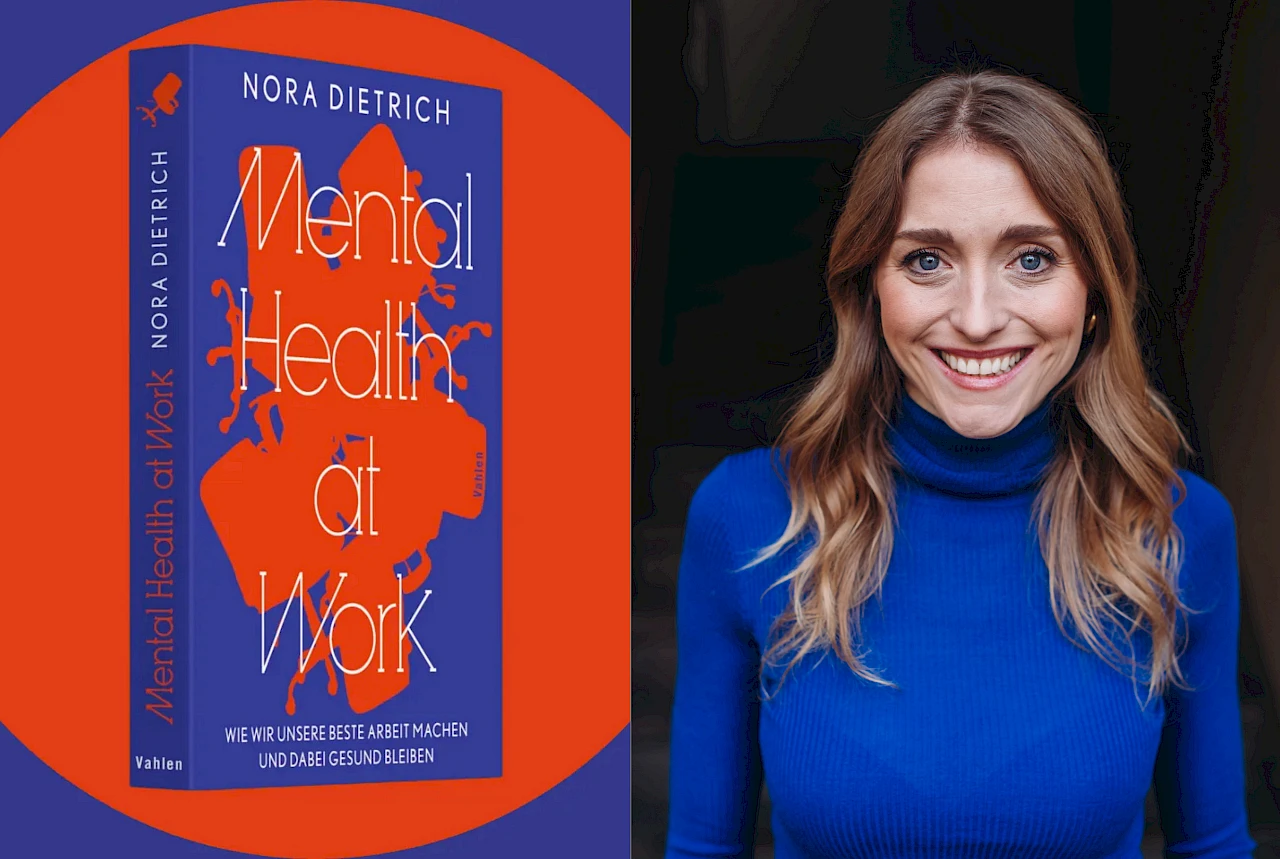
 Mental health is more prominent in organisations today than ever before. At the same time, stress, exhaustion and uncertainty continue to increase in many workplaces. Why are individual measures often not enough? And how can organisations create conditions that promote both health and performance? We spoke to psychologist and author Nora Dietrich about these questions.
Nora, since our last conversation, the world of work has continued to change. What are you currently observing when it comes to mental health in organisations? What has improved, and what has perhaps become more challenging?
The world of work is undergoing enormous change at the moment. Particularly in large organisations, I am seeing restructuring and transformation processes that bring with them tremendous uncertainty. For people, these involve very fundamental questions: Will my job still exist? Will my role change?
AI is adding a new, more subtle form of uncertainty: the Fear of Becoming Obsolete. In other words, the concern: Will the skills I have today still be relevant tomorrow? Where is my place in a world of work in which tasks and skills requirements are changing so rapidly? In many organisations, this transformation is not yet taking place within the context of a clear and well-communicated vision for the future. And it is precisely within this vacuum that a diffuse sense of anxiety emerges.
This is particularly challenging for managers. Many are themselves affected by these changes while simultaneously being expected to provide their teams with direction – often without having sufficient information themselves. They are expected to convey a sense of security in a situation in which they themselves are experiencing uncertainty.
At the same time, we are seeing a paradox: we talk about mental health more than ever before, and yet psychological strain continues to rise. The latest figures make this very clear: in the first half of 2026, sickness absence due to mental health conditions increased by nine per cent compared with the same period in the previous year. In the DAK analysis, mental health conditions were therefore the most common cause of sickness absence for the first time.
For me, this also demonstrates the limits of what we have done so far. We have invested heavily in awareness and individual initiatives, but we still address the root causes too rarely. And particularly when budgets become tighter, we tend to see a return to more reactive approaches: we support people once they are already exhausted or unable to work. Prevention needs to begin much earlier – with leadership, workloads and organisational design; with participation and decision-making autonomy; and with the question of how we support people through change.
The title of your new book is “Mental Health at Work”. What prompted you to write this book now, and what gap did you want it to fill?
I wanted to write a practical bible. A book that is scientifically grounded but does not stop at the realisation that mental health, resilience or psychological safety are important. We know that by now. The far more interesting question is: What does that actually mean at 3 pm on a Tuesday?
That is exactly where I wanted to start. Many of these supposedly “soft” topics remain surprisingly vague. We know the terminology, but we often lack practical ways of translating it into our everyday lives. That is why the book combines self-reflection with highly practical strategies and formats: What can I do myself? What can we change as a team? And what structures are needed at organisational level?
At the same time, it was important to me to bring together different generations and perspectives on work. Mental Health at Work is not intended to be a book for “those affected”. It concerns all of us, because we all bring our psychological selves to work – and because we all have an influence on how work is experienced.
And there was perhaps something else that mattered to me: taking some of the heaviness out of the subject. Mental health does not only need our attention when we are struggling. Understanding ourselves better, working together differently and shaping work more consciously can actually be enjoyable.
Many organisations have now introduced their first mental health initiatives. Where do you see genuine progress, and where do you believe there is still the greatest need for improvement?
I see genuine progress in access to support. Many organisations have now established EAPs – Employee Assistance Programmes – that provide low-threshold access in different languages and through different channels, including individual one-to-one counselling. In this way, they can at least partially close a gap in care and offer people support without them having to wait months for a therapy place.
The second major area of progress, in my view, is increasing openness, particularly at leadership level. More and more managers are talking about their own mental health, thereby giving their teams permission to address the subject as well. Role models are incredibly important gatekeepers here. It makes a difference whether an organisation simply says, “You are allowed to talk about this here”, or whether people in positions of responsibility genuinely demonstrate that vulnerability and performance are not mutually exclusive.
But for me, the greatest need for improvement begins precisely where these initiatives generate insights. Through EAPs, surveys and other formats, organisations now learn a great deal about what is placing their people under strain, where risk factors lie and which issues recur. The crucial question is: What do we do with this knowledge?
If I repeatedly see that people are struggling with a lack of direction, constant overload or certain ways of working, the answer cannot simply be another resilience training course. I have to ask what this means for our objectives, our leadership, our decision-making processes or our organisational design.
For me, this is where the next level of maturity lies: mental health must not become a do-it-yourself project for employees or remain a matter of simply treating symptoms. It needs to become a driver of systemic change.

You write about the risk of burning out while simultaneously wanting to fulfil your own potential. Why do performance and mental health still so often appear to be at odds, and how can this apparent contradiction be resolved?
There is a term for this in research that I find particularly interesting: interessierte Selbstgefährdung – deliberately putting oneself at risk in the pursuit of work-related goals. The problem is often not that we do not know our limits. We consciously exceed them because we believe that something awaits us beyond that red line which, in that moment, seems more important than our health: recognition, the next step in our career, success, impact or even work that we find particularly meaningful.
And the tricky thing is that this can work for a surprisingly long time. We can exceed our limits and still appear highly capable. But in doing so, we are effectively taking out a loan from our future selves. We are using energy that is no longer really available. And at some point, the system calls in that debt – potentially with interest.
At the same time, this is not purely an individual problem. We work within organisational cultures that are fundamentally performance-driven. Regeneration is not automatically understood as a prerequisite for good performance. What is often visible and rewarded are the overtime, the extra mile, the additional project. And when precisely this behaviour promises recognition and career opportunities, it becomes very difficult for individuals to genuinely allow themselves to set boundaries.
That is why we also need to change our understanding of performance. The crucial question is not: How can I get even more out of myself today? It is: How can I do a really good job over the long term, remain capable of learning and continue to regenerate?
In elite sport, this principle is taken for granted: excellent performance needs excellent recovery. No one would seriously expect a top athlete to train permanently at competition intensity. Yet in the world of work, that is often exactly what we do. Sustainable performance does not emerge despite recovery, but because of it.
What role do managers play in the mental health of their employees, and where does their responsibility end?
Managers are among the people who have the greatest influence on our mental health in the workplace. A frequently cited UKG study even found that employees rate their manager’s impact on their mental health as being similar to that of their partner – and greater than that of their therapist. That represents an enormous responsibility. It can be used very effectively, but it can of course also be a burden.
A great deal begins with managers’ own behaviour. How do I, as a manager, deal with stress, overload and uncertainty? How do I communicate difficult news? What behaviours do I model? And do I know my team well enough to notice changes and early warning signs in the first place?
For me, health-sensitive leadership therefore does not mean being able to diagnose mental health conditions. It means recognising when something has changed and then being able to have a good, caring conversation. And when strain becomes visible, I need a repertoire of options: Where can we specifically reduce the pressure? What can we change in terms of priorities, capacity or ways of working? And when should I refer someone to professional support?
This is precisely where the boundary is crucial: managers are not therapists. Their responsibility is to deal with the impact of strain within the work context – and with its causes when those causes lie within the work itself. For everything else, they need to know where they can refer people for further support.
At the same time, mental health is not a conversation you have once and then tick off the list. It requires follow-ups, regular check-ins and capacity checks. The recurring question is always: How are you doing right now – and what does that mean for the way we work together?
And we must not forget the managers themselves. Middle management in particular is often caught between expectations from above and the needs of their teams. Managers are expected to absorb uncertainty, translate change and remain emotionally available – while being under pressure themselves. If we want health-sensitive leadership, we therefore also need to support the people from whom we expect it.
Many employees are currently experiencing a high pace of change, driven by factors such as AI, transformation and restructuring. What helps people and organisations remain mentally healthy while continuing to perform?
We are currently seeing very high levels of perceived strain during change processes. Seventy-one per cent of employees said they felt overwhelmed by the amount of change at work. And a large German study involving more than 53,000 employees shows that people experiencing organisational change have an 82 per cent higher prevalence of poor mental health. That does not mean that change itself makes people ill. But we need to look very carefully at how we manage it.
Change is unavoidable. The crucial question is therefore not whether we can prevent change, but how we can move through it in a healthier way.
For me, this begins with our view of people. We are all familiar with the classic change curve. But people do not simply move through different phases of change according to a fixed pattern. What also matters is: What kind of future am I actually looking towards? For management, the vision of the future is often more positive and, above all, more controlled. The people involved have helped develop the change, understand the reasons behind it and experience a sense of agency. For employees, the very same change can look completely different. Initially, they experience what they are losing – a role, colleagues, routines, status or security – while having considerably less control over what is happening.
One of the most important questions in change management, therefore, is: How do we compensate for this experience of losing control?
One principle I particularly like is: Through them, not to them. Change should not simply be done to people, but, as far as possible, through and with them. That means participation wherever genuine participation is possible. But it also means transparency where participation is not possible.
This includes not simply selling the new vision of the future. We also need to talk about what is being lost, why we are nevertheless choosing this path and what business realities lie behind a decision. Acceptance does not mean agreement. People can disagree with a decision and still be better able to deal with it – and retain trust in their leaders – if they can understand how that decision was reached.
For me, therefore, the rule in times of high uncertainty is: communicate early, communicate transparently and probably communicate more than we initially think necessary. At the same time, we need to check in regularly: How are people coping with the change? What is happening within collaboration right now? Where are overload, conflict or withdrawal emerging? And where can we restore a sense of agency?
This is why I am critical of the fact that some organisations are currently cutting back on mental health initiatives, resilience programmes or change-management training for leaders. We do not need these skills less; we need them more. Managers have to guide people through situations whose outcomes they themselves may not yet know.
Uncertainty is not a problem we can completely solve. The question is how we deal with it together. Good transformation therefore does not promise certainty where none exists. It creates direction, participation and agency amid uncertainty.
If you could give organisations just one piece of advice today to strengthen their employees’ mental health sustainably, what would it be – and why?
If I could choose just one lever, I would invest in managers. To me, they are a little like the octopus of an organisation: eight arms simultaneously reaching into operations, strategy, transformation processes and the everyday experiences of people. Hardly any other role has so many points of contact – and therefore so much influence over how work is ultimately experienced.
But to achieve this, we need to allow managers to learn about mental health.
At the same time, this training cannot be a one-way street. A manager can be exceptionally well trained, but if they repeatedly hear that their team is overloaded, pass this information upwards and nothing happens, even the best caring conversation will eventually become ineffective.
So, alongside managers’ skills, organisations need to listen to what is being fed back from their teams: Where are risk factors emerging? What repeatedly overwhelms people? Which structures or ways of working are getting in the way of health? And what do we need to change as a result?
If we empower managers while at the same time taking seriously what they reflect back from the organisation, we will already have changed an incredible amount.
What role do spaces and working environments play in mental health, and what should organisations pay particular attention to when designing offices and hybrid workplaces?
Spaces have a greater influence on our mental health than we often acknowledge. They affect focus, the processing of stimuli, opportunities for retreat and social interaction. In psychology, we even talk about healing architecture: spaces can not only reduce strain, but actively support health and recovery.
With open-plan offices in particular, we can see that the original idea does not always work as intended. Greater physical proximity does not automatically mean greater connection. Systematic reviews tend instead to identify disadvantages associated with noise, distraction and a lack of privacy, including effects on stress, wellbeing and productivity.
This is particularly relevant to knowledge work. Our brains need not only collaboration, but also protected attention. If I am constantly hearing conversations or am always available to be approached, I have to use some of my cognitive energy to filter out those stimuli. For me, focus is therefore not only a productivity issue, but also a mental health issue.
That is why, in line with the research, I am a fan of activity-based workplaces – an ecosystem of spaces that suits both my preferences and the task at hand. This is particularly relevant for people experiencing mental health challenges, chronic illnesses or neurodivergence.
Hybrid working is also a major opportunity when it is based on trust. People should not be disadvantaged simply because they are less physically visible. What matters is the quality of their work, not the quantity of their presence.
At the same time, we need genuine places for people to come together – for collaboration, but also simply to spend time together without a specific purpose. Particularly as AI becomes more prevalent, we should ensure that technological proximity does not lead to artificial intimacy accompanied by simultaneous loneliness.
The crucial question, therefore, is not: How many days should we spend in the office? It is: Which activity and which human need require which space?
Nora, thank you for the interview.