



 IBA editorial team
 With the document “A Shared Vision for a Circular Furniture Industry in the Office and Contract Sector”, the German Interior Business Association (IBA), together with its members, has formulated a common understanding of how circular economy principles can be further developed within the industry. At its core are five key areas for action: material selection, product design, durability and modularity, take-back and reuse, as well as energy and transport efficiency. In an interview with the IBA Forum, Verena Anger from Bene and Iris Grzybek from Vitra explain why such a joint statement is particularly important at this moment in time, what role the IBA plays, and how companies are already putting circular principles into practice today.
Ms Grzybek, Ms Anger, the IBA has developed a “Shared Vision for a Circular Furniture Industry” together with its members. Why was it important, in your opinion, to publish such a joint statement now?
Iris Grzybek: For several years now, we have been engaged in an intensive exchange on sustainability topics within the IBA sustainability working group. Over the past two to three years in particular, this dialogue has intensified significantly. The circular economy is a very good example of a topic that cannot be meaningfully addressed in isolation by individual companies. It concerns material cycles, resource flows and product lifecycles—systems that only function if we think beyond individual company boundaries. In addition, the topic has gained considerable importance from a regulatory perspective. Against this backdrop, it made sense for us as an association to establish a shared understanding and define which aspects we can influence together.
Verena Anger: What I find especially valuable is that we have articulated a shared vision. The statement clearly indicates the direction in which we, as an industry, want to move. It is not about listing individual measures, but about taking a holistic view of sustainability and circular economy principles and advancing them collectively. We are currently experiencing a time in which many developments overlap: regulatory requirements, rising expectations from customers and public procurement, and increasing pressure to reduce emissions and resource consumption. In this context, a shared understanding across the industry is particularly important.
What role does an industry association like the IBA play in this context, and what can a shared framework achieve that individual company strategies cannot?
Verena Anger: A shared framework primarily helps to keep the urgency of the topic visible. We are currently facing many changes and uncertainties, particularly in the regulatory environment. When working on future-oriented topics within a single company, there is always a risk that they fall behind in day-to-day business. Within an association, however, the topic remains visible and firmly on the agenda. That is a very important aspect.
Iris Grzybek: At the same time, many of the challenges we face are similar. Of course, there are areas that companies must address individually, such as take-back programmes for their own products. But there are also many questions that can be tackled collaboratively: How do we define key terms? Where are the shared challenges? Which solutions can be developed across companies? Particularly in areas such as reuse, refurbishment and remanufacturing, a shared understanding is essential. The IBA provides the framework for this.
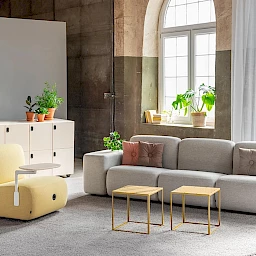
The vision identifies five key areas for action: material selection, product design, durability and modularity, take-back and reuse, and energy and transport efficiency. Looking back at the development process, what considerations shaped this selection, and what was particularly important to you personally?
Iris Grzybek: For us, a key principle was that a large proportion of a product’s environmental impact is already determined during the development phase. Many decisions made in the design process—regarding materials, construction, repairability or circularity—have long-term consequences. If a product is not designed to be repairable from the outset, disposal often remains the only option, at best recycling. From this perspective, the five areas of action emerged quite naturally. They represent the points at which crucial decisions are made throughout the entire product lifecycle.
Verena Anger: For me, it was particularly important to take a holistic view. Focusing on a single aspect is not sufficient. Circularity does not result from isolated measures, but from the interaction of multiple factors—from material selection and design to take-back and reuse. In practice, it becomes clear that progress is only made when these aspects are considered together—for example, when product design already anticipates future reuse.
The vision is deliberately formulated in an open way, without prescribing specific measures. How do you interpret this document? As a commitment, a shared language, or a framework for future decisions?
Verena Anger: For me, it is primarily a shared framework and a description of a goal. It is not about creating additional obligations, but about defining a direction and establishing a common understanding. At the same time, it provides a solid foundation for developing company-specific strategies and concrete measures.
Iris Grzybek: I see it in a similar way. The document sets out guiding principles and clarifies how we, as manufacturers in the office and contract furniture sector, understand circularity. The term is often used in very different ways. With this statement, we aim to show which dimensions we can realistically influence and what shared understanding exists within the association.

Durability, modularity and repairability are described in the statement as “long-established strengths” of the industry. Could you each give an example from your company that illustrates how these aspects are already being implemented in practice?
Iris Grzybek: At Vitra, durability has long been a core part of our identity. From a sustainability perspective, it is crucial because it reduces the need for new products and conserves resources. However, we do not see durability as something to rest on. We continuously refine our products—for example, by improving repairability or making covers replaceable. This allows products to adapt to new requirements without needing to be replaced entirely.
Verena Anger: At Bene, high quality has always been a fundamental principle. This is evident in the fact that products from the 1950s and 1960s are still in use today. Durability is therefore deeply embedded in our product culture. Modularity and user-driven repairability, however, have gained even greater importance in recent years. Requirements are evolving, and we are responding accordingly. Particularly in the context of refurbishment and second-life models, these characteristics are essential—they are the foundation for enabling multiple use cycles.
Material selection involves recycled, low-emission and socially responsible resources. Where does your company currently stand in this regard, and what challenges remain—for example in terms of availability, quality or cost?
Verena Anger: We have implemented a comprehensive procurement policy that all our suppliers must sign. This policy covers not only environmental aspects but also social criteria and biodiversity. For us, it is important to consider sustainability across the entire value chain. The United Nations Sustainable Development Goals play a key role in this. Challenges arise where materials are available but do not yet meet the required standards in terms of quality, reliability or economic feasibility.
Iris Grzybek: At Vitra, plastics are a particularly important material group. We have therefore committed to switching to recycled plastics wherever technically feasible. In recent years, we have adapted major product lines accordingly, aiming for a high proportion of post-consumer material. We are also continuously increasing recycled content in materials such as aluminium and steel. At the same time, we face limitations—for example in terms of cost or market developments such as green steel. Close collaboration with suppliers is therefore essential. We see material selection as part of our corporate responsibility and work together with partners to develop viable solutions.
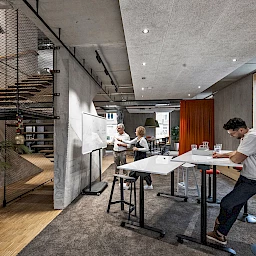
Take-back, refurbishment and reuse of furniture are key to true circularity. What models or pilot projects are Bene and Vitra currently testing in this area, and how are customers responding?
Verena Anger: At the moment, we are particularly focused on comparing the environmental impact of different models. For example, we analyse how various take-back and refurbishment approaches affect emissions—comparing local partnerships with centralised processing. Initial findings clearly show that short transport distances are a crucial factor. At the same time, we see strong interest from customers in refurbished furniture. For many, the key question is not price, but how emissions and resource use can be reduced. We are currently developing scalable refurbishment and second-life models that can be economically integrated into the market.
Iris Grzybek: We have been offering used products to end customers for several years, primarily from our own stock such as showrooms. However, the topic has evolved significantly, particularly on the business customer side. With Vitra Circle for Contract, we have established a structured offering for corporate clients based on three pillars: refurbished products in large quantities (available via a digital platform with thousands of items in stock), refurbishment services for medium to large project volumes, and take-back and buy-back options that feed into the system. In addition to resource conservation, refurbished products offer fast availability, which is particularly attractive for short-term needs. For us, circularity is no longer an initiative—it is an established business area and a core component of our sustainability strategy.
The statement highlights new developments in European standardisation and EU projects related to reuse and refurbishment. Which developments are you observing most closely, and where do you see opportunities for the industry?
Iris Grzybek: There is currently a great deal happening. The EU Green Deal and its related requirements affect us in many ways—from reporting obligations and the upcoming “Empowering Consumers” directive on green claims to digital product passports. While some developments may initially appear bureaucratic, they create greater transparency and clearer rules in the long term. From my perspective, this is fundamentally positive—for the environment, for consumers and for businesses.
Verena Anger: The Circular Economy Action Plan in 2020 was a key turning point. Since then, circularity has been discussed in much more concrete terms. New regulations and shared definitions help transform what was once an abstract concept into a practical field of action. Initiatives such as the digital product passport and clear definitions for reuse and refurbishment are particularly important, as they enable transparency and new business models.
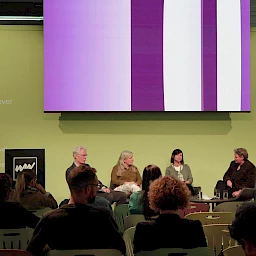
Circularity always involves collaboration beyond company boundaries. Which forms of collaboration do you consider particularly future-proof?
Verena Anger: In my view, any form of collaboration is future-proof if committed individuals pursue a shared vision. I have seen both unsuccessful projects and highly impactful collaborations. The decisive factor is not the format, but the level of commitment and shared purpose.
Iris Grzybek: I agree. Real progress happens where there is a shared understanding and common goals. That is the strength of such collaborative formats.
What advice would you give to planners and procurers who want to integrate circular principles into tenders?
Verena Anger: My advice would be: be bold. Ambitious requirements create constructive pressure on manufacturers and often accelerate innovation. Clear criteria can be very effective.
Iris Grzybek: I would add that it is important to remain open to different solutions. In this field, there are rarely black-and-white answers. There are often valid reasons why certain requirements cannot be met exactly as specified—but alternative solutions may still be effective. Dialogue with suppliers is therefore essential to develop practical and sustainable solutions.
Ms Anger, Ms Grzybek, thank you for the interview.