


 Rebecca Blach
 The Digital Product Passport (DPP) is set to become a mandatory requirement under the EU’s Ecodesign for Sustainable Products Regulation (ESPR) for products placed on the European market. The first sectors affected will be batteries and textiles, followed by furniture. The EU’s objective is clear: to conserve natural resources, reduce harmful substances and promote a climate-friendly economy based on the principles of the circular economy. Within this framework, the Digital Product Passport is regarded as a key enabler of the transition.
The consequence is significant: in the coming years, it will no longer be possible to market components or furniture products within the EU without a DPP – often summarised as “no data, no market”. For many companies, the topic still appears abstract and primarily regulatory in nature. In reality, however, the DPP offers far more than new compliance obligations. It has the potential to become a strategic tool that advances digitalisation in supply-chain and quality management, improves operational efficiency and enables entirely new business models and customer services.
As part of the R‑evolve project, the team at Darmstadt University of Applied Sciences has developed the Factsheet „The Digital Product Passport in the Furniture Sector“, which summarises the regulatory requirements and highlights the opportunities and benefits associated with the DPP. This article provides an introduction to the topic and outlines the key issues companies should already be addressing today.
What will become mandatory under the ESPR?
At European level, the ESPR is a central pillar of the Green Deal. Alongside broader sustainability objectives, the EU’s Circular Economy Action Plan (2020), the Clean Industrial Deal and the Single Market Strategy (2025) also aim to reduce Europe’s dependence on raw materials, develop new markets and strengthen competitiveness.. The ESPR seeks to make sustainable products the norm across the European Single Market. In the future, products are expected to be more durable, repairable, resource-efficient and free from harmful substances. The data contained within the DPP will make these characteristics transparent and verifiable.

The specific requirements for furniture will be defined in a dedicated product-specific Delegated Act. Article 5 of the ESPR already outlines the product characteristics likely to be relevant, including:
- Durability and reliability
- Repairability and maintainability
- Reusability and upgradeability
- Material composition and recyclability
- Presence of substances of concern
- Environmental and climate impacts
For furniture manufacturers, this represents a fundamental shift. Sustainability information will no longer be voluntary but increasingly a prerequisite for access to the European market. Importantly, the ESPR applies not only to finished products but also to components. Companies must therefore begin examining their supply chains and establishing structured data flows at an early stage.

What role will the DPP play?
Within the ESPR framework, the DPP serves as the central mechanism for exchanging product-related information across the value chain. The European Commission sees the DPP not merely as a repository of information, but as a digital infrastructure supporting a more circular and data-driven product economy. By standardising data structures, product information can be collected, exchanged and processed automatically. Once established, this common framework can strengthen quality management and supply chain management while enabling innovative companies to develop new differentiators and business opportunities.
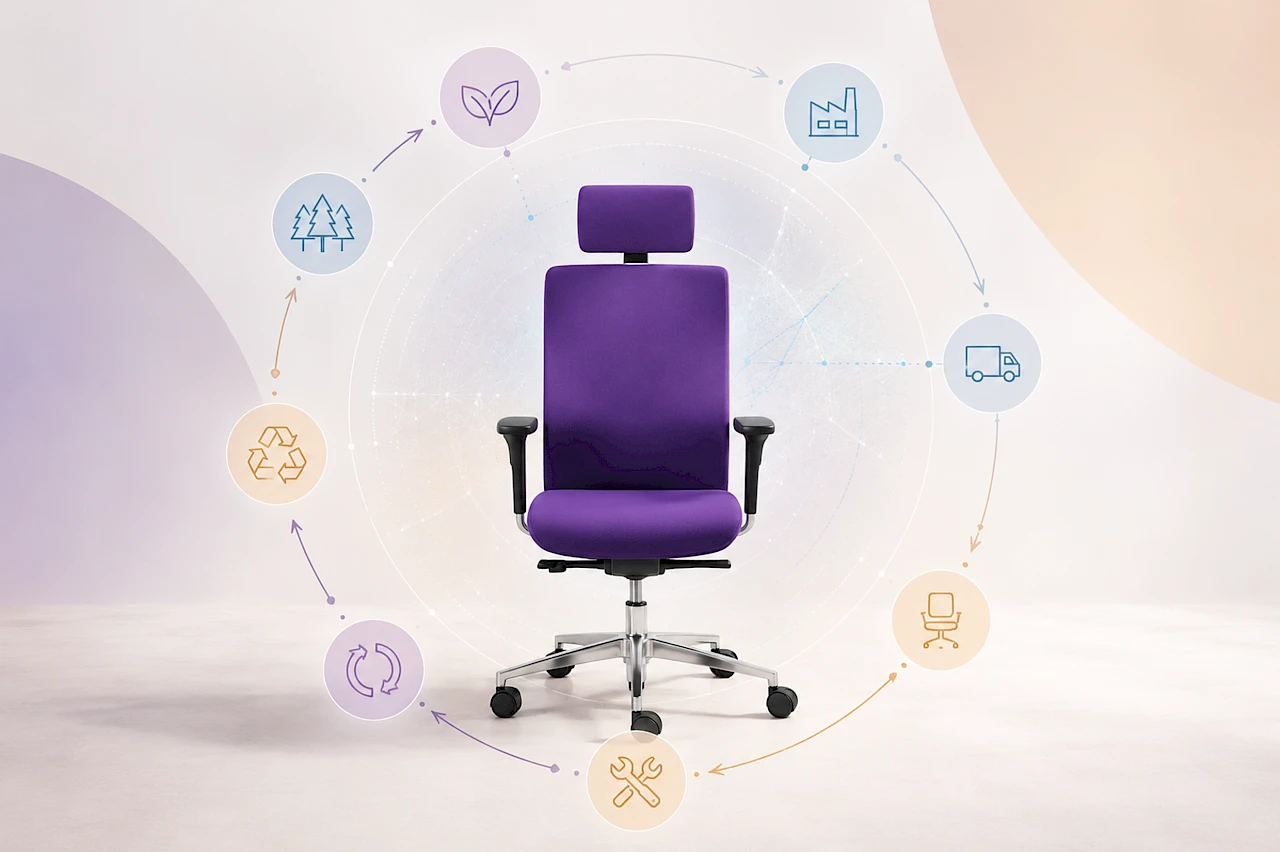
The DPP makes information available throughout a product’s entire lifecycle – from raw materials and component manufacturing to use, maintenance, repair, reuse and recycling. Different stakeholders will gain access to the information relevant to them through a tiered “need-to-know” access model.
For furniture manufacturers, the DPP may in future provide information on material composition, components, spare parts and repair instructions. This will make products easier to repair, maintain, reuse and recycle. Environmental claims and footprint information will also need to be substantiated through verifiable DPP data.
At the same time, the DPP standardises and digitises the exchange of product information throughout the supply chain. Sustainability and product data that are currently requested manually or managed across multiple systems can be made available much more efficiently. Looking ahead, the DPP is expected to capture not only static product information but the entire lifecycle history of a product.

What strategic and operational opportunities does the DPP offer furniture companies?
While many businesses still view the DPP primarily as a regulatory challenge, its true potential extends far beyond compliance. Companies that begin adapting their data structures and processes early can gain significant strategic advantages.
One major benefit lies in the more efficient management of supply chains. The standardisation associated with the DPP significantly reduces the effort required to manage product and sustainability data. Information can be exchanged automatically throughout the supply chain, ensuring consistency and accuracy. This is particularly valuable for furniture manufacturers with complex supplier networks. At the same time, it improves traceability and supports quality management processes.
The DPP also creates new opportunities for service-oriented business models. When information about spare parts, compatible components and maintenance procedures is digitally available, repair, maintenance and refurbishment services can be offered more efficiently and in a more customer-centric manner. This creates additional opportunities for spare parts management, maintenance contracts and second-life offerings. Particularly within the office furniture sector, such services can strengthen customer relationships and generate new revenue streams.
Circular business models, including leasing and Furniture-as-a-Service concepts, also benefit from improved digital traceability and condition monitoring. In this way, the DPP can become an important enabler of the circular economy by encouraging manufacturers to design products from the outset for repair, reuse, refurbishment and recycling.
Transparency itself is becoming a competitive advantage. Furniture manufacturers that can provide reliable information on material use, product quality and environmental performance build trust among customers, public procurers and business partners. The DPP therefore supports not only regulatory compliance but also serves as a proof point for quality and sustainability.

What can furniture companies do right now if they want to benefit from data exchange via the DPP?
Many organisations already possess large amounts of relevant information. The challenge is that this data is often fragmented, non-standardised and difficult to access. The first step is therefore to engage suppliers early. Since much of the information required for the DPP originates within the supply chain, companies should clarify as soon as possible which data will be needed in future and how these data can be provided automatically. For small and medium-sized enterprises in particular, the development of shared industry standards will be crucial.
Internal systems should also be prepared in good time. ERP, PIM and PLM systems must be capable of processing and linking structured product data automatically. The integration of product, material and sustainability information with lifecycle data will become increasingly important.
In addition, furniture manufacturers should view the DPP not merely as a compliance requirement but as an opportunity to identify new business potential. Companies that gain experience early and develop data-driven services can secure valuable competitive advantages.
The DPP as the starting point for digital transformation
The Digital Product Passport is far more than a regulatory data system. Used strategically, it forms the foundation of a circular and increasingly data-driven furniture industry. Furniture manufacturers that start building data structures, integrating supply-chain data and developing new business models today will not only be able to meet future regulatory requirements. They will also strengthen their competitiveness in the long term.
The coming years will be decisive. The DPP will not only become relevant once it is mandatory — the real preparation begins today.

Rebecca Blach studied Industrial Engineering (B.Sc.) at Karlsruhe University of Applied Sciences and the Universidad de Vigo in Spain. In 2020, she completed the Master’s programme in Risk Assessment and Sustainability Management (RASUM) at Darmstadt University of Applied Sciences. The programme focuses on proactive risk and sustainability management and organisational transformation processes. Since 2018, she has worked as a research associate at the Research Group for Institutional Analysis (sofia) at Darmstadt University of Applied Sciences, including within the R‑evolve project, which aims to advance the circular economy in the European furniture industry. Since 2024, she has been pursuing a PhD on the topic of governance for the Digital Product Passport in the furniture sector. Her research focuses on how the DPP must be designed to support circular business models while contributing to the objectives of the European Green Deal. Particular attention is paid to company processes, value-chain collaboration and the regulatory framework required for successful implementation. Further information: https://itp.h‑da.de/team/rebecca-blach
Cover photo: AI-generated using the product image of the Dauphin sim‑o task chair with headrest.