


 IBA editorial team
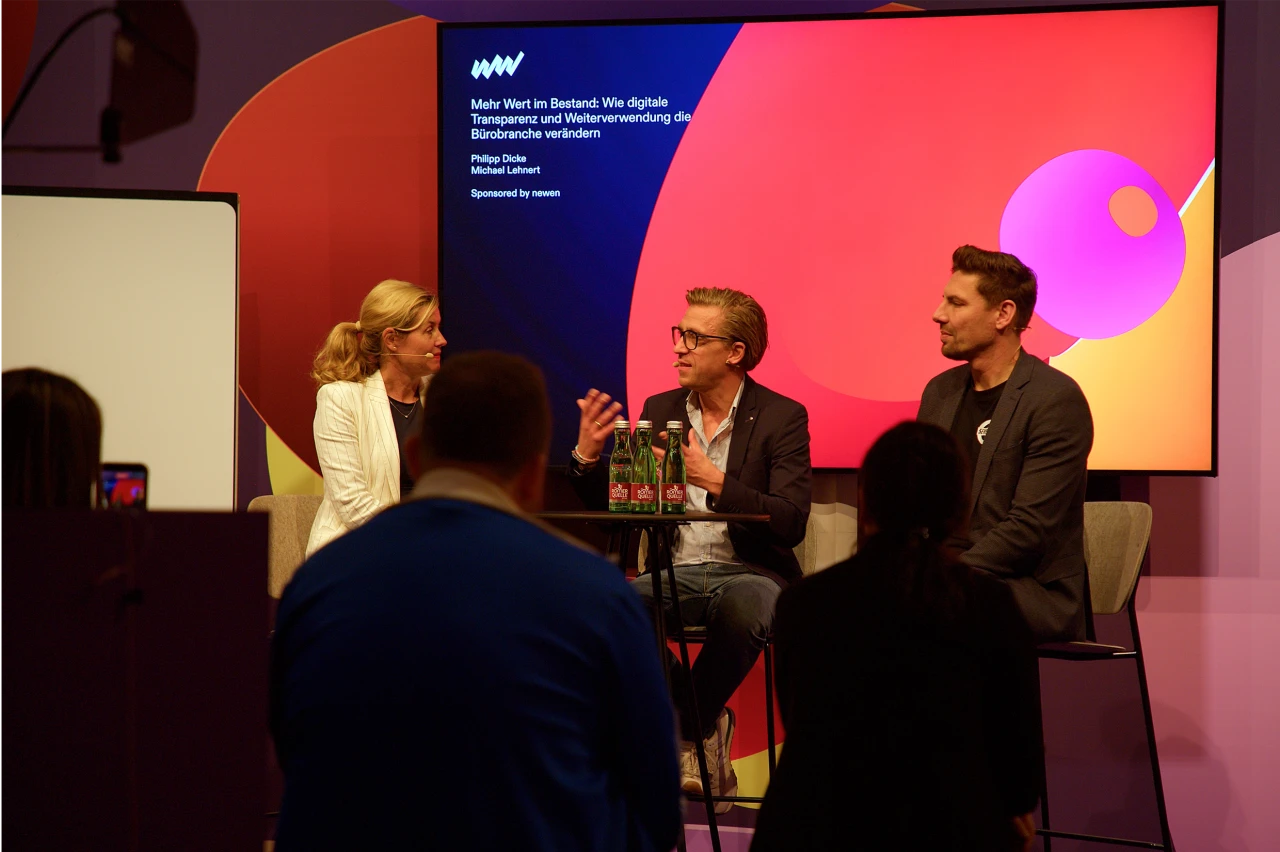
What happens to office furniture when companies relocate, redesign their workspaces or close sites? Often, they lack even a basic overview of what they own. At Wherever Whenever – Work Culture Festival, newen Director Philipp Dicke and seventhings CEO Michael Lehnert demonstrated how digital inventory management, artificial intelligence and new business models can make it easier to reuse office furniture and equipment.
A company relocates, downsizes its office space or introduces a new workplace concept. Desks, office chairs, cabinets and other furnishings are left behind. Many are still fully functional. Yet they often end up in storage or are disposed of. Not necessarily because they have lost their value, but because essential information is missing: What furniture is actually available? What condition is it in? And who could make use of it? This is precisely where the collaboration between the digital platform newen and the technology company seventhings comes in. At Wherever Whenever – Work Culture Festival 2026, newen Director Philipp Dicke and seventhings CEO Michael Lehnert, discussed how data and new value creation models can help extend the useful life of existing office furniture and equipment. The discussion was moderated by Nicola Bramkamp.
Companies often do not know what they own
Transparency is the foundation of any reuse strategy. Yet this is precisely what is often lacking. While companies record the purchase value of their office furniture and equipment in their accounting systems, they frequently have little information about their actual inventory, the location of individual items or their condition. This is where seventhings comes in. The company specialises in the digital recording and management of inventories. Using an app and artificial intelligence, furniture and equipment can be recorded, measured and matched to product catalogues while walking through office spaces. Additional information about their condition can also be stored. A process that previously involved considerable manual effort can thus be made significantly easier and faster. The resulting data provides the basis for reusing furniture within a company or returning it to a new cycle of use. After all, existing office furniture and equipment are not just a sustainability issue; they also represent economic value. Particularly for companies with multiple locations, transparent inventory data can help make better use of existing resources rather than purchasing new products.
Turning used furniture into new value
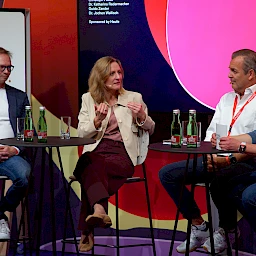
While seventhings provides digital transparency, newen brings suppliers and potential buyers together. The B2B platform, which is closely connected to the German Interior Business Association (IBA) and its industry network, facilitates the return of used office and contract furniture to the original manufacturers and their professional refurbishment partners. What makes the model distinctive is that newen itself neither stores nor physically refurbishes the furniture. Instead, the platform focuses on data-driven matching and coordination. Manufacturers can take back suitable products, refurbish them professionally and bring them back onto the market. This creates a business model that complements the traditional linear value chain in the office furniture industry. Rather than discarding furniture after its first period of use, the aim is to keep it in circulation for as long as possible. The IBA network plays an important role in this process. It provides access to manufacturers who know their products and their technical characteristics in detail. This expertise is essential when high-quality office furniture is to be professionally refurbished.
A second life – with verified quality
An office chair that has been in use for many years is not necessarily at the end of its useful life. High-quality materials, durable construction and the ability to replace individual components provide a sound basis for continued use. But how can companies ensure that professionally refurbished furniture still meets the necessary standards of quality, safety and functionality when it reaches its next user? This was the question Nicola Bramkamp raised at the Work Culture Festival. After all, refurbishment only makes sense if the original quality is maintained. To address this challenge, the IBA and TÜV Rheinland jointly developed the newen verified label. The standard underpinning the label defines requirements for the professional refurbishment of high-quality used office and contract furniture. The process includes preparation, cleaning, inspection, maintenance and, where necessary, repairs. Original spare parts are used, while TÜV Rheinland LGA Products GmbH independently verifies compliance with the specified requirements. The aim is to make professional refurbishment transparent and build confidence in the quality of reused products. After all, a second life is only a convincing alternative to buying new furniture if the quality is right.
Circular economy must also be economically viable
The discussion at the Work Culture Festival also made it clear that a circular economy does not automatically mean that every piece of furniture will enjoy a second life. Alongside condition and quality, demand and economic considerations are crucial. While high-quality swivel office chairs can often be refurbished successfully, other products present greater challenges. Traditional mobile pedestals, for example, are no longer in high demand in many modern office concepts. Similarly, with non-height-adjustable desks, the question arises as to whether and how they can be reused in an economically viable way. Logistics are another factor. Collecting, inspecting and refurbishing individual items of furniture is labour-intensive. Larger quantities, by contrast, make commercially viable processes easier to achieve. During the discussion, Philipp Dicke suggested around 25 items as a guideline for a worthwhile collection. Expectations around pricing also need to change. Professionally refurbished office furniture is not necessarily significantly cheaper than new products. High-quality refurbishment, original spare parts and quality assurance all come at a cost. Its added value therefore lies not solely in the price, but also in extending the use of existing resources and potentially avoiding the costs of new purchases and disposal.
Data as key to new business models
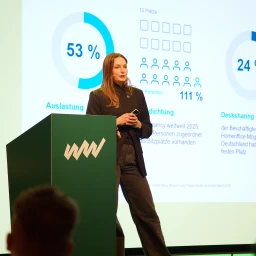
The potential of digital inventory management extends beyond finding new users for furniture that is no longer needed. In future, companies could identify at an early stage which products are available at which locations and when they might become suitable for alternative uses. This would allow supply and demand to be matched more effectively – potentially even before furniture is taken out of its current use. For the office furniture industry, this opens up new opportunities. Manufacturers can develop additional services and business models around take-back, refurbishment and resale. Companies gain greater flexibility in using their furniture and equipment while conserving resources. And digitalisation can help simplify reuse processes that have often been complex and time-consuming.
If the PR fairy granted three wishes …
But how can an entire industry be encouraged to embrace new approaches to the circular economy? At Wherever Whenever – Work Culture Festival, moderator Nicola Bramkamp approached this question with a touch of humour. Suppose a PR fairy appeared and offered three options: the German Sustainability Award, an article in DB Magazine or a feature in Harvard Business Manager. Which would the two speakers choose? Philipp Dicke and Michael Lehnert agreed: the feature in Harvard Business Manager. Their reasoning was clear. Establishing new business models in the office furniture industry requires more than winning over employees and industry specialists. The key is to reach senior management, where investment decisions are made and the direction of future procurement and usage models is determined. Philipp Dicke, however, had a fourth wish: influential individuals who would publicly champion such changes and lend them credibility. Because alongside technology and economic arguments, trust is essential.
The future starts with what we already have
The potential of this approach also became apparent in Nicola Bramkamp’s closing question: Where did the two speakers see their companies in 2035? While Philipp Dicke wants to drive newen’s international expansion, Michael Lehnert is focused on a fundamental prerequisite: greater transparency about existing resources. His vision is to have at least half of the total inventory digitally recorded by then. Whether and to what extent these ambitions can be realised remains to be seen. What is clear, however, is that the better companies understand the furniture and equipment they already own, the greater their opportunities to use these assets for longer and more economically. This brings the discussion full circle to its opening question: What happens to office furniture that is no longer needed? Ideally, it will neither sit unused in storage for years nor be disposed of. Instead, thanks to digital transparency, professional refurbishment and new business models, it will find its way back into the world of work.
Philipp Dicke is an entrepreneur and co-founder of newen, the IBA Used Platform. A B2B initiative for circular business models and reuse structures in the office and property sectors. He brings more than 15 years of experience as a managing director, executive and consultant, supporting growth-oriented and transformation-driven organisations. Throughout his career, he has guided companies through phases of expansion, restructuring and strategic repositioning, with a focus on strategy, go-to-market, organisational development and leadership. His approach combines entrepreneurial responsibility with hands-on operational execution. A significant part of his experience stems from the office furniture, workplace and commercial interiors industry. He has an in-depth understanding of the sector’s structures and dynamics, from manufacturers and distributors to project business and collaboration with planners and architects. Today, this expertise forms the foundation of his work in developing future-proof, sustainable concepts for circular use. His perspective combines deep market knowledge, organisational expertise and a commitment to making sustainability both practical and economically viable.
Michael Lehnert has been exploring how technology can help companies use resources more intelligently and sustainably for more than 15 years. He gained extensive experience with future technologies such as the Internet of Things (IoT) and Artificial Intelligence (AI) in senior roles at international technology companies, where he led complex digital transformation projects for organizations including HeidelbergCement and EnBW. At the same time, he began focusing early on sustainable business models, ranging from renewable energy to urban green-tech solutions. Today, Michael Lehnert is CEO of seventhings, a leading European platform for digital and circular asset management. seventhings creates transparency around the physical resources within organizations, how they are used, and how furniture, IT equipment and other assets can be kept in circulation for longer. In his work, Michael Lehnert brings together two major transformations of our time: digitalization and the circular economy. His focus is on how data, AI and intelligent software can turn corporate inventory into a strategic resource — helping organizations reduce costs, resource consumption and carbon emissions.
Cover photo: Simon Baucks
