


 IBA editorial team
What brings people back to the office? An attendance mandate alone certainly won’t do the trick. At the Wherever Whenever – Work Culture Festival 2026, Amelie Marie Fischer and Dr Ann Sophie Lauterbach explained why modern office design requires more than attractive spaces and flexible workplace concepts. Drawing on current research, Fischer and Lauterbach advocated a socially informed approach to spatial design that considers people, ways of working and leadership together.
Five days in the office, but not enough desks. When Amazon announced in September 2024 that its employees would be required to return to the office five days a week from January 2025, the decision did more than cause dissatisfaction among staff. At several US locations, a very practical problem soon emerged: there were not enough workstations or parking spaces. Employees had to find somewhere to sit, only to spend much of their time attending video conferences on their own. Amelie Marie Fischer of the Future of Work Lab at the University of Konstanz and Dr Ann Sophie Lauterbach, an organisational psychologist at Dresden University of Technology, used this example to open their presentation, “Social Thinking about Space: From Office to Connection”, at the Wherever Whenever – Work Culture Festival at ORGATEC 2026. For the two researchers, the case highlights a fundamental problem: viewing the return to the office solely in terms of attendance days and space capacity misses the bigger picture. What matters is the added value of working together on site and how physical spaces, working practices and social relationships interact.
The office must once again prove its value
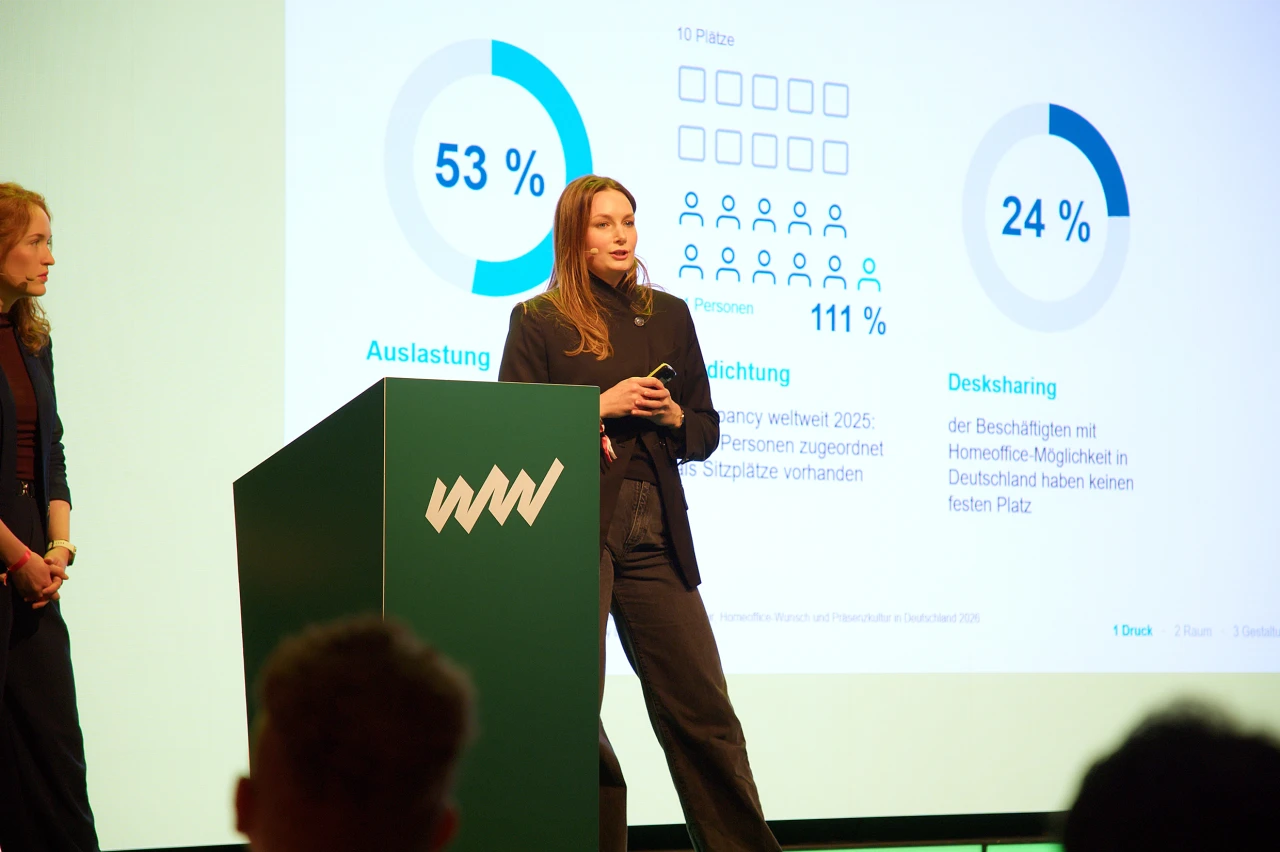
Current research findings show that the office is under pressure. According to international data from CBRE presented during the session, average office occupancy reached 53% in 2025. At the same time, office space is being used more intensively: globally, there were approximately eleven employees for every ten workstations. Working environments are changing in Germany, too. A study by the University of Konstanz found that 24% of employees who have the option of working from home no longer have an assigned desk in the office. Meanwhile, 46% reported that their offices had been refurbished or redesigned within the past five years. Yet new workplace concepts alone are not enough to encourage employees to return. For many people, working from home has become an established part of their working lives. The Konstanz Working from Home Study found that 75% of respondents would prefer a hybrid working model. Only 6% wanted to work exclusively from the office, while 19% preferred to work entirely from home. For 2026, respondents indicated that they would ideally like to work from home for an average of 2.78 days per week, compared with the 1.85 days they currently work from home. These findings do not support the widespread assumption that employees simply no longer want to come into the office. Rather, most want to combine the advantages of both working environments.
Why mandatory office attendance is rarely the answer
Calls for greater office attendance often come from senior management. However, the differences between managers and employees are smaller than the public debate might suggest. According to the Konstanz data, 25% of managers favour stricter office attendance requirements, compared with 18% of employees without managerial responsibilities. What is particularly interesting is what drives this preference for greater physical presence. The research presented by Fischer suggests that this preference is associated with coordination and communication difficulties, as well as a perceived decline in employees’ identification with their organisation. Managers who have received training in hybrid leadership, by contrast, are less likely to favour stricter attendance requirements. The impact of such policies is also sobering. International studies have found no significant improvements in key financial performance indicators following mandatory return-to-office policies. Instead, they have identified negative associations with employee satisfaction and retention. For Fischer and Lauterbach, the conclusion is clear: organisations seeking to make the office more attractive should focus first on the quality of collaboration on site rather than on imposing attendance requirements.
From workplace to social space
So what makes an office a good place to work? The two researchers also put this question to the audience. Responses included the ability to choose a suitable workspace depending on the task at hand, as well as a pleasant atmosphere shaped not only by design but also by the people using the space. This is precisely where socially informed spatial thinking comes in. An office is more than its floor space, furniture and acoustics. It is also shaped by working patterns, shared routines, relationships and leadership. Fischer and Lauterbach identified three key dimensions: Purpose, Orientation and Connection. Purpose addresses the reason for coming together: Why do people need to meet in person? Orientation concerns clarity about when, how and for what purposes spaces are used. Connection focuses on relationships: Who should employees encounter, which connections do organisations want to encourage, and what makes these interactions valuable? Connection in particular is often underestimated. Simply being present in the same office does not necessarily lead to collaboration. Physical proximity does not automatically generate interaction. And even when people engage in conversation, this does not necessarily result in joint activities or new ideas. Creating meaningful encounters requires appropriate reasons to come together, coordinated working practices and a culture that actively supports human connection.
Spaces for interaction – and for concentration
A closer look at existing office environments reveals that these conditions are far from universal. According to the Konstanz data presented during the session, 35% of surveyed employees have no dedicated spaces for informal encounters or interaction in their offices. At the same time, many people still value a private, personal workspace. The study found that employees working in open-plan offices would prefer significantly more days working from home than those with a private office. Desk sharing is also associated with a stronger preference for working from home. This offers an important lesson for office planning: spaces designed for interaction alone do not make an office attractive. Areas for retreat, privacy and suitable conditions for focused work are equally important. The challenge, therefore, is to balance different tasks and needs. An office should encourage informal contact and collaboration across teams while also providing opportunities for uninterrupted individual work.
Leadership and workplace culture cannot simply be designed into a space
Whether a new workplace concept succeeds depends on more than its physical design. Leadership plays a crucial role. According to a Swedish longitudinal study presented during the session, employees perceived their managers as less relationship-oriented after moving into activity-based offices. Familiar opportunities for contact and established routines can be lost when new spatial concepts are introduced without consciously adapting working practices. For Lauterbach and Fischer, this means that spatial transformation always involves changes to collaboration and organisational culture. Managers therefore need to be involved at an early stage and prepared for the new demands this creates. This includes working with their teams to establish what forms of communication are needed, where confidential conversations can take place and how regular interaction should be organised. It is equally important to involve employees in designing and testing new working environments. The more flexibly an office is intended to be used, the more guidance and clarity its users need.
Shared rhythms instead of rigid rules
The researchers illustrated what this might look like in practice with the example of a jointly agreed team day. Rather than simply requiring everyone to come into the office on a particular weekday, the day could follow a meaningful structure: focused individual work in the morning, a shared lunch to encourage informal interaction and collaborative tasks in the afternoon. Such a model combines physical spaces with coordinated schedules and opportunities for social interaction. Crucially, these arrangements should be developed collaboratively and reflect the team’s actual needs. This places specific responsibilities on organisations, managers and the office furniture industry. Managers should actively coordinate collaboration and nurture relationships. HR and organisational development teams need to support change processes and involve employees. Facility managers, workplace designers and manufacturers, meanwhile, should provide not only open spaces for interaction but also areas for concentration and privacy, alongside clear guidance on how different spaces are intended to be used. The success of an office concept should therefore not be measured solely by occupancy rates. Equally important is how employees experience their working environment and whether it genuinely improves collaboration.
At the end of their presentation, Fischer and Lauterbach returned to their three opening questions: Why do we come together? How do we provide orientation? And what kinds of encounters do we want to encourage? They summed up their central message in a single sentence that could also serve as a guiding principle for the design of future workplaces: “Attendance can be mandated. Meaningful encounters must be created.”
Dr Ann Sophie Lauterbach is an expert in evidence-based workplace design. As a researcher at Dresden University of Technology, she works with partners in the field to design sustainable, healthy, and inclusive working environments—based on scientific principles, participatory approaches, and an eye for the often underestimated details of organizational change. Her work combines insights from organizational psychology, architecture, and management research and highlights how workplace design has a lasting impact on motivation, collaboration, and health. She publishes in practical formats such as the Journal of Leadership and Organization and PERSONALquarterly (Haufe). Together with Amelie Fischer, she also writes the IBA column “Die Raumdenkerinnen” (The Space Thinkers), in which she presents scientific findings in an understandable and practical way. Further information: https://www.linkedin.com/in/ann-sophie-lauterbach/
Amelie Marie Fischer is a PhD researcher and management consultant specializing in organisational culture and transformation. As an engaged scholar at the Future of Work Lab at the University of Konstanz, she researches sustainable working methods and environments. Amelie combines her interdisciplinary academic knowledge with practical experience in politics, SMEs, and consulting. As a project manager and agile coach, she is involved in international cultural, transformation, and technology projects. Her passion lies in linking research and practice to break down dysfunctional patterns in organisations. Further information: https://www.linkedin.com/in/amelie-fischer/
Cover photo: Simon Baucks
