


 IBA editorial team
Longer working hours are being proposed as a way to stimulate the economy and tackle the shortage of skilled workers. But is working more really the answer? At the Wherever Whenever – Work Culture Festival, three experts discussed why businesses cannot solve their productivity problems simply by increasing working hours, and the role that flexible working models, leadership and the right working environment can play.
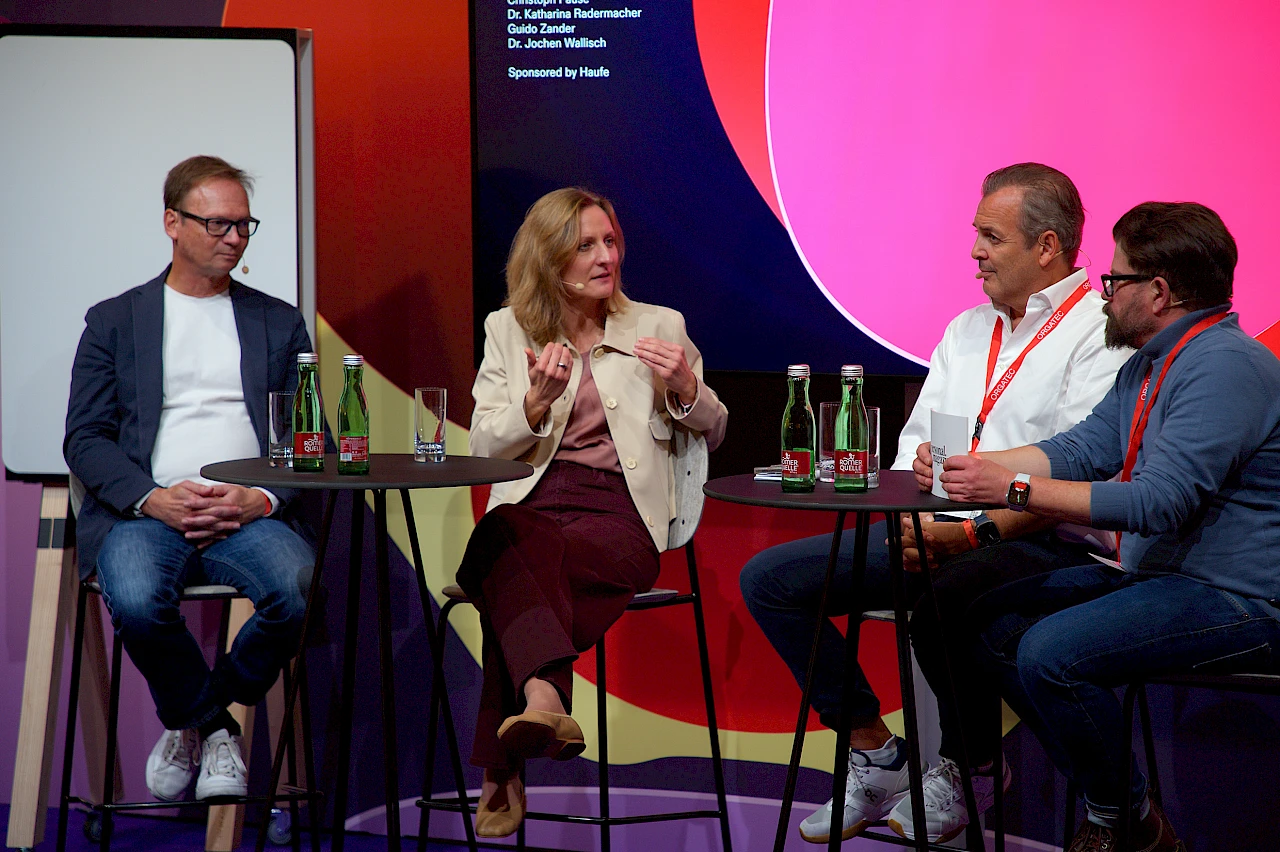
Have Germans become too lazy? Are we working too little? Or is the real problem the way we organise our work? These were the questions with which Christoph Pause, editor at Haufe Personalmagazin, opened a timely and controversial discussion at the Wherever Whenever – Work Culture Festival 2026. His guests were Dr Katharina Radermacher from Paderborn University, working-time expert Guido Zander from SSZ Beratung, and Dr Jochen Wallisch, former CEO of Eurowings and former HR executive at Siemens. It quickly became clear that the three experts agreed on one point: blanket calls for longer working hours miss the bigger picture. Instead, businesses need to examine how productively existing working hours are being used and which organisational conditions enable or hinder performance.
Busy, but not necessarily productive
The experience of many employees stands in stark contrast to the public debate about a supposed lack of willingness to work. Packed diaries, constant availability and heavy workloads are part of everyday working life. Yet the question of whether people should be working more continues to be raised. For Jochen Wallisch, this is a distraction from the real issue. Rather than investigating the causes of poor productivity, businesses fall back on familiar metrics: working hours and physical presence. Yet in knowledge-based roles in particular, performance can no longer be measured simply by the time invested. An additional hour does not automatically produce a better result. Guido Zander also observes that employees are often working at the limits of their capacity. The problem, he argues, is less about a lack of commitment and more about inefficient structures. In manufacturing, for example, rigid shift systems are widespread and are often unable to respond to fluctuating order volumes. Employees may be required to remain on site even when there is little work to do, while additional shifts become necessary during periods of high demand. Katharina Radermacher emphasised that increasing working hours alone does not guarantee higher productivity. What matters is how work organisation, leadership and other HR measures are aligned with a company’s strategic objectives. Rather than adjusting individual elements in isolation, businesses need to consider how their measures work together.
Greater flexibility – beyond the office too
For the panellists, more flexible working arrangements are a key starting point. This is not simply about working from home or flexitime, but particularly about jobs in which employees have traditionally had little influence over their working hours. Fixed shift patterns remain common in manufacturing, retail and healthcare. Yet employees’ needs vary considerably. While some primarily value predictable schedules, others want greater scope to adapt their working hours to family responsibilities or personal circumstances. Guido Zander therefore advocated offering different working time models within the same organisation. Employees could, for example, choose between a reliable, fixed shift pattern and more flexible alternatives. Digital workforce management systems could also take account of availability and individual scheduling preferences, or enable employees to volunteer for additional shifts. Although this initially involves more effort than traditional shift planning, it can better accommodate both operational requirements and employees’ needs. In this context, Katharina Radermacher referred to research findings on the importance of autonomy. People who have greater control over when and how they carry out their work are better able to cope with higher demands. Self-determination has a positive effect on job satisfaction and helps reduce emotional strain. More flexible working arrangements can also make employers considerably more attractive. Particularly in manual and operational roles, which are often overlooked in the New Work debate, this represents largely untapped potential for attracting and retaining skilled workers.
Where productivity is lost
Rigid working time models are not the only factors holding businesses back. In knowledge work, common obstacles include too many meetings, constant interruptions, complicated coordination processes and lengthy decision-making procedures. Jochen Wallisch criticised the tendency of businesses to look outside their own organisations for the causes of productivity problems. In reality, a substantial proportion of these problems stem from structures and processes that companies themselves have the power to change. Guido Zander added that emails, digital messages and tightly scheduled meetings often leave employees with little opportunity for focused work. The challenge, therefore, is not simply to distribute working hours more flexibly, but to use them more effectively. Which meetings are genuinely necessary? Where could decisions be made more quickly? And which tasks actually create value? The answers vary depending on the nature of the work. While demand-driven workforce planning may be crucial in manufacturing, knowledge work often requires conditions that enable uninterrupted concentration and reduce organisational friction.
Office attendance alone does not create collaboration
The close relationship between work organisation and the working environment became particularly evident during the discussion about returning to the office. Katharina Radermacher presented findings from a study examining how different office attendance requirements affect employees’ perceptions. According to the results, an office attendance requirement of two days a week was viewed significantly more positively than a four-day requirement. In particular, when companies introduced stricter attendance policies without a clear and convincing explanation, dissatisfaction and intentions to leave increased. However, the study also showed that workplace design makes a difference. When new attendance policies are accompanied by activity-based working environments that genuinely facilitate collaboration and interaction, the negative effects can be mitigated. The crucial factor is that employees understand the purpose of a measure. If people are expected to spend more time in the office, they should find conditions there that offer clear advantages over working from home. Guido Zander illustrated this with an example of a company that had increased its office attendance requirements despite no longer having enough suitable workstations. Some employees had to find desks in other departments and, despite being physically present, continued to work separately from their own teams. For the panellists, this demonstrated what can happen when businesses change individual policies without considering their implications for workflows and the physical working environment.
Trust rather than control
Underlying many of these questions is a fundamental leadership issue: how much autonomy are businesses prepared to give their employees, and how much control do they believe is necessary? For Katharina Radermacher, greater autonomy also requires a shift in leadership thinking. If performance can no longer be judged on the basis of physical presence, other approaches to performance evaluation and collaboration must be developed. This applies not only to managers, but also to processes, remuneration systems and organisational culture. Guido Zander sees a lack of trust as a major obstacle. Although many companies introduced flexible working arrangements during the pandemic, they made few changes to their underlying leadership and organisational structures. There is now, in some cases, a tendency to revert to old patterns. Yet this transformation cannot be achieved through new rules alone. It also requires courage, Radermacher stressed. Businesses must be willing to experiment with new models, evaluate their impact and make adjustments where necessary. Not every change will work perfectly from the outset. What matters is learning from experience rather than clinging to outdated structures out of uncertainty.
What businesses should change now
To conclude the discussion, Christoph Pause asked his guests a practical question: what should businesses do differently first if they want to become more productive? Katharina Radermacher recommended starting with strategic objectives. Companies first need to clarify what they actually want to achieve and which forms of work organisation, leadership practices and HR measures are required to support those goals. Guido Zander called for a thorough assessment of the current situation. What working time models are already in place? How much does staffing demand fluctuate? What flexibility does the business actually need, and what flexibility do employees want? Only with this understanding can suitable models be developed. Jochen Wallisch, meanwhile, called for an honest discussion about what performance really means today. This must go beyond simply urging employees to work harder or more efficiently. Instead, businesses themselves need to change the structures that make productive work difficult – from overloaded diaries to unnecessarily complicated processes. Although their approaches differ, they lead to a shared conclusion: productivity does not come simply from working longer hours. Above all, it depends on businesses creating the conditions in which people can do their work well, efficiently and with the autonomy they need.
Christoph Pause is Editor for Innovation & Transformation at Haufe’s news portals. A trained historian and journalist, he has been covering the transformation of organisations, leadership cultures and the world of work for two decades – repeatedly asking the same question: What really remains once the hype has faded? Previously, he headed the editorial team at acquisa and served as Editor-in-Chief of Haufe New Management.
Dr. Katharina Radermacher conducts research, teaches and advises on workplace design, flexible working practices and employer branding, with a particular focus on the dynamic intersections between these three areas. As a Senior Lecturer at the Chair of Human Resource Management at the University of Paderborn and a PhD-qualified expert in workspace design, she was examining the strategic importance of the office long before the ‘New Work’ boom. In her work, Katharina Radermacher adopts a multi-perspective, empirical approach to make well-founded predictions about which working models contribute sustainably to employee wellbeing and make companies future-proof. She not only passionately shares these scientific findings with her students, but also transfers them directly into the business world as a catalyst for change. Through lectures and workshops, she helps organisations to better understand the dynamics of the new world of work and to design HR practices that contribute to strategic business objectives.
Dr. Jochen Wallisch is one of the leading practitioners shaping the future of work and complex transformations. For more than 25 years, he has been driving successful change – as a senior executive at Lufthansa and Siemens, as CEO of Eurowings, and as an advisor to organisations ranging from DAX-listed corporations and SMEs to start-ups. He knows the kind of transformation he writes about from first-hand experience: he has personally led restructuring processes, digital transformations and growth initiatives. His conviction: transformation is not about technology, but about people – it cannot succeed against them, only with them. Today, he advises and supports executive boards and entrepreneurs through major transformations – as a Senior Advisor and supervisory board member, as well as an investor and founder. A lawyer with a doctorate and a Master of International Management from McGill University, he has a passion for good books and long-distance hiking and lives in Munich and Salzburg.
Guido Zander holds a degree in Business Informatics and has been Managing Partner of SSZ Beratung since 2005. The consultancy specialises in strategic workforce planning, workforce requirements planning and working time consulting. With almost 30 years of practical experience in implementation-focused consulting, Guido Zander is one of the most sought-after experts when it comes to companies’ most expensive resource: their workforce. A clear and direct focus on employees has been a recurring theme throughout Zander’s career. As an IT consultant, he implemented time-tracking and workforce scheduling systems and later headed the consulting division of a leading workforce management software provider. To date, Guido Zander has delivered more than 200 projects for renowned clients across a wide range of industries and company sizes. His focus is not only on developing solutions, but above all on implementing and firmly embedding them within organisations. As a thought leader, he is a sought-after keynote speaker on working time and the future of work. In 2023 and 2025, Personalmagazin named him one of Germany’s 40 leading HR minds.
Cover photo: Simon Baucks
