

 IBA editorial team
 The headquarters of the Flemish insurer Ethias on Prins Bisschopssingel in Hasselt has shaped the cityscape with its striking, futuristic architecture for around 40 years. However, three decades after its opening, the building faced a fundamental question: demolition and new construction, or a comprehensive refurbishment? With the “Change Over” project, Ethias opted for the latter. The renovation addresses both climate targets and the creation of a new working environment for around 500 employees.
From existing building to reference project
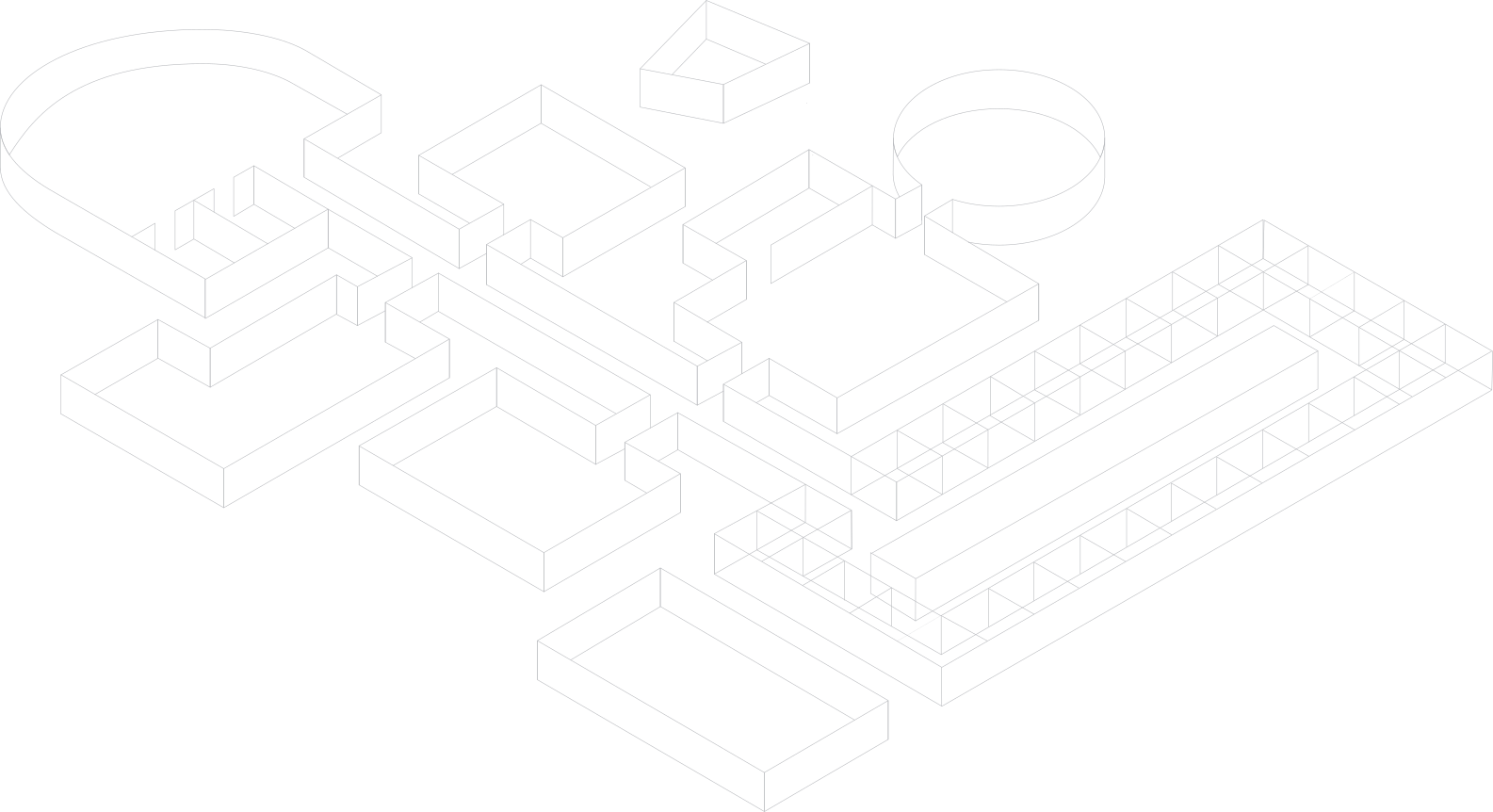
The original architecture was designed by Jaspers Eyers Architects, who were also commissioned to carry out the extensive refurbishment. The project aimed to modernise the building’s energy performance and preserve its iconic presence in the urban landscape, while also developing a masterplan for future workplace concepts at Ethias, including its Walloon headquarters in Liège and other locations. The glass façade was completely replaced and fitted with high-performance insulating glazing to improve thermal insulation and acoustic comfort. A geothermal system will enable the building to be heated without using fossil fuels, and photovoltaic systems complement this energy concept. Consequently, the office building meets high technical standards and is targeting a BREEAM ‘Very Good’ certification.
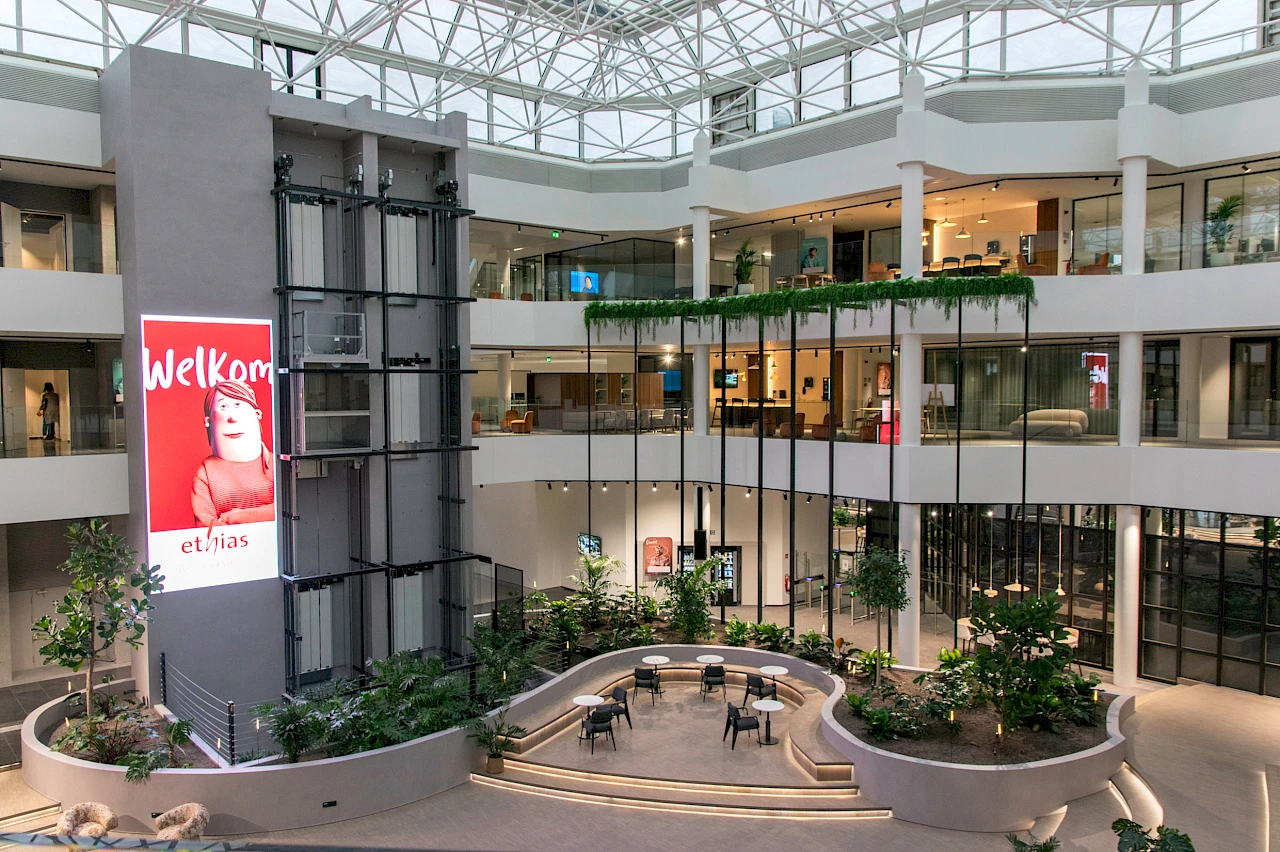
A GLIMPSE OF The ETHIAS Headquarters:


Hybrid working as a guiding principle
Alongside the climate strategy, the creation of a new working environment was a central focus. Following the COVID-19 pandemic, employees in Hasselt divide their working time between the office and working from home in a 70:30 ratio. Ethias used the refurbishment as an opportunity to fundamentally rethink workplace structures. Employees were involved from the outset and were able to express their needs and expectations through workshops and mood boards. The result is an interior concept based on natural materials and restrained colour palettes, such as beige and terracotta, offering a wide variety of work settings. These range from traditional sit-stand workstations to quiet focus areas and meeting and conference zones. Consistent desk sharing reduced the space required per workstation by around 40% without compromising functional quality.
Workspace design with a circular approach
For the office fit-out, Ethias partnered with PAMI, its workspace specialist. Based on the overall design framework, PAMI developed a furnishing concept that reflects the existing architecture and supports new working methods. The circular economy and sustainability played a key role. Ethias and PAMI opted to reuse a large part of the existing furniture, refurbishing it where necessary, and supplementing it with new elements, such as acoustic panels. The result is a functional upgrade that integrates seamlessly into the new design, avoiding unnecessary resource consumption. The furnishing concept combines PAMI’s own sustainable product range with solutions from around 20 established partners. At the same time, PAMI used its flexible production processes in Belgium to develop customised furniture solutions for areas such as management workstations and central meeting spaces.
A cross-location masterplan for Ethias
The redesign of the Hasselt site is not just a standalone project. It serves as a blueprint for other Ethias locations, particularly the Walloon headquarters in Liège, which employs around 800 people, and various regional branches. Core principles such as hybrid working models, zoned office layouts, desk sharing and circular furnishing are gradually being implemented across the organisation. Ethias is also pursuing an ambitious sustainability strategy with the aim of becoming climate-neutral by 2030 and achieving net-zero emissions in the long term. The refurbishment in Hasselt, with its geothermal energy system and BREEAM ambitions, is a key component of this transformation.
Conclusion: Rethinking existing buildings rather than rebuilding
Ethias’ Flemish headquarters in Hasselt demonstrate how existing buildings can be transformed into future-ready workplaces when architecture, energy systems, and interior design are considered together. The renewed working environment supports a wide range of activities, from focused individual work to project collaboration and client consultations, while enabling hybrid working practices. At the same time, it creates an environment that conveys professionalism, reliability, and openness to clients. The opening of the new office during a family day at the end of 2023 emphasised that Ethias’ transformation is not only a construction project, but also a significant cultural shift towards modern working and corporate practices. As the workspace designer, PAMI contributed to making this transformation tangible and usable by creating a furnishing concept centred on sustainability, flexibility, and the intelligent use of existing resources.
Pami is one of Belgium’s leading specialists in office furnishings and workplace solutions. The company combines workspace design with the development and production of office furniture under one roof, supporting projects from conception through development and manufacturing to transport, installation and reuse. Thanks to local production in Belgium, Pami can tailor its furniture to the specific requirements of clients and architects, whilst maintaining control over quality, sustainability and delivery times. The focus is on ergonomic workstations, sustainable, circular solutions and modern working environments that can be flexibly adapted to changing requirements. Further information at: https://www.pami.eu
Photos: ©Pami