


 IBA editorial team
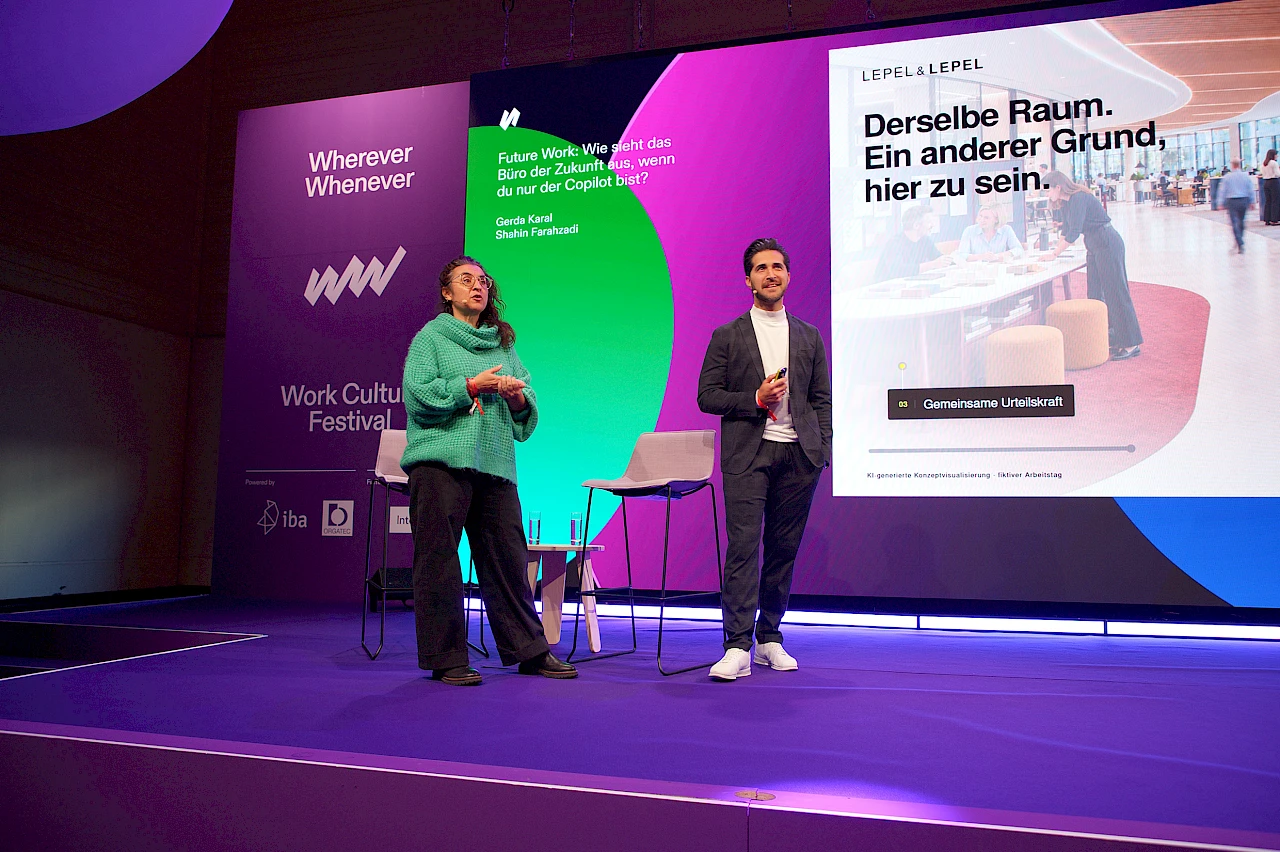
What do we do while artificial intelligence works for us? How do work processes change as we increasingly delegate tasks to intelligent systems? And will we even need a traditional desk-based workstation in the future? At the Wherever Whenever – Work Culture Festival, Gerda Karal, interior architect (bdia) and partner at LEPEL & LEPEL, and Shahin Farahzadi, architect and Chief Strategy Officer at one.vision, explored how collaboration between humans and AI affects the design of our working environments. Their central thesis: the more digital our work becomes, the more space we need for what makes us human.
From linear workflows to collaboration between humans and AI
Alex works in an architectural practice. Rather than modelling different designs for a development site herself, she formulates a prompt. She defines the intended uses, the desired mix of uses and the spatial qualities, and instructs the AI to develop several design options. While the system processes the task, Alex looks out of the window, moves around the office or talks to colleagues. She then evaluates the results, refines her requirements and discusses with the team which option should be developed further.
What Gerda Karal and Shahin Farahzadi illustrated through the fictional employee Alex is already part of Farahzadi’s everyday working life. The architect has been involved in the digitalisation and automation of planning processes for many years and develops AI-based applications himself. His experience demonstrates how fundamentally the logic of work is changing. Linear workflows are giving way to an iterative process of instructing, generating, reviewing, refining and making decisions together. The more complex the tasks, the longer AI may work independently. This frees up time for people. But how should we use it?
Looking busy is not the same as being effective
The obvious response to the time saved through AI would be to take on additional tasks and pack more work into the same amount of time. Karal and Farahzadi advocate a different approach to these intervals. For them, they are an opportunity to reclaim time for creativity, reflection, communication, learning and recovery. ‘Looking busy is not the same as being effective,’ said Farahzadi, summing up a fundamental problem in today’s work culture. Performance is still frequently equated with visible activity. Someone concentrating on their screen appears to be working. Someone looking out of the window, walking around the office or chatting to colleagues by the coffee machine may not give the same impression. Yet good ideas often emerge precisely when we step away from a specific task and allow our minds to wander. So why should we not consciously recognise these moments as part of our work?
For the design of working environments, this means creating not only conventional focus rooms but also spaces where people can pause, reflect and develop new perspectives without screens or digital distractions. A library, a window seat or a sheltered outdoor area can be just as valuable as a workstation with an ergonomic set-up. However, this requires a work culture in which thinking is recognised as work, even when it does not look like it. Leaders have a crucial role to play in setting an example.
A multispace office is not yet an AI office
By moving towards activity-based working environments, many companies have already established important foundations for flexible working. A variety of work settings, focus rooms, meeting areas and informal communication zones enable employees to choose the most suitable place for their particular activity. But is a conventional multispace office sufficient to meet the demands of an increasingly AI-supported world of work?
Farahzadi illustrated these changes through his own way of working. Rather than spending hours programming in front of a screen, he now uses various AI systems, some of which he instructs verbally. In what is known as vibe coding, programming tasks are described in natural language and translated into code by AI systems. While these systems are working, he walks around the office, develops further ideas or engages in conversations with colleagues. Even when he is on the move, he can use a dictation function to send new instructions to his systems. For this way of working, he has less need for a permanently assigned desk than for freedom of movement, voice input capabilities, spaces for exchanging ideas and a suitable screen on which to review the results.
This also changes the requirements for the spatial organisation of an office. As employees increasingly speak to AI systems rather than interacting with them exclusively via keyboards and screens, the acoustic quality of the working environment becomes even more important. At the same time, spaces must accommodate different working rhythms and needs for movement without employees disturbing one another. For Karal, a thorough needs assessment is therefore essential. Before designing spaces, it is important to understand a company’s working processes, the needs of its users and its everyday work culture. After all, not every company or employee will work with AI in the same way.
Spaces alone cannot change work culture
A sofa in an office does not automatically create a space for creativity. Nor does a generous communication area necessarily lead to more interaction. What matters is the function a space serves in everyday working life and whether using it is accepted and seen as entirely natural. Karal and Farahzadi illustrated this through the example of their own office. There, it has become perfectly normal for employees to work on their laptops in the kitchen simply because they feel comfortable there at that particular moment. However, this work culture has evolved over several years.
Offering a choice of work settings requires not only the appropriate technical infrastructure but also trust and the freedom to make use of them. If employees feel they have to justify sitting on a sofa or looking out of the window during working hours, even well-designed spaces will fail to achieve their intended effect. Work culture and spatial design must therefore be considered together from the outset. Design establishes the spatial conditions for new ways of working, while leadership and everyday interactions within the company make them possible in practice.
The more digital our work, the more important human interaction becomes
As AI increasingly takes over operational tasks and work becomes less dependent on a particular location, the office is gaining importance as a social anchor. Particularly in times of technological upheaval, when many people are questioning what their future role in the world of work will be, we need places that provide a sense of security, direction and belonging. The office can become a safe haven where people share their uncertainties, learn from one another and develop new perspectives together. Although AI can generate numerous potential solutions in a short space of time, evaluating them, placing them in a wider context and taking responsibility for decisions remain human tasks. Using architecture as an example, Farahzadi explained that assessing spatial qualities requires more than simply comparing different designs. It calls for experiential knowledge, an understanding of the future users’ everyday lives and a sense of how people experience spaces emotionally.
Creativity, active engagement, judgement, networking and collective decision-making are therefore becoming increasingly important. The human role increasingly involves developing a shared perspective and making sound decisions from a multitude of technologically generated possibilities. The office of the future is thus less a place where people complete tasks alongside one another and more a place where they create meaning together.
A vibrant heart for the office of the future
How can this ambition be translated into spatial design? One of LEPEL & LEPEL’s key design tools is what the practice calls the ‘heart’ of the office. This refers to a central, vibrant area within the working environment where different functions converge, facilitating both planned and spontaneous encounters.
Communication areas, food and drink facilities, seating and multifunctional spaces such as an arena can all be brought together here. Further spaces for focused work, retreat, recovery and collaboration can be arranged around this vibrant hub. Project studios and workshop spaces are also gaining importance in this context. They provide space for developing ideas together, experimenting and exploring specific challenges away from digital working processes.
Even the area around the coffee machine can serve an important function. It is often during the transition from focused work to informal interaction that conversations take place and new ideas emerge. Such places should therefore not be regarded as leftover spaces but deliberately designed as part of the working environment. This does not necessarily require a new building. Existing working environments also offer potential for further development. The key is to recognise existing spatial qualities, observe how spaces are actually used and learn from employees’ experiences.
What do we need to work well in the future?
In Karal and Farahzadi’s opinion, every project should therefore begin by asking what people collectively need to do their jobs well. What qualities does the existing working environment already offer? What needs to change? Which spatial settings support everyday working life, collaboration and continuous learning? Three key areas for action emerge from these questions: evaluating work outcomes together, providing a choice of work settings, and continuously testing and developing working environments.
Established design disciplines such as acoustics and lighting will also become increasingly important. During the subsequent discussion, Karal advocated incorporating acoustic quality into the fundamental design of spaces and involving relevant specialist consultants. The response to increasingly voice-based interaction with AI cannot simply be to install more and more phone booths. Instead, spaces need a solid acoustic foundation that allows freedom of movement and supports different forms of collaboration.
A question from the audience highlighted that a consistently people-centred approach to design must not stop at the office door. If the working conditions of office-based and production employees increasingly diverge, there is a risk of different work cultures developing within the same company. Here, too, it is essential to consider the needs of all employees and create spatial qualities appropriate to their respective activities.
More room for people
So, do we still need the traditional desk-based workstation? Or does its very existence sometimes prevent us from exploring other ways of working? For Karal and Farahzadi, these are questions that companies and designers increasingly need to address in light of technological developments. This is not about fundamentally questioning established and proven work settings. Rather, it is about moving beyond traditional notions of what work should look like and designing spaces around changing activities and human needs.
The two speakers see artificial intelligence not as a competitor but as an opportunity to make more room for our humanity in the world of work. Whether this potential is fully realised, however, depends on more than technology alone. It is a question of work culture, leadership and, not least, the spaces we create to support them. Perhaps the most important task in designing the AI office of the future is therefore to give people more opportunities to be human.
Gerda Karal is an Interior Architect bdia, Partner at LEPEL & LEPEL, and an expert in identity-driven interior architecture and future workplace design. After studying at PBSA in Düsseldorf, she worked internationally for renowned companies in retail, showroom and workplace design. Together with Monika Lepel, she developed the award-winning shop concept for Telekom Deutschland, recognised nationally and internationally. A key focus of her work today lies in designing modern work environments that combine functionality, identity, and sustainability. As a DGNB Registered Professional, Gerda Karal is particularly committed to climate-friendly projects and regularly shares her expertise through lectures and industry events.
Shahin Farahzadi is an architect and CSO at one.vision, and an expert in BIM, AI, and digital general planning. His work combines strategic project development, data-driven planning, and digital technologies into integrated planning processes for the construction and real estate industry. Previously, he founded REHUB, where he developed digital workflows for BIM, automation, and AI-supported planning. His focus is on making complex construction projects manageable earlier, more transparently, and more reliably, while enabling new forms of collaboration in planning.
Cover photo: Simon Baucks
