

 IBA editorial team
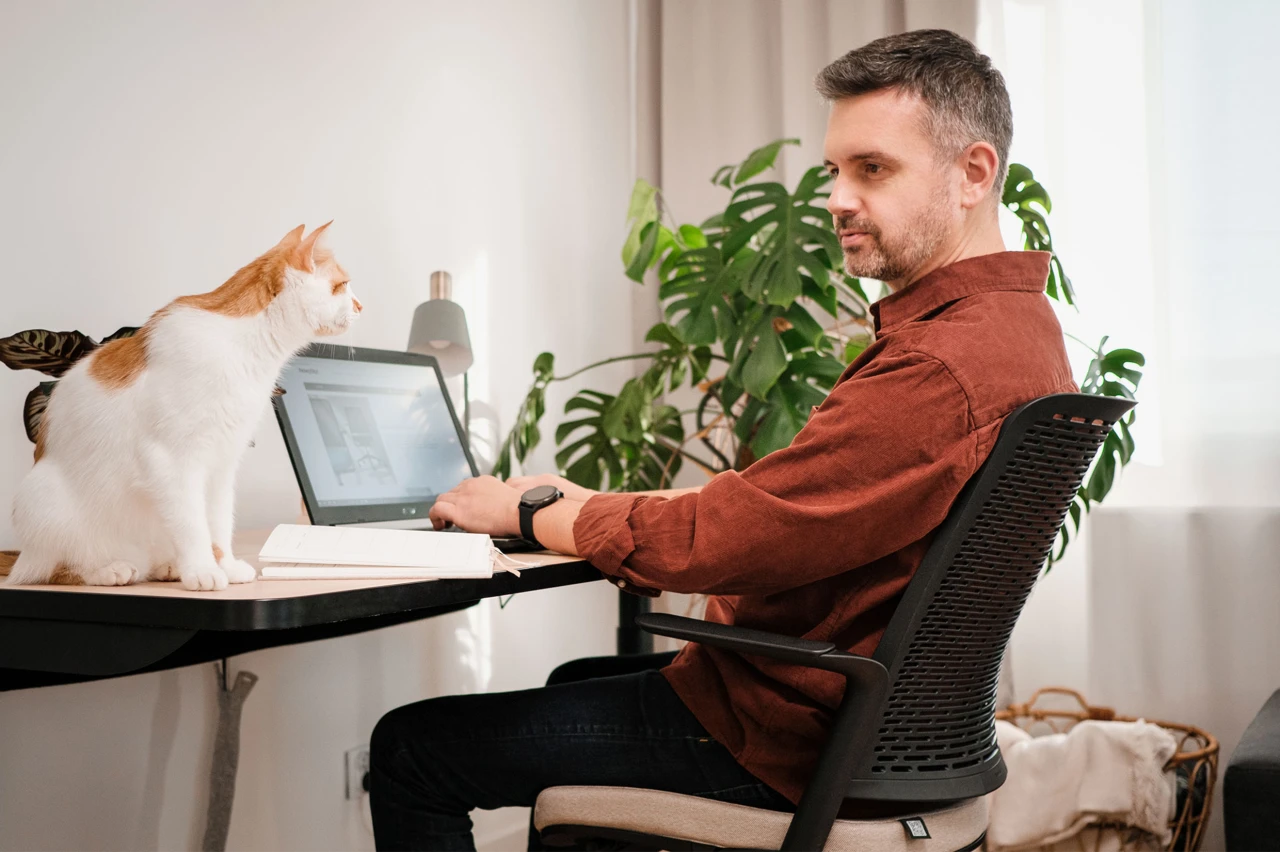
 Hybrid working has become an established part of everyday working life. While the main question in recent years was whether working from home actually works, the focus has now shifted towards how it can be made effective in the long term. In 2025, the German Social Accident Insurance (DGUV) comprehensively updated its guidance on working from home and republished it under the title „Working from Home“. The publication is aimed equally at employers, employees and occupational health and safety professionals. Its message is clear: anyone who works from home regularly or several days a week requires a workspace that meets ergonomic, organisational and technical requirements.
Working from home is no longer an improvised solution
During the pandemic, many home workspaces were created quickly and pragmatically. Kitchen chairs became office chairs, living room tables became desks, and video calls took place between bookshelves and children’s bedrooms. Today, the situation has changed fundamentally. Remote working has become an integral part of hybrid working models in many organisations. As a result, expectations regarding the quality of workspaces outside the office have increased significantly. According to the DGUV, display screen work carried out at home should follow the same ergonomic principles as work carried out in the office. The objective is to prevent health-related problems while enabling productive and sustainable ways of working over the long term.
Good workspaces evolve step by step
The DGUV deliberately avoids taking an “all or nothing” approach. Instead, its guidance demonstrates how home workstations can be improved progressively. It distinguishes between three workplace categories – MINIMAL, FUNCTIONAL and OPTIMAL – and explains which level of equipment is appropriate for different levels of home working. For occasional work, a basic setup consisting of a laptop and a suitable table is often sufficient. Employees working from home on a regular basis should have adequate desk space, an ergonomic office chair, and external input devices such as a keyboard and mouse. For permanent home working, the DGUV recommends a workstation that complies with the requirements of ASR A6, the German Technical Rule for Display Screen Workstations. This graduated approach allows organisations to align workplace investments with actual usage rather than adopting a one-size-fits-all solution.

What are the requirements for a display screen workstation under ASR A6?
The German Technical Rule ASR A6 “Display Screen Work” defines the minimum requirements for permanently installed display screen workstations, including teleworking arrangements in the home. The Committee for Workplaces (ASTA), which operates under the German Federal Ministry of Labour and Social Affairs (BMAS), distinguishes between three workstation categories:
MINIMAL – Suitable for occasional home working:
- Work surface of at least 800 × 600 mm
- Fixed-height desk (approximately 740 mm)
- Minimum free movement area of 800 × 800 mm
- A dining chair or visitor chair is considered sufficient
FUNCTIONAL – Suitable for working from home several days per week and compliant with ASR A6 requirements for telework, provided an office swivel chair and at least 1.5 m² of movement space are available
- Work surface of at least 1,200 × 800 mm
- Fixed-height desk
- Minimum free movement area of 1,200 × 800 mm
OPTIMAL – A fully compliant display screen workstation under ASR A6:
- Height-adjustable work surface of at least 1,600 × 800 mm
- Minimum movement area of 1,600 × 1,000 mm
- Ergonomic office swivel chair with suitable castors
Additional ASR A6 requirements
- Sufficient natural daylight and an external view
- Glare-free positioning of screens
- Minimum illuminance of 500 lux (supplemented by desk or floor lighting where required)
- Adequate legroom (minimum 600 mm width × 600 mm depth for MINIMAL; 850 mm width × 800 mm depth from FUNCTIONAL upwards)
- Regular breaks from screen work through movement and changes of posture
Employers are responsible for ensuring that teleworking workstations are appropriately equipped and that employees receive guidance on ergonomic sitting posture, dynamic sitting, working time arrangements and break management.
Source: DGUV “Working from Home”, FBVW-402 (October 2025); ASR A6 “Display Screen Work”.
Technology alone is not enough
Furniture and equipment are only part of the picture. Technical infrastructure also plays a vital role. Reliable broadband internet access and secure connections to corporate networks – for example via VPN – are essential for effective remote working. Organisations should therefore ensure that sufficient technical capacity is available to support hybrid work reliably. Digital infrastructure has become just as important as the physical workplace itself.
Lighting and movement matter too
An ergonomic workstation consists of more than just a desk and chair. The DGUV recommends sufficient natural daylight, an external view and glare-free lighting conditions. Display screen workstations should be arranged to minimise reflections while ensuring adequate lighting levels. Movement is equally important. Prolonged sitting should be interrupted regularly through changes of posture and breaks for movement. Even simple measures, such as standing during telephone calls or taking brief walking breaks, can help reduce physical strain. These recommendations apply equally to work carried out in the office and at home.
Hybrid working is also an organisational challenge
The DGUV publication addresses not only workplace equipment but also work organisation and psychological stress. Regular communication, social inclusion and clearly defined expectations regarding availability are identified as essential prerequisites for successful home working. Employees should remain fully integrated into the organisation and receive information through a variety of communication channels. Face-to-face meetings, telephone conversations and video conferences all help maintain social cohesion and strengthen collaboration. Equally important are clear rules within the home environment. Concentration, uninterrupted working time and agreed working hours are just as essential to successful home working as suitable technology and ergonomic furniture.
Home working is becoming increasingly professional
Overall, the updated guidance reflects a significant shift in thinking. Working from home is no longer regarded as an exception but as a normal component of modern work organisation. Consequently, expectations regarding workplace quality, organisational structures and leadership continue to rise. For organisations, this means viewing home working as part of a broader hybrid working strategy rather than as a standalone arrangement. Effective hybrid working is achieved when the office and the home workspace complement each other. Each location fulfils different functions, yet both should support employees in working healthily, efficiently and with focus.
Workplace quality remains essential
The DGUV recommendations make it clear that ergonomic workplace design can make an important contribution to health, performance and wellbeing beyond the traditional office environment. They also demonstrate that even gradual improvements can significantly enhance the quality of work. For organisations, this presents an opportunity to establish sustainable hybrid working models. Investing in well-equipped workplaces – whether in the office or at home – creates the foundation for productive work, helps reduce sickness-related absence and strengthens an organisation’s attractiveness as an employer.