


 IBA editorial team
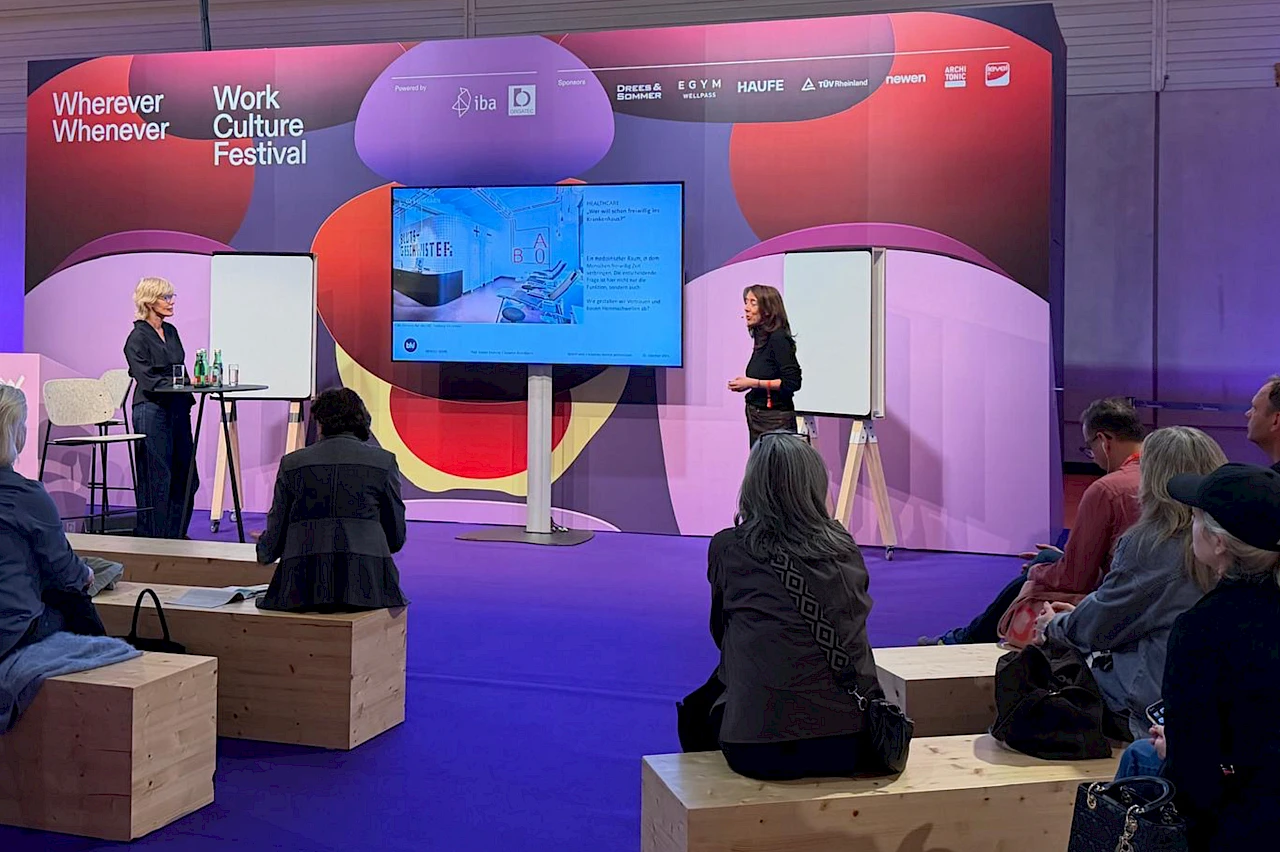
What does an office have in common with a hotel lobby or a hospital? Why can years of experience sometimes get in the way of creative thinking? And when does a space become a place that people identify with? At the Wherever Whenever – Work Culture Festival at ORGATEC 2026, interior designers Susanne Brandherm and Sabine Krumrey explored why good design requires us to look beyond the boundaries of our own discipline – and why it pays to keep questioning what we think we know.
A hotel lobby where people work. An office that feels like an apartment. A hospital whose communal areas could just as easily belong to a museum. The boundaries between different types of space are becoming increasingly blurred. For Susanne Brandherm and Sabine Krumrey of brandherm + krumrey innenarchitekten, this development provides a fascinating starting point for rethinking the design of working and living environments. In their presentation at the Wherever Whenever – Work Culture Festival, the two interior designers approached the subject from five perspectives. They explored the blurring of boundaries, the courage to challenge assumptions, interdisciplinary collaboration, creative experimentation and the question of what turns spaces into meaningful places.
1. Challenging boundaries: When different environments converge
What still defines an office, a hotel lobby or a living space? Drawing on a range of projects, Susanne Brandherm and Sabine Krumrey demonstrated how different types of environment are increasingly converging in terms of design. Hotel lobbies are no longer simply reception and waiting areas. They now provide spaces for working, conversation and shared activities. At the same time, offices are adopting elements from the hospitality sector: lounges, communal kitchens and open social areas create new opportunities for people to connect. One example is a communal space at REWE, whose different functional zones make it look more like a contemporary hotel lobby than a conventional office area. In healthcare environments, too, the quality of the visitor experience, atmosphere and service are becoming increasingly important. However, the two interior designers also take a critical view of this development. As workplaces become more homely and leisure facilities increasingly form part of office environments, questions arise about the boundaries between work and private life. Does an office really need to feel like a second home? For Brandherm and Krumrey, the aim is not to merge different types of space completely. Instead, their respective qualities should be used to create environments that support concentration, interaction, collaboration and relaxation – without losing sight of the necessary distinction between work and leisure.
2. Challenging assumptions: Breaking out of familiar ways of thinking
Anyone who has spent years designing offices, hotels or healthcare facilities builds up a wealth of experience. Yet that very expertise can also become a limitation. When we believe we know exactly how a particular type of space should function, it is easy to fall back on familiar solutions. Susanne Brandherm and Sabine Krumrey therefore advocate regularly questioning one’s own experience and consciously moving beyond established patterns of thinking. They illustrated the potential of this approach with a project for the University Medical Center Hamburg-Eppendorf. The brief was to create an appealing blood donation facility on the university campus, particularly aimed at younger people. The budget was extremely limited. Rather than following conventional approaches to healthcare design, the designers developed a space centred on the needs of its target group. The student project “Work to go”, presented at ORGATEC in 2018, followed a similar principle. Second-semester students developed an experimental working environment despite having very little professional experience themselves. It was precisely their fresh, unbiased perspective that opened up new ways of thinking about the future of work. At the heart of the project was the understanding that work is an activity, not a fixed location. Both examples demonstrate that new solutions often emerge when we challenge what appears self-evident and approach familiar tasks from an unfamiliar perspective.
3. Connecting disciplines: Good design is a team effort
Interior design involves far more than selecting colours, materials and furniture. It brings together spatial, technical, functional and social requirements. As a result, successful projects depend on a wide range of expertise. Susanne Brandherm and Sabine Krumrey emphasised the importance of collaboration with architects, lighting designers, acousticians, building services engineers and other specialists. They attach particular importance to the contribution of skilled tradespeople. After all, even the most convincing design must ultimately be brought to life. Joiners, painters, tilers, metalworkers and other tradespeople contribute not only their practical skills but often their own ideas and valuable suggestions for improvement. The two interior designers explicitly see this collaboration as an exchange between equals, in which everyone involved can learn from one another. They also used the example of Design Offices to demonstrate that interdisciplinary thinking extends well beyond the design process itself. For customer-facing service roles, the company deliberately recruited people with experience in the hospitality industry. Hospitality, attentiveness and a strong service mindset are qualities that also play a crucial role in contemporary working environments. The example shows that the quality of a space depends on more than its physical design. The culture experienced within it and the way people interact are equally important. After all, collaboration does not always begin at a meeting table. Some of the most valuable conversations arise informally, perhaps over a shared meal or in the kitchen.
4. Making room for creativity: Why not every idea needs to be visualised immediately
Sabine Krumrey also illustrated the importance of moving beyond familiar patterns of thinking through her teaching at AMD Akademie Mode & Design in Hamburg. In a current project, students are exploring iconic furniture designs, initially drawing them by hand before digitally placing them in unexpected spatial contexts. They experiment with scale, proportions, geometry, light and colour. What happens when a piece of furniture suddenly takes on a completely different size? How does its impact change when it is placed in a space with unusual proportions? The focus is not on achieving a perfect result, but on the process of getting there. Students are encouraged to observe, experiment, develop variations, question their decisions and embrace uncertainty. Krumrey described how deeply the students immersed themselves in freehand drawing. Working with analogue techniques was not seen as the opposite of digitalisation, but rather as the starting point for a creative process that could subsequently be developed using digital tools. For Brandherm and Krumrey, this also carries an important message for professional design practice. Under time pressure, and with AI-generated visualisations becoming increasingly accessible, there is a risk of committing too early to solutions that appear complete. The two interior designers therefore continue to place considerable value on sketches, simple models and collaborative experimentation. A drawing does not have to be perfect to communicate a good idea. Sometimes, its very imperfections create opportunities for new interpretations. Their many years of working together have shown them just how effective this approach can be. As early as the development of the World Pharmacy for Expo 2000 in Hanover, ideas emerged through sketching together, discussing concepts and repeatedly revisiting designs from different perspectives.
5. Creating identity: When does a space become a place?
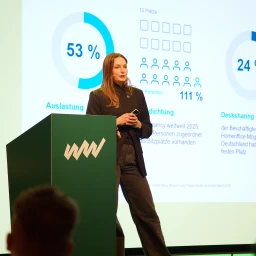
The final perspective of the presentation returned to a fundamental question in interior design: When does a functional space become a place with an identity of its own? Using a project for REWE, Susanne Brandherm and Sabine Krumrey demonstrated how an existing corridor could be transformed into a versatile spatial environment with relatively modest resources. An area originally intended for circulation became a place for meetings, breaks and informal encounters. The key was not an elaborate refurbishment, but the ability to recognise and make better use of existing potential. Another example was a foyer designed to serve not only as a reception area but also as a venue for readings and other events. Such spaces derive their particular qualities from their flexibility, but above all from the people who bring them to life. For Brandherm and Krumrey, identity is therefore not created through architecture or design alone. A space only becomes a meaningful place through the ways it is used, the encounters it enables and the experiences people associate with it. This is particularly relevant to working environments. Corporate culture cannot simply be translated into physical space through corporate colours or logos. It needs to be tangible in the atmosphere, the opportunities a space offers and the everyday interactions between people.
New questions instead of old answers
At the end of their presentation, Susanne Brandherm and Sabine Krumrey brought their five perspectives together in one overarching insight: innovation does not necessarily come from finding ever better answers to familiar questions. Sometimes, we first need to question the questions themselves. It is often where different disciplines meet that established assumptions are challenged. New perspectives emerge, familiar routines are reconsidered and previously unrecognised opportunities become visible. For the design of future working environments, this means that specialist knowledge and design expertise alone are not enough. Openness, curiosity and a willingness to embrace different perspectives are equally essential. New ideas often emerge precisely where the boundaries of our own thinking begin.
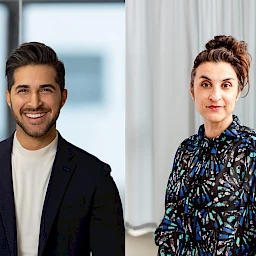
Sabine Krumrey is an interior architect, co-founder of brandherm + krumrey interior architecture, and since 2025 Professor at AMD Academy of Fashion & Design in Hamburg. After studying interior architecture at Rosenheim University of Applied Sciences, she worked for several interior architecture practices in southern Germany before establishing herself as an independent interior architect in 1993. In 1999, she co-founded brandherm + krumrey interior architecture together with Susanne Brandherm. Since 2000, she has led the firm’s Hamburg office, creating workplace and brand environments with a focus on identity-driven interior architecture. Sabine Krumrey was nominated for the INsider Award in 2008 and received the German Interior Design Award 2019 from the Association of German Interior Architects (bdia). Since February 2025, she has been a Professor at AMD Academy of Fashion & Design in Hamburg.
Susanne Brandherm is an interior architect, co-founder of brandherm + krumrey interior architecture, and head of the firm’s Cologne office. After studying interior architecture at Detmold University of Applied Sciences, she gained professional experience at renowned interior architecture practices in Cologne before co-founding brandherm + krumrey together with Sabine Krumrey in 1999. Her work has received numerous awards, including the INsider Award 2013 and the German Interior Design Award 2019 presented by the Association of German Interior Architects (bdia). Alongside her professional practice, she has been actively involved in teaching for many years and is currently a lecturer at Düsseldorf University of Applied Sciences (PBSA). She also contributes her expertise as a juror, speaker, and author. Since 2012, she has been a member of the Advisory Board of architect@work Germany, has served on the Advisory Board of bdia NRW since 2024, and has held the honorary position of Vice President of the Association of German Interior Architects (bdia) since 2026.
Cover photo: IBA
