

 IBA editorial team
 A new special analysis of the University of Konstanz Home Office Study delivers a thought-provoking message for the office furniture industry: whether employees prefer working in the office or from home depends less on the refurbishment status of the office than on whether it provides them with a personal space of their own.
As organisations increasingly question whether investments in new office environments deliver a worthwhile return—particularly when employees continue to favour working from home despite newly refurbished workplaces—the latest findings provide valuable evidence. For the 19th survey wave, 1,017 employees with access to home working were surveyed. The sample is representative of Germany’s working population with home-working opportunities in terms of age and gender. For the first time, the study focused specifically on the physical office environment: office layouts, desk-sharing concepts, collaboration spaces and their relationship to employees’ preferred number of home-working days. The findings offer clear guidance on where investments in workplace design can genuinely make a difference.
Traditional office layouts dominate, while activity-based concepts remain a niche
German office environments remain largely conventional in their design. Almost half of respondents (49%) work in shared offices accommodating between two and nine permanently assigned workstations, while 29% occupy private offices. By contrast, activity-based offices, which provide different zones and furniture solutions depending on the task being performed, remain a niche concept, accounting for just 6% of surveyed workplaces, despite the measurable advantages highlighted by the study. Assigned desks also continue to dominate. Some 76% of employees have a permanently allocated workstation, while 24% work in desk-sharing environments, particularly within larger open-plan offices.
A lack of spaces for interaction is clearly noticeable
Employers often justify calls for greater office attendance by highlighting the importance of exchange and organisational culture. However, 35% of respondents reported that their workplace offers no dedicated spaces for interaction or informal encounters. This figure has actually increased slightly since 2022, when it stood at 33%. In activity-based workplaces, by comparison, only 14% reported a lack of such spaces. The study also found that activity-based office environments are associated with slightly higher levels of peer support and lower levels of exhaustion and loneliness. Interestingly, however, employees reported little difference in their perceived individual performance. For the office furniture industry, this represents a clear message. Well-designed collaboration areas and quiet retreat spaces are not simply desirable workplace amenities—they make a measurable contribution to employee wellbeing.
Desk sharing can increase the desire to work from home
Perhaps the study’s clearest finding concerns the relationship between workplace models and employees’ home-working preferences. Employees working in desk-sharing environments would ideally spend an average of 3.40 days per week working from home. Those with permanently assigned desks, by contrast, preferred 2.59 days. One third of desk-sharing employees would ideally work entirely from home, compared with only 15% of employees with dedicated workstations. Office size shows a similar pattern. Employees with private offices preferred an average of 2.34 home-working days, whereas those working in open-plan offices with more than 24 workstations preferred 3.56 days. These findings suggest that neither desk sharing nor open-plan offices are inherently problematic. However, without compensating measures—such as personal storage, territorial cues or opportunities for privacy—they significantly increase employees’ desire to work from home.
Renovation is not the answer
One finding is particularly relevant for the industry: the renovation status of an office has surprisingly little influence on employees’ preferred level of home working. Employees working in offices renovated within the past six years expressed a preference for an average of 2.7 home-working days per week, compared with 2.9 days among those working in older office environments—a relatively small difference. This suggests that the decisive factor is not whether an office has been recently renovated, but whether it provides employees with a sense of personal ownership and an individual place to work. Simply introducing new furniture will not solve organisations’ workplace attendance challenges. A well-designed workplace strategy, however, is far more likely to do so.
What this means for manufacturers and workplace designers
For office furniture manufacturers, workplace consultants and designers, the findings point to three clear priorities. Firstly, the desire for an individual, personal workspace remains deeply rooted in German workplace culture. Desk-sharing concepts therefore require carefully considered compensatory measures, such as personal storage, intuitive booking systems that help employees return to familiar workstations, or clearly defined neighbourhoods and team zones. Secondly, one in three organisations still lacks dedicated spaces for informal interaction and collaboration. This represents significant untapped potential for the industry, particularly given the study’s evidence that such spaces have a measurable positive impact on employee wellbeing, social cohesion and workplace experience. Thirdly, the industry’s value proposition needs to evolve. Rather than focusing primarily on office modernisation, manufacturers and workplace designers should demonstrate how workplace design creates tangible value for both employees and organisations. The office of the future must do more than simply look new. It must offer a workplace experience that people actively value.
About the study:
Since spring 2020, the University of Konstanz Home Office Study, led by Professor Florian Kunze at the University of Konstanz’s Future of Work Lab, has been monitoring the development of mobile and hybrid working practices in Germany. The current special analysis of workplace utilisation is based on the 19th survey wave, involving 1,017 participants, and forms part of the full research report: “The Office Under Pressure: Workplace Infrastructure, the Demand for Home Working and Workplace Presence in Germany 2026” (June 2026). The full report is attached to this article.
About the authors:
Professor Florian Kunze holds the Chair of Organisational Behaviour at the University of Konstanz and heads the Future of Work Lab. He is also a Principal Investigator at the Cluster of Excellence “The Politics of Inequality.” Amelie Marie Fischer is a PhD researcher in Organisational Behaviour at the University of Konstanz and works as a consultant specialising in organisational culture and transformation.
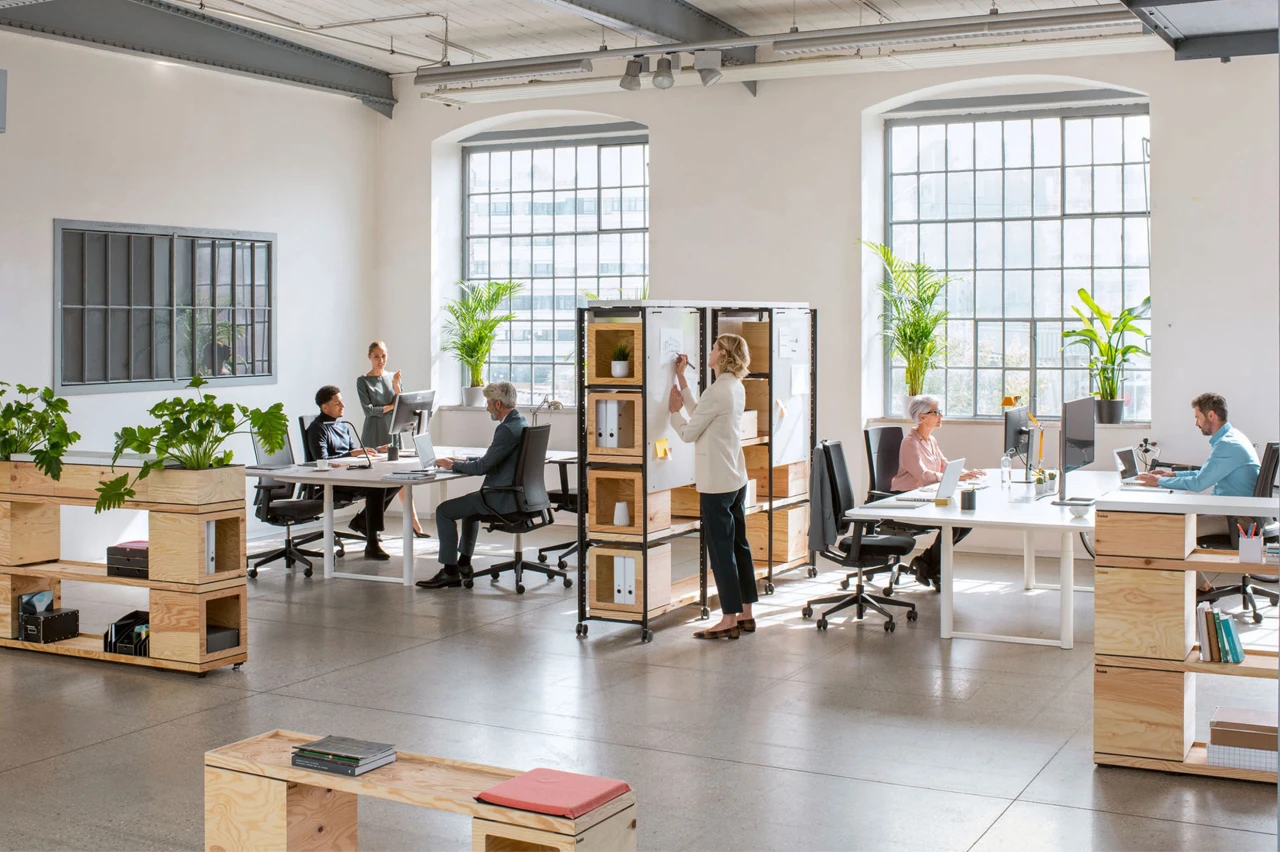
Cover photo: ©Bene