


 IBA editorial team
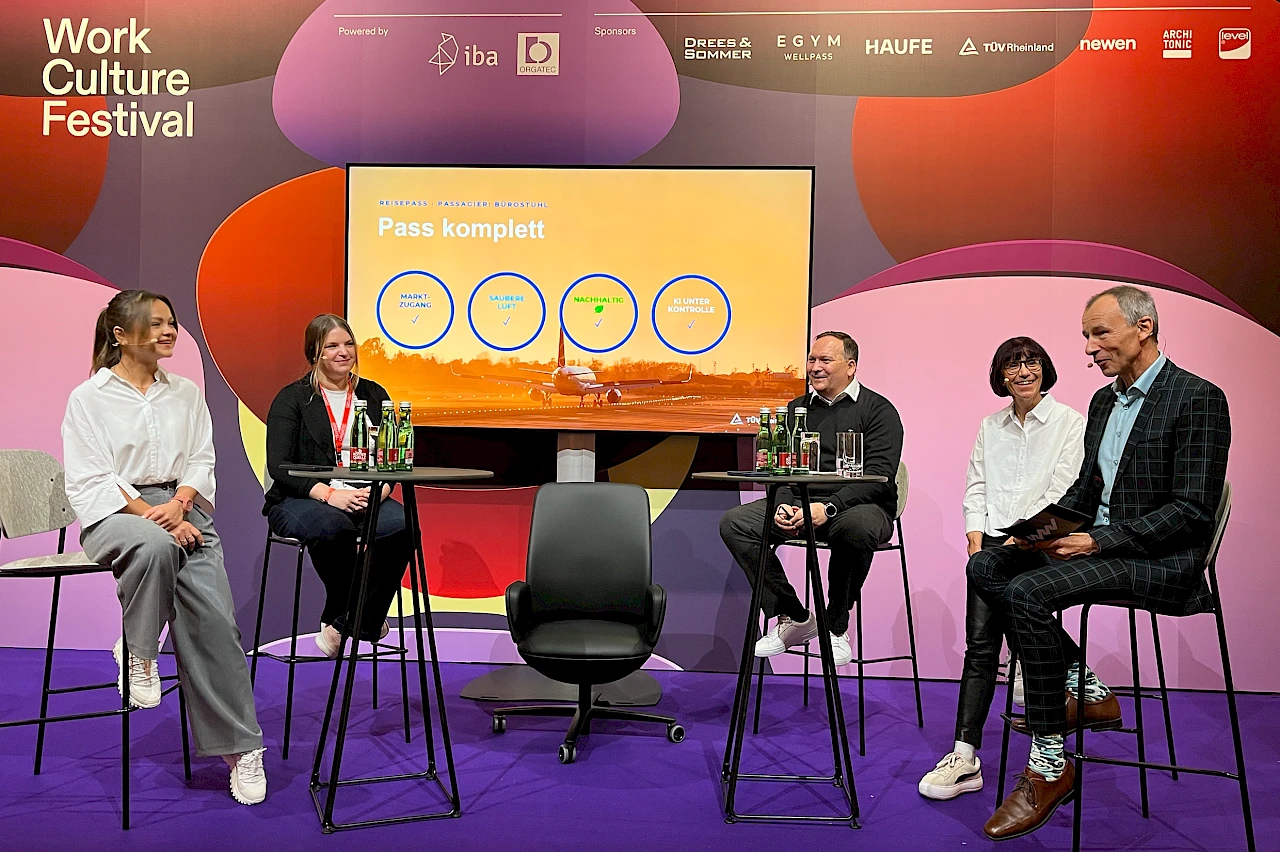
An office chair travelling around the world: what initially sounds like an unusual travelogue turned out to be a concise overview of the challenges currently facing the office furniture industry at the Wherever Whenever – Work Culture Festival 2026. Four experts from TÜV Rheinland explained the requirements manufacturers must meet when entering international markets, addressing product emissions and circularity, and the role artificial intelligence is already playing in these areas.
What does an office chair need to travel from Cologne to India, make a stop at a testing laboratory and ultimately comply with European sustainability regulations? This was the question explored by the panel “Passport, please! What your furniture needs to travel the world and why AI is already on board” on the Academy Stage at Work Culture Festival. Moderated by Volker Weßels, who is responsible for sustainability, standardisation and certification at the German Interior Business Association (IBA), four TÜV Rheinland experts accompanied an office chair on its symbolic journey. The destinations: New Delhi, Nuremberg, Brussels and back to Cologne. Each stop presented a different challenge, ranging from national certification requirements and indoor air quality to new demands on product design and the use of AI.
India: When certification becomes a barrier to market entry
The first stop was India, an increasingly attractive market for European furniture manufacturers. However, companies wishing to sell their products there must navigate specific regulatory requirements. This was highlighted by Corinna Reget, who heads Global Market Access Services at TÜV Rheinland. Since the beginning of 2026, several furniture categories in India have been subject to mandatory certification requirements under the BIS (Bureau of Indian Standards) system. These include office chairs, other seating furniture, tables, desks, storage furniture and beds. A successful product launch in Germany or elsewhere in Europe therefore no longer guarantees that a piece of furniture can be exported to India without further requirements. Manufacturers must determine whether their products comply with the applicable Indian regulations and which approvals and markings are required. Failing to prepare adequately can have significant consequences: without the necessary documentation, companies risk customs delays, storage costs and lost revenue. Even after import, violations of the regulations may result in penalties imposed by Indian market surveillance authorities. Reget therefore recommended incorporating regulatory requirements into export planning at an early stage. Companies that address testing and certification requirements in good time can avoid costly surprises and enter new markets more effectively.
Nuremberg: What furniture releases into indoor air
The next stop was Nuremberg, where TÜV Rheinland operates a large laboratory for emissions testing. Dr Jelena Galinkina, an expert in emissions and pollutant testing as well as odour assessments, focused on an invisible characteristic of furniture: its impact on indoor air quality. People spend a large proportion of their lives indoors. This makes it all the more important to understand which substances furniture and other interior products release into their surroundings. However, the smell of a new piece of furniture is not a reliable indicator of whether it poses a health risk. A strong odour does not necessarily indicate harmful emissions. Conversely, even products with no noticeable smell can release substances that may affect health. Galinkina illustrated this using typical material odours. While the smell of wood is often perceived as pleasant and natural, chemical odours from leather upholstery, for example, may be considered unpleasant. Whether there is an actual health risk, however, can only be determined through targeted measurements. Standardised testing procedures are used to identify which substances a product releases into indoor air and in what quantities. The results are then assessed against the relevant evaluation criteria. Such emissions testing is essential not only for quality assurance. Low-emission products are also increasingly sought after in tenders for office buildings and other interior spaces. For manufacturers, reliable test results therefore provide both evidence of product quality and an important competitive advantage.
Brussels: Circularity begins with design
From Nuremberg, the journey continued to Brussels, where new European requirements are set to shape the furniture industry in the years ahead. Kai-Uwe Schlegel, who is responsible for TÜV Rheinland’s Furniture Technical Competence Centre, explained the significance of European ecodesign regulations for the sector. Although specific product requirements for furniture are still being developed, the overall direction is clear: greater consideration will be given to the entire product lifecycle. The focus will extend beyond safety and functionality to include durability, repairability, reusability and environmental footprint. The aim is to extend product lifespans, conserve resources and reduce waste. For the office furniture industry, this challenge begins at the design stage. Which components are particularly prone to wear? Can they be replaced? Are connections designed so that a piece of furniture can be dismantled and reassembled several times without losing its stability? Manufacturers must balance different requirements. After all, a repairable chair must continue to function safely and reliably even after it has been repaired. The digital product passport will play a central role in the future. Among other things, it is intended to make relevant information about the materials used in products available – not only at the point of sale, but also during use and at the end of the product lifecycle. Schlegel sees this as more than an additional documentation requirement. Information about materials, components and repair options could, for example, help maintenance providers, refurbishers and recycling companies keep furniture and its materials in circulation for longer and preserve their value. The challenge for manufacturers is to collect this data from their supply chains at an early stage, ensure its long-term digital availability and present it in a meaningful way for different user groups.
Back in Cologne: AI Is already part of the furniture industry
The final stop brought the journey back to Cologne and to a technology that is already being used in many areas of the furniture industry. Alina Selbach, Global Head of AI at TÜV Rheinland, demonstrated that artificial intelligence is no longer simply a topic for the future. As early as 2019, a chair whose design had been developed with the help of AI was presented at the Milan Furniture Fair. The objective was to reduce material consumption while ensuring comfort and safety. Today, the potential applications extend much further. AI supports furniture and interior design, digital showrooms, sales, the analysis of supplier documentation and automated quality control. However, introducing AI does not automatically lead to better processes. On the contrary, if existing weaknesses are not addressed beforehand, automation can actually amplify them. Selbach illustrated this with a hypothetical example from furniture production: an AI system is designed to identify defective chairs using cameras. However, if it has been trained exclusively on images of black chairs, it might subsequently classify chairs in other colours as defective. The example demonstrates just how crucial the quality and diversity of training data are. Equally important are clearly defined responsibilities and ensuring that people can review the systems’ results. Selbach therefore warned against introducing AI simply because the technology is available. Companies should first establish which specific problem they want to solve, whether their data is suitable for the task and how success can be measured. There are also questions of accountability, transparency and regulatory compliance. Managers must decide where AI can be used effectively, what risks are involved and how reliable oversight can be ensured.
Four questions for the office furniture industry
By the end of its journey, the office chair had received its four symbolic stamps. The panel’s key message was that manufacturers wishing to develop, produce and market furniture successfully on an international scale must look beyond the immediate function of their products. This leaves manufacturers with four central questions: Do our products meet the requirements of their respective target markets? Do we know which substances they release into indoor air? Are they designed for durability, repairability and circularity? And are we using AI where it delivers demonstrable benefits? These topics are more closely connected than they might initially appear. International certifications require reliable product information. Circularity depends on knowledge of materials and components. And AI can help analyse this data and make processes more efficient – provided the foundations are in place. The TÜV Rheinland panel thus made one thing clear: the future of the office furniture industry will not be determined solely by the quality of the finished product. Equally important will be how transparently, responsibly and proactively companies design their products with the entire lifecycle in mind, even though they themselves are responsible for only the beginning of that lifecycle.

Dr. Jelena Galinkina is a Global Competence Expert and Certifier Emissions at TÜV Rheinland Products GmbH. Her expertise focuses on VOC emissions and test chamber examinations as well as the chemical testing and evaluation of products. She has extensive experience in assessing emissions from consumer and construction products, including furniture, building materials and other materials used in indoor environments. As an expert at TÜV Rheinland, she contributes to testing programmes and technical specifications for products tested for emissions and harmful substances. Her expertise covers the testing of volatile organic compounds (VOCs) as well as product assessment according to different national and international requirements.
Corinna Reget supports in her role as Manager Market Access Services the testing and certification of innovative technologies, enabling manufacturers to successfully access international growth markets. She is also actively involved in national and European standardisation committees. Of particular note is her role as Chair of the DIN Standards Committee “NA 131–01–02 AA – Technical Systems for Drones”, where she has played a key role in the development and harmonisation of regulatory frameworks for future technologies.
Kai-Uwe Schlegel has worked for more than 30 years at TÜV Rheinland in many different positions and gained deep insights into the furniture industry. Whether as an expert in the testing laboratory, in the certification of furniture to national and international standards, as an auditor on site or in the development and implementation of new services with and for the furniture industry, the graduate in wood and plastics technology always keeps an eye on the latest developments and challenges. As head of the furniture department, it was out of a deep conviction that he began to focus on the sustainability of furniture more than ten years ago. For example, TÜV Rheinland was involved in the development of the European Level Programme, the sustainability label of the European Office Furniture Association (FEMB). In addition, the current Global Head of the Technical Competence Center Furniture is involved as a sustainability expert in various committees, including the standardisation committee for ‘Circularity of Furniture’ (DIN and CEN).
Alina Selbach is Head of Furniture Business in Germany at TÜV Rheinland and is responsible for the testing and certification of furniture and furniture components for the European market. Prior to this role, she spent several years working in international business development and corporate strategy, gaining a global perspective on product safety, sustainability, and market access requirements. She supports furniture manufacturers with questions relating to testing, certification, and international standards — ranging from European FEMB levels and North American requirements to new ecodesign regulations. At the Wherever Whenever – Work Culture Festival, she shares her experience to make the practical challenges of exporting and preparing furniture products for different markets more tangible, while highlighting pathways toward greater transparency and safety within the supply chain.
.
Cover photo: Alina Selbach
