


 IBA editorial team
Human-centred design, flexible spatial concepts, acoustics, new technologies and circular economy: At ORGATEC 2026, numerous IBA member companies will address various questions about the future workplace. Selected trade show concepts and announced new products from exhibitors at the Wherever Whenever – Work Culture Festival offer insight into the topics currently being addressed by the office and furniture industry.
How should work environments be designed to support different activities and needs? What role does the office play as a place for interaction and collaboration? And how can flexibility, wellbeing and responsible resource management be brought together? These questions have been on the agenda of the office furniture and interiors industry for years. However, changing working practices, new technologies and increasing demands on how space is used are adding new dimensions to the discussion.
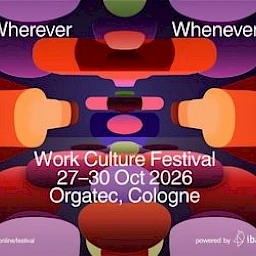
Under the overarching theme “From Rooms to Relationships”, ORGATEC 2026 will focus on the connections between people, spaces and work culture. IBA member companies exhibiting as part of the Wherever Whenever – Work Culture Festival in Hall 6 from 27 to 30 October will also explore these connections. Based on selected trade show concepts and announced new products, five thematic areas can be identified.
Human-centred work environments
The needs of employees are a key starting point when designing work environments. This is no longer simply a matter of ergonomic furniture. Lighting, acoustics, materials, spatial diversity and the ability to choose between different work areas all influence the quality of a workplace. Sedus addresses these aspects with its “Habitats by Sedus” concept. Under the guiding topic “Spaces that Care – Wellbuilding for Human Nature”, the company presents the office as an interplay of different spatial settings for concentration, interaction, movement and relaxation. Employees should be able to choose between different environments depending on their activities and individual needs. Actiu also places individual needs at the centre of its approach under the motto “Life Friendly Spaces: Living the Experience”. Alongside the adaptability of spaces, the concept focuses on sensory perception: materials, surfaces, acoustics and atmosphere are considered factors that influence how people experience a work environment. Kinnarps takes a different approach. Through its Next Office® workplace analysis, the company examines how people actually work and what this means for workplace design. Quantitative data and qualitative insights provide the basis for spatial concepts tailored to users’ needs. Rather than starting with predefined furnishing solutions, Kinnarps focuses on how work environments are used in practice.
Interaction, flexibility an a homely atmosphere
As working practices change, so do expectations of the office. Alongside individual workstations, areas for collaboration, informal conversations and shared activities are becoming increasingly important. At the same time, spaces are increasingly being designed to accommodate different uses. Under the motto “New Designs for Human Connection”, INCLASS focuses on designing spaces for communication and interaction. Flexible meeting areas and residential-style communal areas are intended to support different forms of exchange. Forma 5 and esPattio also emphasise the social function of work environments. Their approach combines comfortable, residential-style seating areas and shared spaces with ergonomic seating solutions from Löffler ERGO. For Mara, the emphasis is on the adaptability of spaces. The manufacturer describes its exhibition concept as “An ecosystem of evolving spaces” and focuses on furnishing solutions that can be used in a variety of workplace, conference, coworking and hospitality settings. Viasit addresses the adaptability of work environments through modular and mobile furniture concepts. The growing convergence of workplace, residential and hospitality environments is also reflected in the concepts presented by Interstuhl and Thonet. Under the motto “Office is all.”, Interstuhl combines homely design with ergonomic requirements and movement during the working day. Thonet, meanwhile, explores how comfort, design diversity and functionality can be brought together in different work and communication areas.
Acoustics and retreat spaces
While interaction and collaboration are important, quiet and concentration remain essential. Open-plan work environments must therefore accommodate a variety of requirements. Focused work, confidential conversations and virtual meetings call for different spatial conditions from informal exchanges or teamwork. Against this background, acoustics remain an important aspect of workplace design. The aim is not simply to reduce noise, but to create suitable conditions for different activities. Nowy Styl and Kusch+Co are presenting their joint exhibition under the motto “Playing with silence”. Acoustic booths and sound-absorbing elements are intended to create a balance between interaction and opportunities for retreat. With “Designed to belong”, Hushoffice addresses another aspect: alongside the function of acoustically protected work areas, the focus is on their visual integration into the surrounding space. Different colours and materials allow acoustic booths to be coordinated with the overall interior design. BuzziSpace also combines acoustic solutions with lighting, aesthetics and materials. Sound absorption is therefore considered not merely a technical requirement, but an integral part of designing work environments from the outset.
Technology and learning
New technologies are changing working processes and forms of collaboration. Artificial intelligence in particular raises questions about how tasks will evolve in the future and what this will mean for the requirements placed on work environments. Bene addresses this topic under the motto “OFFICES. BUILT FOR HUMANS. POWERED BY AI.” The focus is on the interplay between people, technology and space. The company explores the impact of artificial intelligence on the world of work and the implications for office design. VS Vereinigte Spezialmöbelfabriken takes a different approach with its guiding principle “New Ways of Working Mean New Ways of Learning”. The company focuses on the growing connection between working, learning and knowledge sharing, as well as the spatial conditions required to support these activities. Flexible environments are intended to accommodate both individual tasks and collaborative learning and working.
Circular economy and resource conservation
The circular economy has become one of the central topics in the office furniture and interiors industry. Alongside the use of recycled and renewable raw materials, increasing attention is being paid to designing furniture that is durable, repairable and recyclable. At the same time, the question of how existing furniture can remain in use for longer is gaining importance. These different approaches are also reflected among the exhibitors. While BuzziSpace works with recycled and bio-based materials, among others, Nowy Styl focuses not only on resource-efficient product development but also on the take-back and refurbishment of used furniture. newen spaces addresses another aspect of the circular economy. The platform supports the redistribution and reuse of high-quality office furniture, connecting manufacturers, providers and new users. This places greater emphasis not only on designing new products but also on making better use of existing furniture.
Work culture as a connecting element
Whether the focus is on design centred on people’s needs, flexible furnishing concepts, acoustics, new technologies or the circular economy, the priorities of IBA exhibitors at ORGATEC 2026 reflect the different requirements placed on modern work environments. What they share is an interest in how spaces can support everyday working life and collaboration. This is closely aligned with ORGATEC’s overarching theme, “From Rooms to Relationships”. It extends the focus beyond the design of individual workplaces to the importance of interaction, exchange and organisational culture. After all, while the way people work together is not determined solely by their physical surroundings, it is influenced by them. The Wherever Whenever – Work Culture Festival in Hall 6 explores this connection between space and work culture. While IBA exhibitors present their concepts and solutions for different work environments, the talks, discussions and workshops will address the societal, organisational and cultural questions surrounding the future of work.
Other IBA member companies at ORGATEC 2026:
The presence of IBA member companies at ORGATEC extends beyond the examples presented here. Humanscale, Federico Giner, Klöber, and LD Seating are also represented at the trade show. This article thus provides a thematic snapshot of the trade show activities of IBA members.
The exhibitor overview for the Wherever Whenever – Work Culture Festival provides information about the companies represented there and their locations in Hall 6: https://iba.online/festival/en/2026/programme/exhibitors/
Cover image: IBA
