


 IBA editorial team
 Returning to the office – but how? Many organisations are currently seeking to increase office attendance. At the same time, the ongoing debate around return-to-office strategies demonstrates just how sensitive employees are to the issue. While organisations hope that greater office presence will improve collaboration, innovation and team cohesion, employees often fear losing flexibility and autonomy.
What role can the workplace environment play in navigating this tension? And how does workplace design influence employees’ acceptance of return-to-office strategies? We spoke to HR researcher Dr Katharina Radermacher, who is currently exploring these questions as part of a research project.
Many organisations are currently tightening their office attendance policies. From a research perspective, how do you view the current return-to-office debate?
Current research into the effects of return-to-office (RTO) mandates reveals a clear tension between the objectives pursued by management and the outcomes identified in empirical studies.
Recent studies point, firstly, to a discrepancy between the perceptions of employees and those of management. While management teams are often convinced that RTO mandates are necessary to improve collaboration, organisational culture and innovation, employees tend to perceive them as a means of controlling their working hours, the way they work and their performance. When it comes to the actual effects of RTO mandates on employees, current studies suggest that these are primarily characterised by a loss of resources and increased stress. This is reflected, for example, in lower job satisfaction and reduced wellbeing as a result of higher stress levels, emotional exhaustion and increased work-family conflict.
At an organisational level, empirical findings indicate that RTO mandates do not lead to improved performance. Instead, they are associated with significantly higher levels of voluntary staff turnover, particularly among highly qualified, high-performing employees. Against this backdrop, research is increasingly focusing on how a return to the office can be managed successfully. The emphasis is shifting towards a holistic consideration of future working models rather than concentrating solely on RTO mandates and the question of the ‘right’ number of days in the office. A targeted approach to the organisation of work as a whole – one that creates a positive on-site employee experience while supporting collaboration, interaction and innovation – can help organisations align their business objectives more closely with employee wellbeing. However, the actual impact of such holistic configurations and approaches has so far received relatively little research attention.
Public debate often focuses on the advantages and disadvantages of home working versus office presence. Which aspects do you believe have received too little attention?
It is precisely this idea of a holistic approach that has so far received too little attention, both in public debate and in academic research. One reason for this is the considerable complexity involved in studying such integrated systems. If office attendance requirements are to be meaningfully embedded within the wider organisation of work, it is important to consider not only the specific design of an RTO mandate, but also how it is communicated, how managers and employees are supported and trained, and how the physical workplace is designed. It is complex, but it is fundamental to the success of new ways of working.
The changing role of the office is frequently discussed in this context. It is clear that its purpose evolves as working models shift between office-based and remote working. Yet the specific role of workplace design in the context of RTO mandates has so far received very little systematic research attention. In particular, it remains unclear to what extent, and under which conditions, the design of the workplace can help ensure that increased office attendance has a positive impact on both employees and organisations.
Your research project examines perceived resource losses and gains associated with office attendance. What exactly does that mean?
This question is based on what researchers often refer to as a ‘resource perspective’ when studying flexible working models. As empirical studies have shown, mandatory office attendance is often experienced as a loss of valuable resources – including time, due to commuting, as well as autonomy and privacy. At the same time, the office can provide valuable resources, such as social interaction, spontaneous exchanges and a clearer separation between professional and private life. For increased office attendance to have a positive effect, organisations should therefore take targeted measures to counterbalance these resource losses while simultaneously creating opportunities for employees to gain new resources.
What role does the workplace environment play in determining whether employees experience returning to the office as a burden or as an added value?
The workplace environment can play a central role both in mitigating resource losses and in supporting the creation of new resources. On the one hand, it can act as a kind of ‘buffer’ or compensating resource. If, for example, an activity-based workplace provides employees with genuine choice, this can help counteract the perceived loss of autonomy. At the same time, appropriately designed zones and workplace settings can support collaboration and interaction, thereby creating new resources for employees. Here, too, however, a holistic perspective is essential. An activity-based workplace must be closely aligned with employees’ needs and tasks. If, for example, it provides insufficient acoustic protection or too few spaces for retreat and focused work, office attendance is more likely to be perceived as a burden and a disruption to concentration. Workplace design that is carefully tailored to actual needs can therefore make time spent in the office more valuable and potentially reduce negative consequences such as increased intentions to leave the organisation.
You also refer to the signalling effect of physical spaces. What message do organisations send when they demand greater office attendance without developing the workplace environment accordingly? And what signals can a consciously designed workplace send?
Employees pay close attention to management’s motives and seek to understand the intentions behind organisational decisions. If increased office attendance is justified on the grounds that it will promote collaboration and innovation, but no corresponding measures are taken to support these goals, the rationale can appear less credible. In such cases, an RTO mandate may quickly be interpreted as a signal of control or mistrust.
By contrast, when an organisation visibly invests in a thoughtfully designed, high-quality workplace that genuinely supports collaboration and innovation, this can be seen as a credible signal that these objectives are being taken seriously. The workplace environment is a particularly powerful means of communicating such intentions because, unlike many other HR practices, it is immediately visible – and can be deliberately made visible.

Social interaction is considered one of the most important reasons why employees choose to come into the office. What spatial conditions are needed for meaningful encounters, collaboration and a sense of team cohesion to develop?
Studies show that meeting colleagues is the most important reason employees choose to come into the office. Measures that facilitate these encounters and encourage interaction are therefore perceived by employees as a genuine benefit. The office environment can play a central role here. The deliberate design of circulation routes and different zones can encourage spontaneous and unplanned encounters. Dedicated spaces for informal interaction – such as lounges or coffee areas – can facilitate casual exchanges, while spaces designed for more focused collaboration, such as project areas or brainstorming zones, can act as a powerful catalyst for teamwork and knowledge sharing.
Once again, however, it is essential to take a holistic approach to workplace design rather than focusing exclusively on interaction and collaboration. Our pilot study for the current research project found that ‘open-plan anxiety’ – the fear of noise and distraction – represents a significant barrier for employees. Only when appropriate quiet zones for focused work are also integrated into the workplace will the office be experienced as an environment where collaboration can flourish without compromising individual productivity. Alongside spatial design, clear guidelines for how different areas should be used and appropriate training for employees also play a crucial role in the success of activity-based workplaces. Organisations therefore need to develop individual solutions tailored to their specific requirements if the office is to fulfil its potential as a catalyst for interaction and collaboration.
What do you hope to discover through the study, and what insights do you hope it will provide for organisations, workplace planners and the wider workplace industry?
The aim of our study is to systematically investigate the extent to which workplace design represents a key condition for the success of RTO strategies and, more broadly, for defining office attendance requirements more generally. At the heart of the research is the question of whether – and under what conditions – a purposefully designed workplace can mitigate the potential negative effects of increased office attendance requirements while simultaneously strengthening their positive effects.
Based on these findings, we aim to develop an evidence-based framework that will support organisations both in determining appropriate levels of office attendance and in designing their workplace environments. The findings will make it possible to identify which resource deficits are particularly relevant within a specific organisational context and how these can be offset through appropriate workplace design. At the same time, the research will highlight where the physical workplace can act as a catalyst for resource gains. Ultimately, the study aims to help organisations define office attendance requirements more effectively and embed them within a holistic organisational framework that makes the best possible use of the benefits of bringing people together. In addition, the study will explore how physical workplaces can be used as a strategic communication tool to convey management’s intentions credibly and increase employee acceptance of office attendance requirements.
Mrs Radermacher, thank you for talking to us.
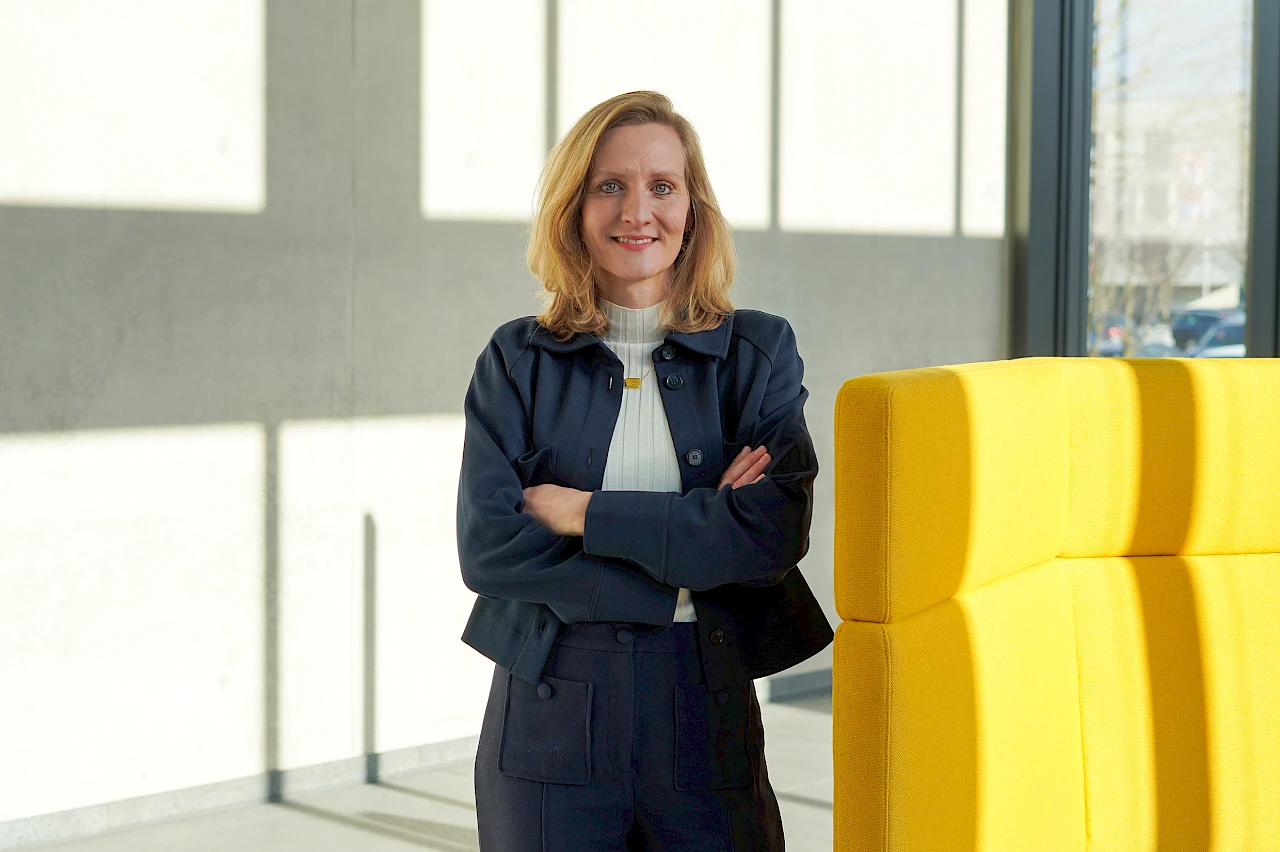
Dr. Katharina Radermacher researches, teaches and advises on workplace design, flexible working practices and employer branding, with a particular focus on the dynamic relationships between these three areas. As an academic staff member at the Chair of Human Resource Management at Paderborn University and a PhD-qualified expert in workplace design, she was exploring the strategic importance of the office long before the rise of the New Work movement. In her work, Katharina Radermacher takes a multi-perspective, empirical approach to understanding which working models can sustainably contribute to employee wellbeing while helping organisations remain resilient and future-ready. She not only shares her academic insights with her students, but also brings them directly into business practice. Through presentations and workshops, she helps organisations better understand the dynamics of the changing world of work and develop HR practices that support their strategic business objectives. Further information: https://www.linkedin.com/in/dr-katharina-radermacher-95b533286/
Cover photo: ©University of Paderborn, Angela Lang