


 IBA editorial team
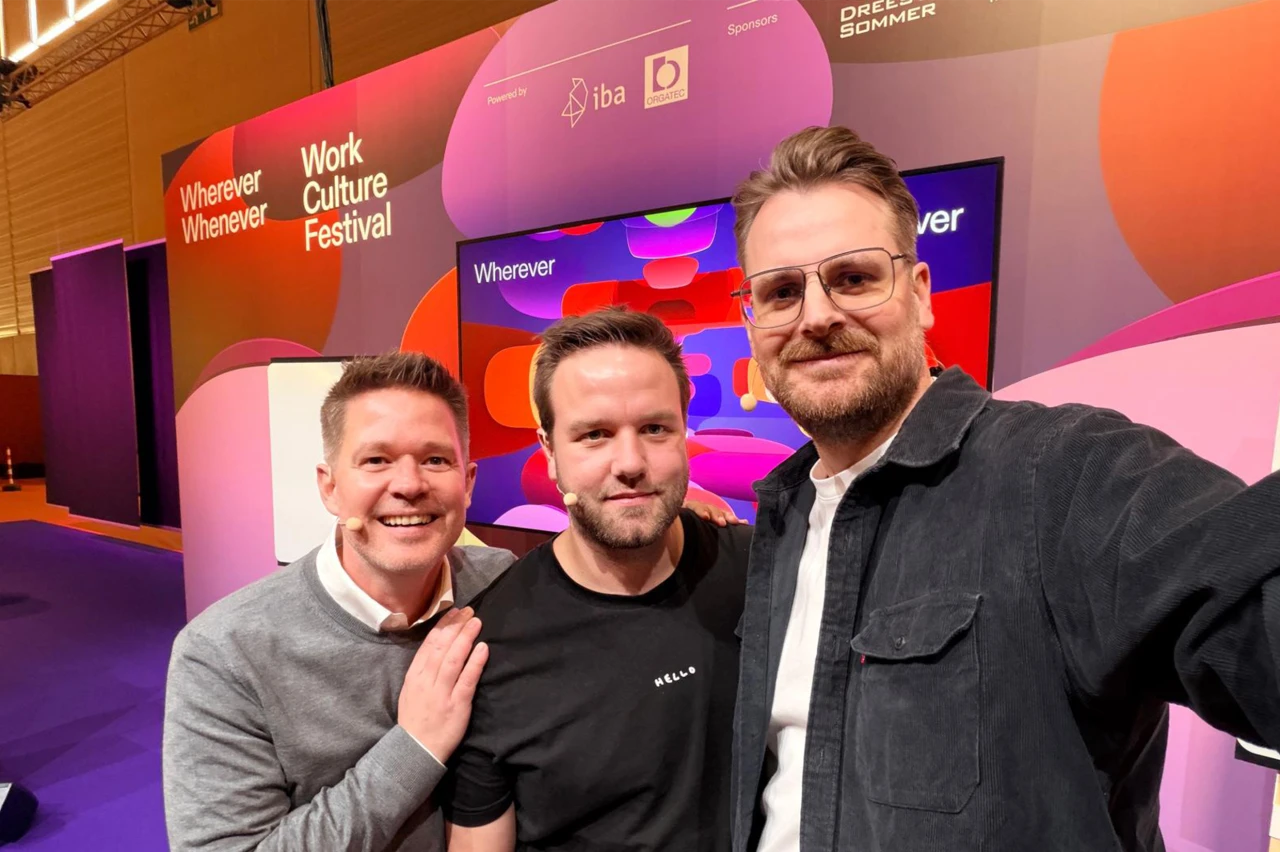
Packed diaries, endless discussions and still no results: for many employees, meetings are among the biggest time-wasters in everyday working life. But does that mean we should get rid of them altogether? At the Wherever Whenever – Work Culture Festival, David Hillmer and Lutz Hüser, authors of the book Kill Meetings, demonstrated how unnecessary meetings can be avoided and essential ones made more productive. In a live podcast with Johannes Füss, they explored meeting resilience, the 3C method and a little red figure that helps keep discussions moving.
Who has ever cancelled a meeting and secretly felt rather pleased about it? This was the question Johannes Füss used to open his discussion at the Wherever Whenever – Work Culture Festival 2026. A few hands went up. Hardly surprising: meetings take up a considerable proportion of working time in many companies, and participants do not always find them worthwhile. For his guests David Hillmer and Lutz Hüser, co-authors of the book Kill Meetings, this is reason enough to fundamentally challenge established meeting culture. In the live podcast supported by EGYM Wellpass, Füss therefore subjected the two to a light-hearted cross-examination. The charge: they want to kill meetings. Yet what initially sounds like an attack on collaboration turns out to be a call to improve it fundamentally.
Putting 90% of meetings under scrutiny
The authors’ central claim is provocative: 90% of all meetings are ineffective in their current form. As David Hillmer readily acknowledged during the discussion, this figure is not scientifically substantiated. Instead, it is intended to encourage people to question established habits. This does not mean cancelling nine out of ten meetings without replacing them. The authors distinguish between three approaches: eliminate, replace or transform. Unnecessary meetings can be cancelled, purely informational sessions replaced by asynchronous communication, and meetings that genuinely require people to come together redesigned to produce meaningful results. Both authors are particularly critical of recurring meetings. Once scheduled, they often remain in diaries for months or even years without anyone questioning their original purpose. Yet one simple question could make all the difference: Do we still need this meeting? David Hillmer described how he had experimentally cancelled one of his own recurring meetings after briefly consulting those involved. Nobody objected, nobody missed it, and it has never been reinstated. His recommendation is that teams should review their recurring meetings at least every three months. After all, while adding new appointments takes just a few clicks, we find it surprisingly difficult to remove existing ones.
Meeting resilience: When attendance becomes routine
What happens when meetings become an end in themselves? The authors describe this phenomenon using an unusual but fitting term: meeting resilience. It refers to the ability to get through meetings almost on autopilot. People are physically present, respond to questions and signal agreement, while their minds have long since wandered to other tasks. Johannes Füss admitted with a smile that he could certainly recognise himself in this description. According to Hillmer, one warning sign is a diary that resembles an overcrowded game of Tetris. When meetings follow one another without leaving sufficient time for focused work, the meetings themselves become an obstacle to productivity. But it is not just about the number of meetings. Participation matters too. Anyone who is only genuinely needed for five minutes of a one-hour meeting will inevitably look for other things to do. A smartphone, laptop or the next email is usually within easy reach. In the authors’ view, the solution is not to introduce ever stricter rules of conduct, but to redesign collaboration. Rather than simply listening, people should be encouraged to think actively, discuss ideas and make decisions together.
The 3C method: From meetings to working together
Lutz Hüser explained how this can work using the 3C method. It consists of three consecutive phases that provide a clear structure, even for short meetings.
- Centering: Participants begin by establishing a shared focus. Why are we meeting? What do we want to achieve? And what do we need to work together effectively? A brief check-in can be enough to provide clarity and direction.
- Collaborate: The main part of the meeting is devoted to actual collaboration. Rather than simply presenting information one after another, participants work together on specific questions or challenges. Workshop techniques help incorporate different perspectives and develop tangible outcomes.
- Close: Finally, decisions, insights and next steps are recorded. Who is responsible for which task? What has been agreed? And which questions remain unanswered? Hüser illustrated this with a memorable image: the room should be left ‘swept clean’. Nobody should have to piece together afterwards what was actually decided.
The 3C method is not intended to make meetings longer. Quite the opposite: with a clear structure and simple facilitation techniques, even 30- or 45-minute meetings can be structured more like productive workshops.
Less listening, more active participation
Hüser demonstrated what this might look like in practice in response to a question from the audience. For a regular project meeting involving five people, he proposed a format beginning with a brief check-in. Participants would then individually note down the topics they felt needed discussing. This technique is known as brainwriting. Unlike traditional brainstorming, ideas are initially collected independently. This allows quieter team members to contribute without the most vocal participants dominating the discussion from the outset. The group then prioritises the topics together. Fixed time slots are allocated to the most important issues. When the time is up, the team decides whether further discussion would be worthwhile. Finally, the outcomes and next steps are documented. The principle is simple: the aim is not to talk as much as possible, but to achieve as much as possible together. This also means taking a critical look at who really needs to attend a meeting. Not everyone has to be present throughout. Sometimes it makes more sense to bring specific people into the discussion only when their expertise is required. Hüser did not accept the argument that this would necessarily undermine informal interaction. If a team needs time for personal contact, discussion and building relationships, that is an entirely legitimate reason to meet. The important thing is to be open about that purpose rather than disguising it as a supposedly necessary status meeting.
ELMO: When it’s time to move on
Towards the end of the discussion, the authors introduced a particularly simple tool for making meetings more productive: the ELMO card. ELMO stands for ‘Enough, Let’s Move On’ – in other words, that’s enough for now, let’s move on. The idea is straightforward. If a discussion starts going round in circles, two people become caught up in details or a topic is no longer relevant to the other participants, anyone can hold up an ELMO card. This provides a friendly signal that it is time to move on to the next point. What may initially seem playful serves an important purpose. The card enables everyone to take responsibility for the flow of the conversation without having to interrupt or criticise others directly. ELMO therefore embodies the approach the two authors want to promote: good meetings are not solely the responsibility of managers or facilitators. Everyone involved can help ensure that time spent together is used effectively.
What does this mean for the working environment?
At a trade fair such as ORGATEC, the question naturally arises as to what kinds of spaces best support this approach to collaboration. If meetings increasingly focus on interaction, joint idea development and tangible outcomes, the requirements for their physical design will change too. Hüser therefore advocated flexible meeting spaces. Tables and chairs should be easy to rearrange, allowing teams to adopt different ways of working depending on the task at hand. Equally important are sufficient surfaces for visualising ideas and recording results, whether through traditional whiteboards or digital collaboration tools. This does not mean turning every meeting into a discussion circle. Rather, the environment should accommodate different forms of collaboration and adapt quickly to changing requirements. For workplace design, this offers an interesting perspective: before creating new meeting rooms, companies should first consider what kind of collaboration is actually intended to take place in them.
Changing meeting culture – but how?
The subsequent audience discussion also highlighted that established habits cannot be changed overnight. How can loss of information be avoided when fewer people attend meetings? How can everyone be encouraged to remain attentive? And how can a new meeting culture be established across an organisation? The authors advocated pragmatic solutions. Outcomes should be documented in a way that allows colleagues who were not present to understand them. Short video messages or shared digital boards could replace lengthy information meetings. Above all, however, change does not necessarily have to begin as a major transformation project. Often, it is enough for individual teams to try out new methods, share their experiences and encourage others to get involved. David Hillmer described this as a kind of gravitational principle: good examples have a gravitational pull and can gradually spread throughout an organisation. Managers also have a responsibility to question established routines and enable new forms of collaboration. After all, a better meeting culture cannot be created through a new set of rules alone. It requires a willingness to work differently together.
Fewer meetings, better collaboration
By the end of the live podcast, the verdict on the two self-proclaimed meeting killers was remarkably lenient. Their aim, after all, is not to bring people together less often, but to ensure that the time they spend together genuinely has real value. Achieving this does not necessarily require complicated methods or elaborate change programmes. Often, it starts with a simple question: Do we really need this meeting? And if so, how can we organise it so that the outcome is more than just another appointment? The key takeaway from the discussion is that good collaboration is not measured by the number of hours people spend together in meeting rooms, but by what they achieve together during that time.
Johannes Füß is Senior Vice President at EGYM Wellpass, Germany’s leading corporate fitness network. His work focuses on how preventive healthcare can become an integral part of modern workplaces and how organisations can support employee health, wellbeing, and performance. In addition, he is the founder of Level Up HR, a community dedicated to the exchange of modern HR practices, and host of the podcast of the same name. His work connects topics such as employee wellbeing, company culture, and the future of work with practical approaches to modern HR management.
David Hillmer is Managing Director of HelloAgile and an expert in effective collaboration. Together with his colleagues, he supports teams and companies on their journey towards applied New Work and an agile corporate culture. HelloAgile is one of the leading providers of professional training in this field. David Hillmer is the author of “Kill Meetings” and “PLAY!”, a standard reference work on LEGO® Serious Play®. In addition to its academy offering, David and HelloAgile focus on workshop and event formats centred around better collaboration and leadership.
Lutz Hüser is a workshop facilitator and trainer with many years of experience in designing and delivering workshops and learning formats. He is the author of “Kill Meetings” and brings extensive practical expertise in meeting and workshop design to the world of work.
Cover photo: David Hillmer
