


 IBA editorial team
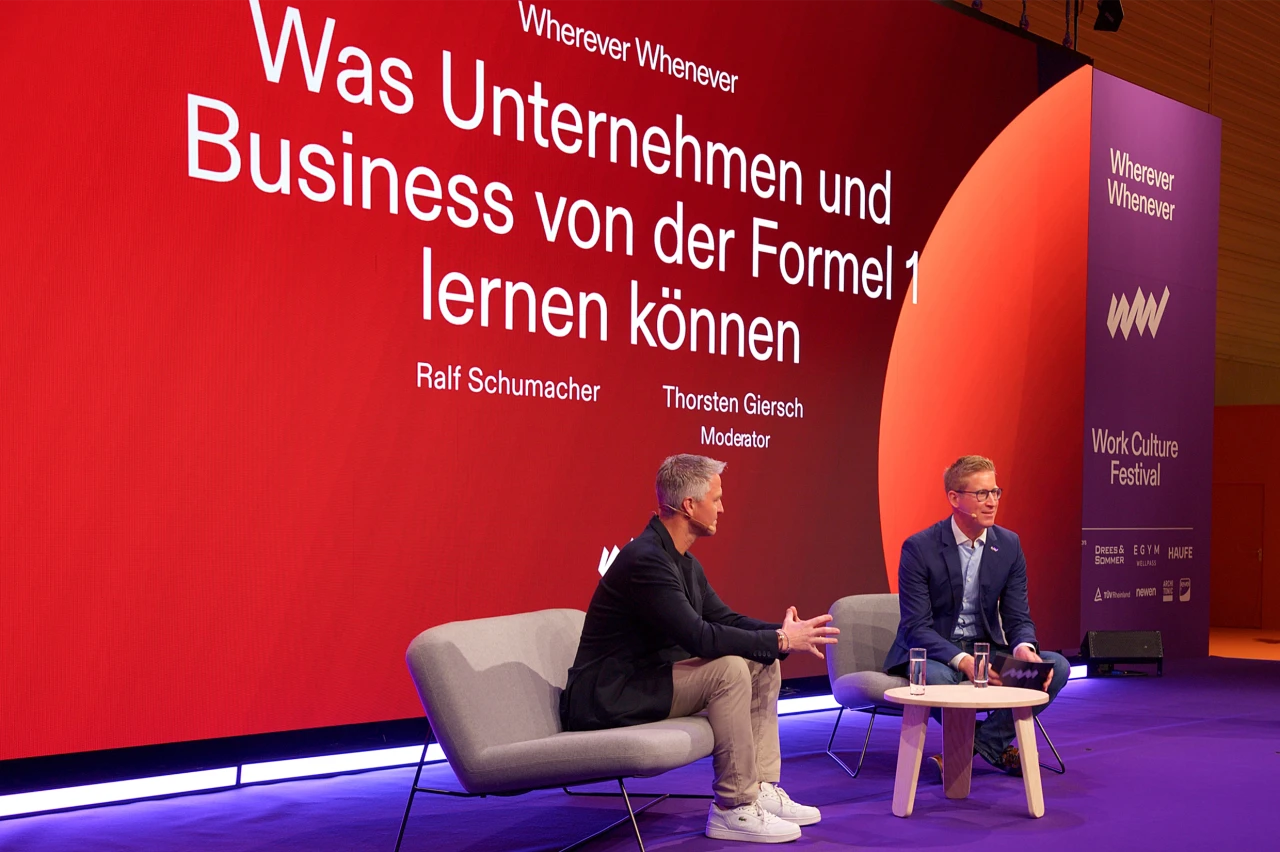
Motivation rather than pressure, precision rather than frantic activity, and the recognition that success is always a team effort: at the Wherever Whenever – Work Culture Festival 2026, former Formula 1 driver Ralf Schumacher spoke to moderator Thorsten Giersch about his experiences in motorsport and the business world. Their conversation explored different leadership cultures, honest feedback, the courage to delegate and why slowing down can sometimes be the key to success.
In Formula 1, fractions of a second can make the difference between victory and defeat. But anyone who believes that this high-performance sport is all about speed is mistaken. Precision, well-coordinated processes, mutual trust and the ability to make the right decisions at crucial moments are just as important.
Ralf Schumacher knows this from personal experience The former Formula 1 driver now works as a television pundit and entrepreneur and also supports young motorsport talent. At the Wherever Whenever – Work Culture Festival at ORGATEC, he spoke to moderator Thorsten Giersch about his racing career and his professional life today. Above all, he shared what motorsport has taught him about people, leadership and collaboration.
Motivation achieves more than pressure
Schumacher explained that at 30, he had been a very different kind of boss from the one he is today. In the past, impatience had often driven him. Today, he takes a more considered view: “Speed creates friction, and friction slows things down.” It is a lesson he also learnt from Formula 1. Even in an environment where speed appears to be everything, constant pressure does not necessarily lead to better results. Quite the opposite: acting too quickly can lead to mistakes that ultimately take considerably more time and money to put right. Schumacher therefore advocates approaching tasks with a clear sense of purpose and proportion, and consciously slowing down when necessary. He considers employee motivation particularly important. “Motivation actually achieves far more than pressure,” he emphasised. He illustrated how closely individual success is linked to the performance of an entire team with a simple example from motor racing: even the best car and the fastest driver cannot win a race if something goes wrong during a pit stop or the car has not been given enough fuel. For businesses, this offers a fundamental lesson: outstanding performance does not depend solely on exceptional individuals, but on the combined efforts of people with different skills and responsibilities. Every contribution matters, regardless of how visible it may be.
What distinguishes different corporate cultures
During his career in international Formula 1 teams, Schumacher experienced very different approaches to collaboration. His encounters with British, German and Japanese working cultures were particularly influential. He described British racing teams as especially cost-conscious and strongly performance-driven. According to Schumacher, financial pressure was often greater there than in Germany, while organisational structures were closely aligned with the specific demands of motorsport. At Toyota, meanwhile, he encountered a corporate culture that placed considerable emphasis on precision, standardised processes and the replaceability of individual roles. While this approach can be advantageous in industrial manufacturing, Schumacher felt it was problematic in motor racing. A Formula 1 team depends on people working closely together over long periods, developing an understanding of one another and learning from shared experience. When roles are constantly reassigned, established routines and valuable collective knowledge can be lost. Schumacher therefore questioned how effectively conventional corporate structures can be applied to highly specialised teams. As a positive counterexample, he cited Mercedes, where the racing team’s established structures had largely been preserved. This observation is particularly relevant to the wider world of work: not every organisational model is suitable for every task. Efficiency, standardisation and clear processes are important. However, in areas that depend on rapid decision-making, creativity and close collaboration, continuity, trust and the freedom to act can be equally decisive.
Honest feedback as a foundation for development
Another central topic of the conversation was the importance of feedback. In motorsport, continuously reviewing performance is part of everyday life. Telemetry data provide precise information, engineers analyse deviations and teams work together to prevent mistakes and make improvements. For Schumacher, this kind of feedback has become second nature. He sees feedback as an ongoing process, even when it is not always pleasant. But it is by no means simply about pointing out weaknesses. Recognising good performance and offering praise are equally important. What matters is a willingness to communicate openly and to see criticism not as a personal attack, but as an opportunity to improve. Schumacher also drew on his experiences with former team principals to illustrate how challenging this can sometimes be. He spoke particularly vividly about his relationship with Eddie Jordan, who put him under considerable pressure during his time at Jordan. Their relationship later became the subject of a costly dispute surrounding Schumacher’s move to Williams. Despite these difficult experiences, the two eventually rebuilt their personal relationship. The episode also highlighted how widely leadership styles can differ and how lasting the consequences of the way employees are treated can be.
Delegating responsibility and helping others excel
For Schumacher, leadership today also means recognising his own limitations. Someone who establishes a business or develops an idea does not necessarily have to continue making every decision themselves. “You have to get things moving, and you have visions and ideas, but then you also have to hand things over,” he explained. Above all, it is about recognising when someone else is better placed to take on a particular task. Schumacher considers this ability essential to successful business leadership. He has repeatedly observed that entrepreneurs struggle to delegate responsibility or listen to younger people. Yet exchanges between generations can offer valuable new perspectives. As an example, he mentioned his son, who takes a more contemporary perspective on certain topics, particularly artificial intelligence. Schumacher himself is also exploring the possibilities offered by AI. At the same time, he stressed the importance of critically examining its results rather than accepting them without question. Underlying this is an understanding of leadership that relies less on personal control and more on trust, a willingness to learn and an appreciation of different skills and perspectives.
Emotions matter – and so does self-reflection
Can people work better without emotions? This was another question Thorsten Giersch put to his guest. Schumacher’s answer was clear: emotions are an important driving force, both in sport and in professional life. He values people who show initiative, move things forward and have the confidence to take risks. Mistakes are part of the learning process. What matters, however, is the ability to reflect critically on one’s own behaviour afterwards and, when necessary, to apologise. Closely connected to this is the question of authenticity. Schumacher believes people should not try to be someone they are not, but should remain true to their own personalities. That does not mean, however, expressing every opinion without consideration or treating others disrespectfully. Authenticity must also be accompanied by courtesy and respect. These were values instilled in him by his family from an early age and which have stayed with him throughout his career.
Looking beyond your own industry
Schumacher’s activities today extend well beyond motorsport. Among other ventures, he runs a guesthouse in South Africa and a winery – a reflection of his curiosity about other industries. Even during his active racing career, he deliberately sought contact with successful businesspeople, listened to their experiences and tried to understand what made them successful. This openness to other people’s experiences and ways of thinking has been an important foundation for his own development as an entrepreneur. Winemaking, in particular, has taught him patience. Unlike in motorsport, you cannot speed up the growth of a plant. At the same time, each year brings changing climatic conditions, yet the aim remains to produce something whose quality and character customers recognise. Here, too, Schumacher sees parallels with racing. The circumstances are constantly changing, but the goal remains the same: to achieve the best possible result through the right combination of people, experience and adaptability.
By the end of the conversation, it was clear that the lessons from Formula 1 extend far beyond elite sport. Whether in a racing team, a hotel, a winery or any other business, success comes when people are able to contribute their skills, take responsibility, communicate openly and remain willing to learn from one another. And sometimes, achieving that success requires not greater speed, but the ability to slow down at exactly the right moment.
Ralf Schumacher is a former Formula One driver and today a TV expert, moderator, and keynote speaker. Between 1997 and 2007, he competed in 180 Grand Prix races, securing six victories and 27 podium finishes, establishing himself as one of the most successful German drivers of his generation. He is considered one of Germany’s most recognised sports personalities. Today, he works as a Formula One expert for Sky, known for his in-depth analysis, technical expertise, and extensive experience in elite motorsport. His media presence spans television formats and international events, where he translates complex dynamics into accessible insights. In addition to his role as an expert, Ralf Schumacher brings his experience from high-performance sport into moderations, talks, and keynotes. His focus includes topics such as performance, decision-making, team dynamics, and handling pressure in highly competitive environments.
Thorsten Giersch is a journalist, publisher, moderator and communications consultant. For around 30 years, he has observed and supported companies, executives and major transformations in the business world. He has an in-depth understanding of SMEs from his many years as a business journalist, conducts around 300 interviews a year and spent four years as a managing director himself. He also worked in the C‑suite office of management and HR consultancy Kienbaum. After around 20 years in senior positions at n‑tv, Markt und Mittelstand and Handelsblatt, he became an independent publisher in October 2026. With Inventuro, he developed an innovative new media platform tailored to the needs of SMEs in the age of AI. In his podcast “Komm in meine Welt”, he talks to executives and entrepreneurs about why taking responsibility is worthwhile. In “Beyond Books”, he speaks with authors of business and non-fiction books.
Cover photo: Simon Baucks
