


 IBA editorial team
Artificial intelligence is taking on more and more tasks, supporting work processes and evolving from a tool into a constant sparring partner. But what does this mean for collaboration between people and for the office? In a conversation about her latest New Work Order study, Collaboration with AI, trend researcher Birgit Gebhardt explains why we need to reorganise work, why employees may soon be talking to AI throughout the office, and what control centres, makerspaces and gaming have to do with the workplace of tomorrow.
Artificial intelligence is fundamentally changing knowledge work. Trend researcher Birgit Gebhardt is convinced of this. At the same time, she does not expect the office to disappear overnight as a result. Rather, AI is accelerating a development that began with digital transformation: people, information and intelligent systems are becoming increasingly interconnected.
For the sixth New Work Order study, commissioned by the German Interior Business Association (IBA), Gebhardt therefore looks beyond the question of which tasks AI might take over in the future. Instead, she asks a different question: How do we work with AI, and how does this change the way we work together? After all, when AI analyses data, processes information and brings together knowledge from different sources, it is not just the division of tasks that changes. Processes, organisational structures and, ultimately, the places where knowledge work takes place also need to be rethought.
From tool to colleague
For Gebhardt, AI is already more than just a tool. Nevertheless, she deliberately avoids describing it as a human colleague. AI has no consciousness and should not be attributed human characteristics. Even so, its everyday use is giving rise to a new form of collaboration. AI can tailor information to individual contexts, identify connections and draw on knowledge that extends far beyond the boundaries of a single company. This makes it a professional sparring partner that is available at all times. AI agents take this development a step further. Rather than simply responding to individual prompts, they can pursue tasks independently, involve other agents and connect with one another within a process. For companies, this creates a new division of labour: collaboration no longer takes place solely between people from different departments, but also between people and various AI systems. The human role is therefore shifting towards coordination, evaluation and responsibility.

When everyone in the office starts talking to their AI
What initially sounds like a technological change has very tangible consequences for workplace design. During the conversation, Gebhardt paints a picture that is both simple and unusual: in the future, employees may routinely bring their personal AI into the office – on their smartphones, through headphones or via smart glasses. This creates a second layer of conversation alongside communication between people. Employees ask their AI questions, have information explained to them or receive translations, working in constant dialogue with intelligent systems. This challenges even familiar office concepts. What does quiet work mean if concentrating on a task may also involve talking to an AI? Will different types of retreat spaces be needed? Will the acoustics of open-plan offices have to change? And how will people cope with a working environment in which information reaches them through an ever-growing number of channels simultaneously? For Gebhardt, this is precisely why the spatial perspective is so interesting. If AI enables many tasks to be carried out without the need for a specific workplace, physical space must provide added value where people genuinely need it.
The office as a control centre
Gebhardt finds one possible model in the control centre. As part of her study, she spoke to Christian Most, Senior Director Digital Operations Optimization at the Lufthansa Group, among others. Routine operations can already be managed largely through systems. Human involvement becomes particularly important when something deviates from the norm, decisions need to be made and complex situations have to be managed. Applied to the office, this could mean that the more standard processes are automated, the more the workplace becomes a space for coordination, problem-solving and collaboration. The office would then become less of a place where everyone works through their individual tasks. Instead, it would become particularly relevant when different areas of expertise come together, information is assessed collectively and solutions are developed.
From makerspaces to gaming hubs
Gebhardt takes this idea even further. Why, for example, should development and production be physically separated when employees need to work together on practical solutions? The office could increasingly become a makerspace – a place where digital twins, prototypes, development and production are directly connected. In her view, principles for future collaboration can also be drawn from the world of gaming. Teams respond quickly, learn through immediate feedback and work together towards a shared goal. What makes this particularly interesting is the connection between the digital and physical worlds: there is a difference between people sitting alone in front of their screens and acting together in the same room, learning from one another and experiencing the team’s reactions first-hand. It is precisely this shared experience that could give the office a new quality. While AI can make information available almost anywhere, social resonance, shared learning and the energy of a group remain rooted in human interaction.

What role remains for humans?
The crucial question, therefore, is not so much which tasks AI will take away from people. More interesting is what contribution humans will be able to make in the future when machines take over an increasing number of routine tasks. Gebhardt certainly sees an opportunity here. If AI reduces routine work, human capabilities could once again move back into the spotlight: thinking creatively, recognising connections, developing new ideas, taking responsibility and bringing together knowledge from different perspectives. For her, this includes, above all, the ability to think ahead. AI draws on existing knowledge and established patterns. Humans, by contrast, can imagine things that do not yet exist. Perhaps this is where one of the most important changes of the coming years lies: AI does not necessarily make people less important. Instead, it forces us to define more precisely what our own contribution to the work of the future should be.
Listen and learn more
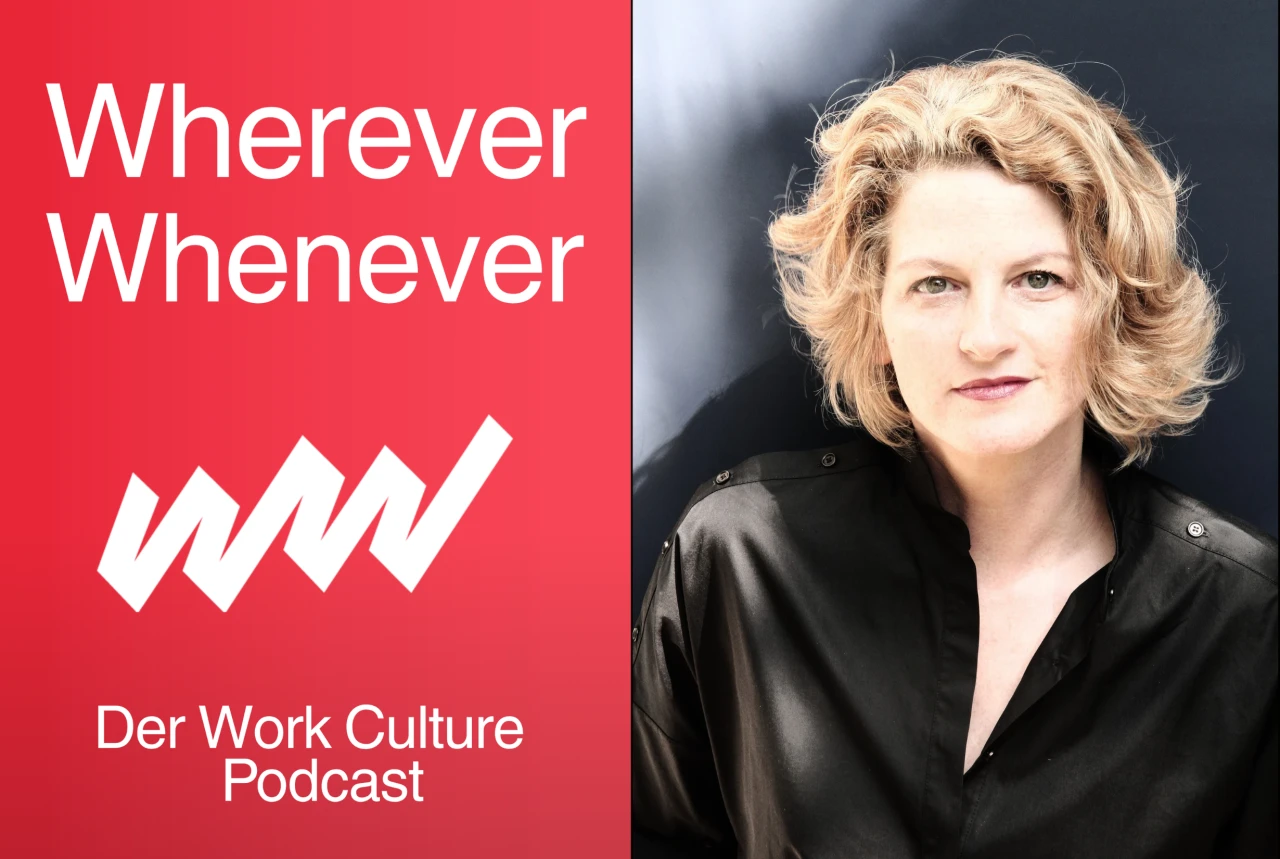
In the first episode of the Wherever Whenever – Work Culture Podcast, Birgit Gebhardt talks to IBA editor Jasmin Najiyya about the latest New Work Order study Collaboration with AI, AI agents and how our collaboration and workplaces are set to change. To Wherever Whenever – Work Culture Podcast on Spotify.
Want to continue the discussion in person? Birgit Gebhardt will be taking part in several sessions at the Wherever Whenever – Work Culture Festival, held from 27 to 30 October 2026 at ORGATEC in Cologne. Her new New Work Order study, Collaboration with AI, will also be presented at the festival.
Cover photo: ©IBA, ©Birgit Gebhardt
